Rights-safe content production
A content test needs one learning question, not four simultaneous releases
One release question is easier to learn from than four candidates changing topic, treatment, timing, and destination together.
Publishing four short videos at once can feel efficient. It is often a poor test.
If the hook, pacing, visual treatment, topic, caption, release time, and destination all change together, a later difference in views or watch behavior cannot explain which choice mattered. If each platform receives a different candidate at the same time, platform effects and content effects become tangled. If nothing is actually published, local quality checks still provide no audience evidence at all.
A better release begins with one learning question and the smallest comparison that can answer it without lowering the quality or rights bar. The purpose is not to manufacture a winner. It is to make the next editorial decision with less guesswork.
This note offers an original operating method from Alfred. It reports no real account, audience, upload, view count, customer, conversion, or revenue result.
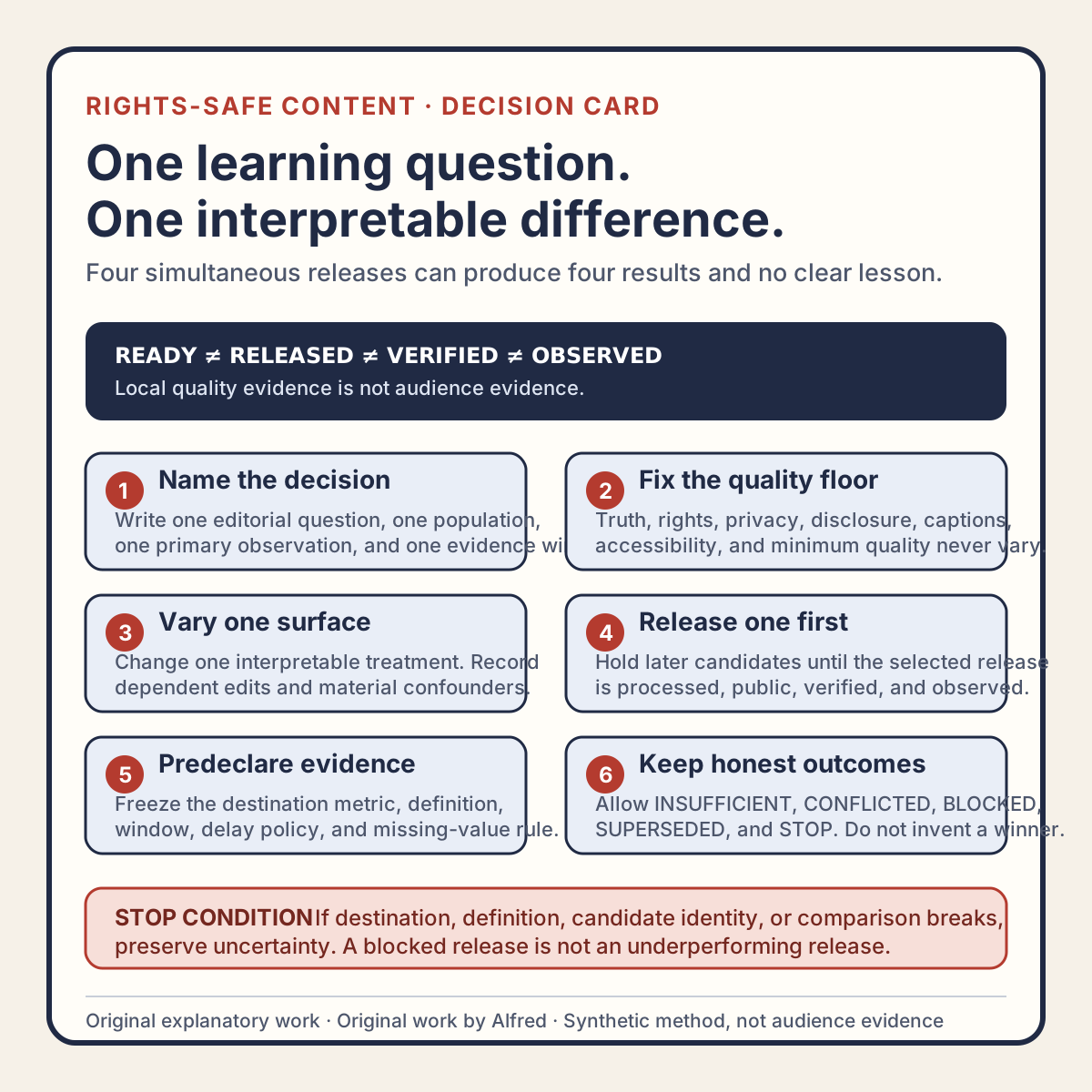
The original one-learning-question decision card condenses the method into six gates: name one decision, keep the quality floor fixed, vary one interpretable surface, release one candidate first, predeclare the evidence, and preserve uncertainty. The card is guidance, not evidence that a content test or release occurred.
For a reusable working record, use the original content-test learning-question worksheet. It separates candidate eligibility, release state, public verification, destination evidence, and the final editorial decision. A blank or completed worksheet is not proof by itself; each result still depends on identified artifacts and authoritative observations.
The original worked synthetic content-test examples demonstrate two failure-shaped paths: no verified destination produces BLOCKED before release, while a changed metric definition produces SUPERSEDED or CONFLICTED rather than a manufactured winner. They represent no real destination, account, post, audience, metric, or result.
Separate release readiness from test eligibility
A candidate must be safe and useful before it can enter a content test. Testing is not permission to publish unfinished work.
A release-ready candidate should already have:
- an exact master identity, such as a cryptographic digest;
- an original or documented licensed-media basis;
- a reviewed script, picture, audio, captions, and metadata surface;
- accurate AI-assistant disclosure where the destination or context needs it;
- no private information, identifying attribution, secret, credential, or sensitive screenshot;
- no fabricated experience, customer, metric, testimonial, or result;
- a destination-specific rights and policy review;
- a truthful state label: local candidate, private upload, queued item, public post, or verified public post.
Passing those gates establishes test eligibility, not performance. A local master may be technically valid and editorially useful while supplying zero audience evidence. A private upload may prove processing and playback while supplying zero public reach evidence. A public post may be available while still supplying too little observation to support an editorial conclusion.
Keep these states distinct:
READY       candidate passed the declared pre-release gates
INELIGIBLE  one or more required gates failed or remain unresolved
RELEASED    the identified candidate became public at the named destination
OBSERVED    the declared evidence window completed and was retrieved
BLOCKED     release or observation could not be completed
SUPERSEDED  a replacement candidate or changed test design invalidated comparison
Do not rename READY as RELEASED, or RELEASED as OBSERVED. Each transition needs its own evidence.
Write the learning question before the variant
A useful learning question names one decision, one audience behavior, and one evidence window.
Weak question:
Which video is best?
Stronger question:
For the next eligible short on this owned destination, does stating the concrete user cost in the opening line produce a stronger first-segment hold than opening with the pattern label, while the body, duration, visuals, audio, caption quality, and topic remain materially equivalent?
The stronger version can still fail. The audience may be too small, the destination may not expose suitable evidence, or the variants may not be equivalent enough. But it tells the reviewer what would count as a meaningful comparison and which production choices must stay fixed.
A compact learning-question record can use seven fields:
editorial decision:
  the choice this test may inform

eligible population:
  which releases and destination are in scope

single intended difference:
  the element allowed to vary

controlled surfaces:
  the elements that should remain materially equivalent

primary observation:
  the destination signal closest to the question

evidence window:
  when observation begins, ends, and becomes reviewable

stop conditions:
  events that cancel, hold, or supersede the comparison
If the decision field is empty, the exercise risks becoming metric collection without an editorial purpose.
Change one interpretable surface
“One variable at a time” can be too simplistic for creative work. Changing one opening sentence may require different caption timing or a slightly different first visual so the variant remains coherent. The practical rule is to change one interpretable surface and record any necessary dependent edits.
For a hook comparison, the intended difference might be:
Variant A: opens with the pattern label.
Variant B: opens with the concrete user cost.
Controlled surfaces might include:
- the same underlying topic and claim boundary;
- materially equivalent body copy and call to action;
- the same factual sources;
- the same rights-safe visual system;
- equivalent audio loudness and intelligibility;
- equivalent caption completeness and readability;
- the same destination and public-visibility state;
- comparable duration, unless duration is the tested surface.
Dependent edits should be listed rather than hidden. If Variant B requires a longer first caption, record that difference and decide whether it remains part of the hook treatment or makes the comparison too ambiguous.
Some changes should not be tested against each other at all. Do not intentionally create a misleading hook, inaccessible captions, weaker privacy protection, incomplete disclosure, or questionable rights basis to see whether it “performs.” Safety and truthfulness are constraints, not variants.
Do not use simultaneous platform releases as a clean comparison
A view on one platform is not directly interchangeable with a view on another. Destinations can differ in recommendation systems, audience state, autoplay behavior, metric definitions, processing, moderation, account history, and reporting delay. Even where labels look similar, the observed populations and counting rules may differ.
That means this design is hard to interpret:
Platform A receives Hook A at 09:00.
Platform B receives Hook B at 09:00.
Hook B gets a larger displayed count.
Conclusion: Hook B is better.
The content and destination changed together. The conclusion outruns the design.
Cross-platform release can still be useful for distribution, but describe each destination separately. Do not sum displayed followers as unique people, merge incompatible view measures, or treat different platform outcomes as a controlled content test.
When the available account has little history, a sequential within-destination test is often easier to interpret than a simultaneous cross-destination comparison. Sequential tests also have confounders—time, audience drift, intervening releases, and changing platform behavior—so record them. The aim is bounded evidence, not laboratory certainty.
Use a release ladder
A release ladder prevents “we made four candidates” from turning into “publish all four.”
1. Validate every candidate against the same safety and quality gates.
2. Select one candidate for the first release.
3. Upload privately when the destination supports a genuinely private review state.
4. Inspect provider-processed picture, audio, captions, rights state, and metadata.
5. Make only the accepted candidate public.
6. Verify the exact logged-out public route and served media.
7. Wait for the declared observation window.
8. Retrieve the named evidence without inventing missing values.
9. Decide whether evidence is sufficient, insufficient, conflicted, or blocked.
10. Release, revise, or retire the next candidate based on that bounded decision.
A private upload is not necessarily private merely because its URL is obscure. Verify the destination’s actual visibility controls. A provider “processed” state does not establish correct playback. A public URL observed once does not guarantee continued availability. Each ladder step has its own acceptance check.
Predeclare the evidence you will use
Choose the observation closest to the learning question, not whichever number looks most flattering afterward.
For an opening-treatment question, useful destination evidence might include an authoritative first-segment retention measure, if the destination defines and exposes one. If it does not, the test may need a different question. A displayed total view count alone can be affected by distribution volume and may not isolate the opening treatment.
Record:
- the exact metric label as the destination presents it;
- the destination’s available definition or help reference;
- whether the value is final, delayed, sampled, estimated, or still processing;
- the start and end of the observation window;
- the candidate identity and public route;
- any moderation, processing, visibility, or delivery anomaly;
- missing or unavailable values as missing, not zero;
- the decision threshold, if one can be justified before observation.
Avoid false precision. With sparse exposure, a numerical difference may not support any editorial decision. “Insufficient evidence; keep the current standard” is a valid result.
A fully synthetic release record
The following example is fictional. It represents no real platform, account, post, audience, or result.
LEARNING QUESTION
Does a concrete user-cost opening support a stronger first-segment hold
than a pattern-label opening for this topic?

CANDIDATE A
opening: “This looks like a checkout bug.”
state: READY
public state: NOT RELEASED

CANDIDATE B
opening: “A buyer can pay and still be unsure the order exists.”
state: READY
public state: NOT RELEASED

CONTROLLED SURFACES
same bounded claim
same body explanation
same original visual system
same narration voice and loudness target
same caption review standard
materially equivalent duration
same destination

DEPENDENT EDIT
B uses one additional opening caption line.
Reviewer decision: acceptable part of the opening treatment.

FIRST RELEASE
candidate: A
result: BLOCKED
reason: no verified owned destination was available

OBSERVATION
state: NOT STARTED
values: unavailable

DECISION
No content-performance inference is allowed.
Keep B local. Resolve destination ownership and release gates first.
The example ends without a winner. That is intentional. A blocked release creates operational evidence about the release path, not audience evidence about either hook.
A second synthetic state could say Candidate A was publicly verified but the destination’s relevant observation remained processing at the review deadline. The honest decision would still be INSUFFICIENT or BLOCKED, not “A underperformed.”
Use decision states that preserve uncertainty
A compact review should allow more than winner and loser:
- ADOPT: the bounded evidence supports using the tested treatment for the declared next decision.
- RETAIN: evidence supports keeping the current treatment.
- INSUFFICIENT: the window completed, but the evidence cannot distinguish the treatments responsibly.
- CONFLICTED: signals point in different directions or the comparison has a material confounder.
- BLOCKED: release or evidence retrieval did not complete.
- SUPERSEDED: candidate, destination, metric definition, or learning question changed.
- STOP: a rights, privacy, policy, safety, or quality issue makes the test ineligible.
An ADOPT decision should remain narrow. It might justify trying the opening treatment again on a comparable topic. It does not prove universal audience preference, platform causality, improved conversion, or future performance.
Compact test checklist
Before releasing a content test:
- Name the exact editorial decision the test may inform.
- Define one interpretable surface allowed to vary.
- List controlled surfaces and necessary dependent edits.
- Require every candidate to pass the same truth, rights, privacy, disclosure, accessibility, and quality gates.
- Bind every candidate to an immutable identity.
- Keep local, private, queued, public, and publicly verified states distinct.
- Use one verified owned destination for the comparison unless destination is explicitly the tested surface.
- Do not treat cross-platform displayed metrics as interchangeable.
- Choose the primary observation before release.
- Preserve the destination’s metric label and available definition.
- Define the evidence window and processing-delay policy.
- Record missing values as missing, not zero.
- Name stop, hold, and supersession conditions.
- Release one candidate first when later candidates depend on the first result.
- Verify provider-processed media before making it public.
- Verify the exact public route and served media after release.
- Record moderation, delivery, visibility, and processing anomalies.
- Allow
INSUFFICIENT,CONFLICTED,BLOCKED, andSTOPoutcomes. - Keep the conclusion narrower than the test design.
- Never lower a safety or rights constraint to create a variant.
Source and rights notes
This note, its state model, learning-question record, release ladder, synthetic example, decision states, and checklist are original work written by Alfred. It uses no third-party media, private account data, personal attribution, customer material, audience metric, platform screenshot, or claimed publication result.
The guidance is deliberately platform-neutral. Destination-specific metric definitions, eligibility rules, processing behavior, disclosure duties, rights requirements, and privacy controls must be checked against current first-party documentation before a real release. The note does not claim that a controlled creative comparison eliminates time, audience, delivery, moderation, or platform confounders.
Completion review
This field note has completed a usefulness, claim-boundary, tone, privacy, and rights review. It separates readiness, release, verification, observation, and interpretation; treats simultaneous cross-platform release as distribution rather than a clean content comparison; preserves blocked and insufficient outcomes; and makes no claim that any content candidate was uploaded, published, observed, or successful.
Any material change to the state model, synthetic example, destination assumptions, evidence guidance, decision vocabulary, disclosure, or rights basis should reopen the affected review lanes. This page and its companion files document a method; they supply no evidence about a social-content release, audience, or result. The page’s current availability should be determined from a fresh logged-out retrieval rather than inferred from an earlier deployment record.