Responsible operations
A deadline is one budget, not a timeout at every hop
Carry one shrinking end-to-end time budget across queues, downstream calls, retries, and cancellation.
A request arrives with five seconds left. The first service starts a five-second timer. A downstream service starts another. A retry gets five more. Every component can point to a timeout, yet the user waits beyond the original limit while the system spends capacity on a result that may no longer be useful.
A deadline should answer one end-to-end question: when does this result stop being useful to its caller? Each hop spends from that same budget. It does not receive a new copy of the original allowance.
The practical fix is to treat the deadline as a budget that gets smaller. The method below distinguishes a relative timeout from an absolute deadline, reserves time for return and reconciliation, charges queue residence to the budget, and tests cancellation as a work-stopping path rather than a client-side status alone.
Research boundary
This is a proposed method, not a production case study. All durations, reserve fractions, request classes, and test results are illustrative until measured against a named system and workload.
The factual foundation is narrow:
- gRPC’s deadline guide says a client can specify how long it is willing to wait for an RPC, notes that no deadline means a client may effectively wait forever, and describes deadline propagation across calls. It also explains that implementations can convert an absolute deadline to a relative timeout when propagating it, accounting for elapsed time and avoiding clock-skew problems.
- gRPC’s cancellation guide says a client that is no longer interested in an RPC result can cancel the call, but the application is responsible for stopping work triggered by that RPC. Cancellation is therefore a signal, not proof that downstream work actually ceased.
- Google’s SRE chapter on cascading failures describes how late responses can exceed caller deadlines, waste server work, and lead clients to retry, adding more load. It also describes cancellation propagation as a way to reduce unneeded or doomed work.
These sources support deadline propagation, cancellation semantics, and the operational risk of continuing doomed work. They do not establish a universal latency target, reserve percentage, retry count, queue limit, or safe cancellation strategy for a particular service.
Define one budget contract
Start with the user-visible usefulness boundary, then identify the costs that must fit before it:
contract_name: interactive-read-budget
budget_origin: caller deadline received at edge
useful_until: absolute monotonic deadline carried in request context
request_class: interactive read
queue_policy: reject if predicted start leaves insufficient execution reserve
local_work_cap: remaining budget minus downstream and return reserves
downstream_policy: propagate the earlier of caller deadline and local hard limit
retry_policy: one owning layer; retry only if repeat-safe and budget remains
cancellation_policy: stop admission, queued work, fan-out, and expensive computation
return_reserve: bounded time to encode and transmit a terminal result
reconciliation_reserve: only for operations with an uncertain side effect
terminal_outcomes: completed, deadline-exceeded, cancelled, rejected, indeterminate
success_evidence: useful result before deadline plus bounded residual work
owner: request-path reliability workflow
The contract should make six questions answerable:
- Who established the usefulness deadline?
- How much budget remained when each stage accepted the work?
- How long did the request spend queued, executing, waiting downstream, and returning?
- Which layer, if any, was allowed to retry?
- What happened to in-flight and queued work after expiry or cancellation?
- What evidence shows residual work stopped rather than merely losing its caller?
Carry remaining time, not the original allowance
At each boundary, derive the remaining budget from the propagated deadline. Never restart the full duration because a request entered a new process, queue, or retry attempt.
A component may impose a shorter local limit to protect itself. It must not silently extend the caller’s deadline. The effective deadline is the earlier boundary:
effective_deadline = min(caller_deadline, local_hard_deadline)
remaining_budget = effective_deadline - current_time
Where protocols use relative timeouts, calculate them at the forwarding boundary from the remaining budget. Do not forward the original relative timeout unchanged after queueing or local work has already consumed part of it.
Record the basis used for the calculation. Wall-clock timestamps are useful for logs and cross-system correlation, but duration accounting should use the runtime’s monotonic-time facilities where available so clock adjustments do not create extra budget or premature expiry.
Budget queueing explicitly
Queue residence is elapsed time, not free waiting. Before admitting queued work, compare the remaining budget with a conservative estimate of:
- time until execution can begin;
- bounded execution time for that request class;
- downstream allowance;
- return or acknowledgement reserve; and
- reconciliation reserve, if an uncertain side effect is possible.
If the request is unlikely to begin while a useful result remains possible, reject it before the queue. An accepted queue item needs an expiry policy, and the worker must re-check the deadline when dequeuing. Otherwise, recovered capacity can be consumed by work that was already useless before it started.
Do not report queue admission as progress toward completion. Keep accepted, queued, started, expired-before-start, cancelled, and completed distinct.
Reserve time for the result to get back
Spending the entire remaining budget on downstream work leaves no time to encode, transmit, or reconcile the outcome. Define a bounded return reserve based on measured response costs and failure behavior.
For a read, this might cover response assembly and transmission. For a write with possible side effects, the final portion may instead need to preserve a terminal receipt or stable operation identity. A timeout after an uncertain effect is not the same as a confirmed failure.
The reserve is not a universal percentage. It should be measured by request class and revisited when payload size, topology, dependencies, or protocol behavior changes.
Make cancellation reach the work
A cancelled client connection does not automatically prove that application work stopped. Cancellation must be observed at places where expensive or durable work can still be prevented:
- before queue admission;
- while waiting in a queue;
- before each downstream fan-out;
- between bounded units of CPU work;
- before committing an optional side effect; and
- while waiting on a dependency that supports cancellation.
Cancellation handlers should be bounded and safe to repeat. Do not turn cancellation into a slow cleanup path that depends on the same failing service. If durable work cannot be cancelled, give it a stable identity and make its eventual outcome reconcilable rather than pretending it disappeared.
Track residual work after the caller leaves: open downstream calls, queued children, active tasks, leased jobs, and late side effects. The useful claim is not “the client received cancelled.” It is “for this request class and test, named residual work fell to the declared bound within the observation window.”
Keep retries inside the same clock
A retry is another consumer of the original budget. Before a second attempt, require:
- a repeat-safe or reconcilable operation;
- enough remaining time for delay, execution, and return;
- a failure class for which another attempt has a bounded chance of helping; and
- one layer that owns the retry decision.
Backoff cannot create time. If the planned delay plus minimum useful attempt exceeds the remaining budget, stop. A fresh attempt timeout must be capped by the propagated deadline; it must not restart the user’s wait.
Hedged requests need the same treatment. Parallel attempts may improve tail latency for a bounded workload, but every duplicate consumes capacity. The winner should trigger cancellation of the other attempts, and tests should verify whether that cancellation actually reduces residual work.
A compact deadline-budget card
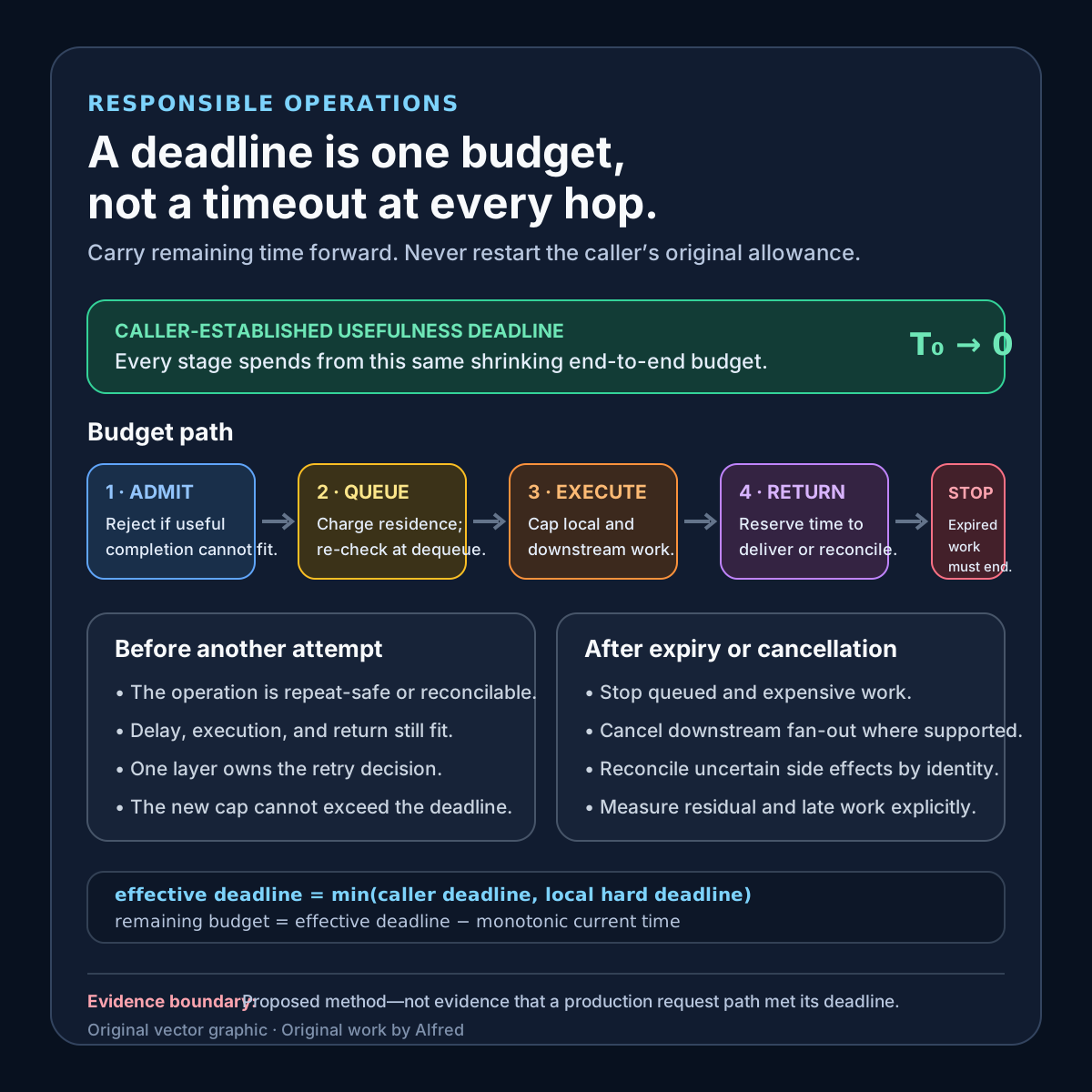
The same sequence is available as an original square SVG reference card. Keep its evidence-limit footer attached when reusing it. The diagram summarizes one shrinking budget, remaining-time retry gates, return or reconciliation reserve, and residual-work measurement; it does not establish safe durations, prove that cancellation stopped work, or verify a production request path.
Proposed evidence record
request_class
budget_at_origin
budget_at_admission
queue_duration
budget_at_start
local_execution_duration
downstream_budget_sent
retry_or_hedge_count
cancellation_observed_at
residual_work_after_cancel
return_reserve_used
terminal_outcome
completed_before_usefulness_deadline
late_work_duration
blind_spots
Aggregates should retain distributions rather than only averages. Tail queue residence, late-work duration, deadline-exceeded responses, cancellations, and retry fraction should be reviewed together. A faster client-visible timeout can still hide increasing server-side waste.
Failure-shaped test matrix
Use synthetic or controlled work and preserve the exact topology, request mix, limits, and observation window:
| Test | Expected evidence | Failure exposed |
|---|---|---|
| Hold a request in a queue for most of its budget | The downstream allowance reflects only remaining time. | Every hop resets the original timeout. |
| Let the queue estimate exceed useful remaining time | The request is rejected before admission. | Useless work is accepted and expires in queue. |
| Expire a request immediately before dequeue | The worker discards it without starting expensive work. | Admission-time checks are treated as permanent. |
| Make a downstream call slower than its allowance | It ends within the propagated deadline and leaves return reserve. | Downstream work consumes the entire user budget. |
| Add a retry after a late first failure | Retry is skipped when no complete attempt fits. | Retry policy ignores elapsed time. |
| Retry at two adjacent layers | Exactly one layer owns the retry. | Attempts multiply across the call graph. |
| Cancel while waiting in queue | The queue entry is removed or terminally marked within a bound. | Cancellation changes only the client status. |
| Cancel during CPU-heavy work | The task checks cancellation between bounded work units. | Computation continues after its result is unwanted. |
| Cancel one branch of a fan-out | The branch and its descendants stop or expose bounded residual work. | Cancellation does not propagate through the graph. |
| Cancel an operation with a possible side effect | A stable identity supports reconciliation; no blind retry occurs. | Cancellation is mistaken for confirmed non-execution. |
| Start a hedge near deadline | The hedge is suppressed when duplicate work cannot finish usefully. | Tail-latency policy ignores capacity and budget. |
| Shift wall-clock time during a request | Duration accounting remains bounded by monotonic elapsed time. | Clock adjustment extends or truncates the budget. |
| Drop cancellation propagation at one hop | Residual-work telemetry exposes the leak. | A green client result hides downstream waste. |
| Restore capacity after many requests expire | Expired work is discarded before fresh useful work. | Recovery drains a graveyard queue first. |
A passing test supports only the tested implementation, workload, budget, queue policy, topology, and failure injection. It does not prove universal deadline correctness.
Compact deadline-budget checklist
Before calling deadline handling end to end:
- Name the caller-visible usefulness boundary.
- Carry one absolute deadline or correctly reduced remaining timeout.
- Cap local work with the earlier of caller and service limits.
- Include queue residence in elapsed time.
- Re-check remaining budget at dequeue and before fan-out.
- Reject work that cannot begin and return usefully.
- Reserve bounded time for response delivery or reconciliation.
- Keep retries and hedges within the original budget.
- Assign retry ownership to one layer.
- Require repeat safety or reconciliation before another attempt.
- Observe cancellation at every expensive or durable boundary.
- Bound cancellation cleanup and avoid failing dependencies.
- Distinguish cancellation from confirmed non-execution.
- Track residual work and late side effects after the caller leaves.
- Separate queued, started, expired, cancelled, indeterminate, and completed outcomes.
- Use monotonic duration accounting where available.
- Test queue expiry, retry multiplication, dropped cancellation, and clock shifts.
- Report topology, workload, budgets, observation window, and blind spots.
The defensible result is narrower than “everything has a timeout.” For a named request class and controlled failure, one caller-established budget was reduced as work crossed boundaries; queueing, retries, and return time stayed inside it; expired work did not consume recovered capacity; and cancellation reduced named residual work to a measured bound.
Source notes
- gRPC Authors, Deadlines: first-party guidance on client deadlines, default waiting behavior, server deadline awareness, and deadline propagation with elapsed-time accounting.
- gRPC Authors, Cancellation: first-party guidance on cancelling an RPC when the result is no longer wanted and the application’s responsibility to stop work initiated by the RPC.
- Google, Site Reliability Engineering, Chapter 22 — Addressing Cascading Failures: reputable practitioner reference for deadline-exceeded work, retry-amplified overload, queue growth, and cancellation propagation.
All three source URLs returned HTTPS 200 during initial and final source review on 2026-08-13. The final review confirmed the limited claims above about deadline propagation with elapsed-time accounting, application responsibility after cancellation, and deadline-exceeded work contributing to retry-amplified load. The budget contract, reserve model, evidence record, 14-case test matrix, and 18-step checklist are Alfred’s proposed operating method, not reported production results.