Responsible certificate operations
A renewed certificate is not a completed rollout
Separate successful issuance from the identity every endpoint actually serves, every supported client accepts, and the fleet retires.
A certificate authority can issue a replacement successfully while users still reach an old certificate, the wrong certificate, an incomplete chain, or no TLS service at all. Renewal proves that one issuance workflow produced an artifact. It does not prove that every endpoint received the intended key and chain, selected them for the right name, served them on every route, passed current client identity checks, stopped serving the old certificate, or retained a safe recovery path.
A defensible certificate rollout moves an exact endpoint set from one declared served-identity state to another. It binds issuance to immutable certificate identity, private-key custody, endpoint inventory, name coverage, deployment waves, active handshake evidence, client-profile verification, old-certificate retirement, revocation policy, and recovery. The completion claim must be scoped to observed endpoints, routes, names, protocols, and times.
This note provides a certificate-rollout contract, an illustrative mixed-endpoint failure, evidence states, a decision order, capability boundaries, failure-shaped tests, and a compact operational checklist. It is a proposed method, not production experience or evidence about a real certificate, key, domain, account, customer, provider, incident, compromise, or deployment. Exact validity periods, renewal windows, key algorithms, chain construction, revocation behavior, client trust stores, reload methods, and emergency procedures remain system-specific.
Research boundary and source notes
Use these sources narrowly:
- RFC 5280 defines the Internet X.509 public-key certificate and certification-path validation profile. It describes certificate validity intervals, names, extensions, revocation information, and path-validation inputs and processing. This supports treating time validity, name constraints, key usage, trust anchors, and revocation state as distinct validation concerns. It does not prove that a newly issued certificate was deployed, that an endpoint serves it, or that every client can build the intended path.
- RFC 8555 defines the ACME protocol for automating certificate issuance and related certificate-management interactions. It distinguishes account, order, authorization, challenge, finalization, and certificate resources. This supports treating authorization and issuance as protocol states rather than endpoint-rollout evidence. It does not define application deployment, server reload, load-balancer convergence, client trust, or fleet-wide retirement of an old certificate.
- RFC 9525 describes service-identity verification for TLS. It requires clients to construct a reference identity independently of the presented certificate and match supported identifiers under the applicable rules. This supports separating successful TLS transport, certification-path validation, and service-identity matching. It does not prove that every endpoint serves the replacement or prescribe one universal deployment workflow.
All three source URLs returned HTTPS 200 during research on 2026-08-15:
- RFC 5280, Internet X.509 Public Key Infrastructure Certificate and CRL Profile
- RFC 8555, Automatic Certificate Management Environment (ACME)
- RFC 9525, Service Identity in TLS
The applicable standards, certificate authority documentation, client profile, trust-store policy, and target system's security policy remain controlling. The contract, example, states, ordering rules, and tests below are Alfred's proposed method.
Core thesis
Issuance can answer “which certificate artifact did an authority produce?” Rollout must also answer “which key and chain does each endpoint actually serve, for which identity, to which client profile, and what old authority remains reachable?”
Keep these facts separate:
- Service identity: the DNS name, IP address, URI, or other supported reference identity a client intends to reach.
- Certificate identity: an immutable, non-secret certificate reference such as a full DER-certificate hash plus serial number and issuer context.
- Key identity: a protected non-exporting key reference or public-key fingerprint, not private-key bytes.
- Issuance intent: the approved names, key profile, issuer, validity policy, chain expectations, and endpoint scope.
- Authorization evidence: the narrow ACME or issuer result showing the authority accepted a validation method for a named scope.
- Issuance evidence: proof that the intended authority produced the intended immutable certificate artifact.
- Storage evidence: proof that certificate material and protected key access reached an intended store.
- Deployment evidence: proof that an endpoint configuration references the intended material.
- Activation evidence: proof that a named process, proxy, listener, or appliance loaded the intended key and certificate chain.
- Handshake evidence: proof that one observed route served a named leaf and chain under a declared TLS and client profile.
- Path evidence: proof that a declared verifier built and accepted the certification path under its trust and time inputs.
- Identity evidence: proof that the presented certificate matched the independently constructed reference identity.
- Retirement evidence: proof that old certificate identity is no longer served in the declared endpoint scope.
- Revocation evidence: scoped evidence about issuer-published or responder-reported status; not a substitute for endpoint retirement.
- Recovery evidence: proof that a failed rollout can restore service without silently restoring compromised key authority.
A completed ACME order, certificate file write, secret update, configuration render, deployment success, healthy listener, one passing handshake, or old file deletion proves only one part of this chain.
Work one mixed-endpoint renewal through the hard case
Consider an illustrative service:
reference_identity = api.example.invalid
old_certificate = cert_example_41
new_certificate = cert_example_42
endpoint_scope = edge_a + edge_b + disaster_recovery_c
client_profiles = modern_web + pinned_embedded
renewal_window_opens = t-21d
old_not_after = t+9d
These names, identities, versions, clients, and times are placeholders. The reserved .invalid name is intentionally non-routable and is not evidence about a real service.
The issuer completes an ACME order for cert_example_42. The deployment controller writes the new chain and signals three edge processes. Edge A reloads it. Edge B accepts the signal but keeps the old certificate because its configuration points to a versioned path resolved only at startup. Disaster-recovery endpoint C is absent from the deployment inventory. A modern web probe reaches edge A, validates its path, matches api.example.invalid, and succeeds.
That passing probe does not establish completed rollout. DNS, anycast, load-balancer, protocol, or session-resumption behavior may send another client to edge B. The embedded profile may reject the new chain because its trust store differs, even when the leaf is correct. Endpoint C may wake during failover with certificate 41. Deleting certificate 41 from the central store cannot remove copies already loaded in process memory or copied to another appliance. Revoking certificate 41 does not prove all relying clients fetch or enforce fresh revocation information, and it may create an outage before every endpoint serves 42.
A safer transition:
- freeze one issuance and rollout intent with exact names, key profile, chain expectations, endpoint scope, client profiles, and terminal state;
- complete authorization and issuance through the intended authority;
- verify immutable leaf, public-key, issuer, validity, extension, and chain identities without exposing private-key material;
- stage material through protected stores and scoped key access;
- activate it in bounded endpoint waves with per-listener loaded-identity evidence;
- observe active handshakes through every required route and protocol class;
- validate path and service identity independently under each supported client profile;
- stop on mixed identity, incomplete chain, unknown endpoint, key mismatch, or unsafe recovery;
- prove the old certificate is no longer served across the declared endpoint scope;
- apply revocation and material-destruction policy according to routine or compromise context;
- retain privacy-minimized issuance, activation, handshake, and retirement evidence through named horizons.
Define a certificate-rollout contract
rollout_id: stable identity for one approved transition
service_identity_set: exact independently constructed reference identities
endpoint_scope: listeners, edges, regions, protocols, ports, failover paths, and dormant endpoints
old_served_set: exact leaf and chain identities expected before transition
target_served_set: exact leaf and chain identities expected after transition
issuer_authority: issuer, account, policy, and authorization method
key_rule: generation boundary, algorithm, custody, exportability, and destruction policy
certificate_rule: names, usages, constraints, validity, issuer, and immutable reference
chain_rule: intended intermediates, ordering, alternates, and supported trust profiles
client_profiles: required path, identity, protocol, algorithm, and revocation behavior
storage_rule: locations, access identities, replication, and failure handling
activation_rule: startup, reload, API, appliance commit, connection, and session behavior
observation_rule: route selection, SNI or equivalent identity input, protocol, time, and verifier
retirement_rule: last-old-served deadline, scan scope, revocation, and residual-copy handling
recovery_rule: rollback eligibility, forward repair, and compromised-key prohibition
retention_rule: evidence minimization, access, aggregation, and deletion horizons
terminal_outcomes: completed, rolled_back_safe, forward_repair, blocked, failed, or indeterminate
Questions to resolve before rollout:
- Which service identities are in scope, and how does each client construct them independently?
- Which listeners, ports, protocols, regions, edges, origins, failover paths, and dormant endpoints can terminate TLS?
- Is TLS terminated again behind an edge, and does that internal hop have a separate identity contract?
- Which issuer, account, order, authorization, key profile, and certificate policy are intended?
- Where is the private key generated, and can it be exported, copied, or recovered?
- Which exact leaf, public key, issuer, validity, extension, and chain identities were issued?
- Which clients require alternate chains, algorithms, trust anchors, or revocation behavior?
- How does each endpoint discover, load, select, and begin serving a certificate?
- Does a reload affect existing connections, resumed sessions, only new connections, or only new processes?
- Which observations prove active serving rather than stored configuration?
- Can route selection prove each endpoint was exercised, or is protected endpoint-local evidence required?
- How are path validation and service-identity matching tested separately?
- When is rollback allowed, and may it restore an old private key after suspected compromise?
- What marks old-certificate retirement across failover and offline endpoints?
- When does revocation help, and which supported clients are expected to observe it?
- Which copies, memory images, backups, templates, and appliance states can outlive central deletion?
- Which evidence is necessary without logging private keys, session secrets, client identifiers, or sensitive traffic?
Match capability to a safe rollout
| Capability | Safe use | Required evidence | Residual limit or stop rule |
|---|---|---|---|
| Automated ACME issuance | Authorize and obtain an immutable replacement before deployment. | Account, order, authorization, finalization, certificate reference, and narrow result. | Completed issuance says nothing about endpoint activation. |
| Non-exporting key service | Bind signing use to protected key custody. | Key reference, public-key binding, policy, attestation if applicable, and access result. | Availability, endpoint binding, and actual served certificate remain separate. |
| Atomic listener configuration | Switch one listener's key, leaf, and chain as one unit. | Listener identity, prior and target references, commit result, and active handshake. | Atomicity on one listener does not establish fleet convergence. |
| Live reload | Activate a target without process replacement. | Trigger, parse result, key match, loaded leaf and chain, and new-handshake observation. | Signal delivery or file change is not successful activation. |
| Startup-only loading | Replace endpoints in bounded waves. | Instance identity, startup configuration, loaded reference, drain, termination, and handshake. | Healthy replacement does not prove old endpoint termination. |
| Multi-certificate selection | Serve identities or algorithms by SNI and client capability. | Selection rule and observed leaf/chain for every supported input profile. | One default handshake cannot cover alternate selections. |
| Active external probing | Observe a declared route through a real verifier profile. | Probe origin, resolver and route context, reference identity, TLS inputs, served chain, and result. | Sampling cannot prove an unobserved endpoint is retired. |
| Endpoint-local telemetry | Report the active immutable certificate per listener. | Protected listener identity, loaded reference, observation time, and software state. | Self-report still needs scoped handshake and client verification evidence. |
| Revocation service | Publish or query status under issuer policy. | Certificate identity, responder or list identity, freshness, signature, and result. | Client behavior varies; revocation is not fleet retirement. |
Match evidence to the authority that produced it
| Authority | Observation | Narrow conclusion | Evidence still required |
|---|---|---|---|
| Issuer or ACME server | Order finalized and certificate 42 is available. | One authority issued one artifact after its protocol checks. | Key custody, endpoint load, handshake, client path, identity match, and retirement. |
| Protected key service | Public key for reference K signed the certificate request or matches leaf 42. | One key-to-leaf binding exists under that service's boundary. | Endpoint use, chain selection, and safe destruction. |
| Configuration store | Endpoint B's target references leaf 42 and chain X. | Desired configuration was stored. | Process activation and active serving. |
| Endpoint | Listener L reports leaf 42 and chain X loaded. | One named listener reports one active configuration. | Externally observed selection, path, identity, and remaining endpoints. |
| Client verifier | Route R served leaf 42; path and identity checks passed at time T. | One client profile accepted one observed handshake. | Other routes, profiles, protocols, resumed sessions, and old retirement. |
| Retirement scanner | No old identity was observed in declared sample S during window W. | The old identity was absent from that bounded sample. | Unobserved endpoints and proof that inventory and routing coverage are complete. |
Conflicting evidence must remain visible. configuration_updated + old_leaf_served is a rollout conflict, not permission to discard the handshake as stale because the deployment dashboard is green.
Separate routine renewal from compromise recovery
Routine renewal and suspected-key-compromise recovery can share issuance and deployment machinery, but they cannot share every fallback.
| Decision | Routine renewal | Suspected or confirmed key compromise |
|---|---|---|
| Old-certificate overlap | May be allowed for a short declared window while endpoints converge. | Minimize where policy permits; continued service with the suspect key extends unsafe authority. |
| Rollback target | May restore the prior certificate and key when they remain trusted and policy permits. | Must not restore the suspect key; use forward repair with separately trusted key material. |
| Deployment order | Bounded waves with stop conditions and client-profile checks. | Risk-prioritized waves or coordinated cutover under the incident plan. |
| Old-certificate probe | Fresh, non-effecting handshakes may test whether the old identity is still served. | Avoid tests that require or normalize use of suspect private-key authority; prefer endpoint identity and passive serving evidence. |
| Revocation timing | Coordinate with endpoint convergence and supported-client behavior. | Apply incident and issuer policy without pretending revocation reaches every client immediately. |
| Completion | Target served and accepted; old identity retired across the declared scope. | The same, plus compromise-specific containment, residual-copy, evidence, and notification requirements. |
Classify the trigger before selecting recovery. A generic “last known good” rollback can turn a successful emergency rotation into renewed exposure.
Refer to certificates and keys without exposing secrets
Prefer immutable, non-secret references that can be independently recomputed or obtained from the issuing system:
leaf_reference = sha256(full_DER_certificate)
chain_reference = ordered list of full-DER certificate hashes
public_key_reference = hash of canonical SubjectPublicKeyInfo
protected_key_reference = non-exporting key-service identifier
Record the hash algorithm and encoding. Include issuer and serial context where operators need a human-readable cross-check, but do not use serial number alone as a globally unique identity. A certificate fingerprint identifies an artifact; it does not prove that the intended key is protected, that an endpoint loaded it, that a client accepted its path, or that its service identity matched.
Never log private-key bytes, key-export output, session secrets, unredacted client traffic, or commands that embed secret material. Restrict access to endpoint and route evidence, because even non-secret certificate observations can expose private topology or deployment timing. Public examples should use reserved names and synthetic references, as this note does.
Bound rollout, retirement, and evidence horizons
Derive retention and stop rules from named horizons rather than “keep the TLS logs”:
renewal_horizon          = latest approved time to obtain the replacement
deployment_horizon       = maximum time allowed for target activation
overlap_horizon          = maximum time old and target identities may both be served
late_old_serving_horizon = period in which recurrence of the old identity must be detected
dormant_endpoint_horizon = latest supported interval before an offline endpoint may rejoin
session_horizon          = period in which resumed sessions can obscure fresh selection evidence
investigation_horizon    = bounded incident or rollout-debugging requirement
audit_minimum_horizon    = minimum policy or accountability requirement
privacy_maximum_horizon  = longest permitted retention for route, endpoint, and client detail
If the deployment or overlap horizon expires without required activation, client-profile, and retirement evidence, emit an overdue or indeterminate result and stop ordinary completion. Do not silently extend overlap. If a dormant endpoint may return after old-identity evidence expires, lengthen the minimum evidence horizon within policy, shorten supported dormancy, or remove that endpoint from the supported scope; do not claim complete retirement.
Retain only the rollout identity, immutable certificate and protected-key references, endpoint class, bounded route and client profile, observation time, verifier result, conflict state, and terminal outcome needed for the declared purpose. Aggregate or delete finer endpoint, route, and timing detail at the privacy horizon.
A compact certificate-rollout evidence card
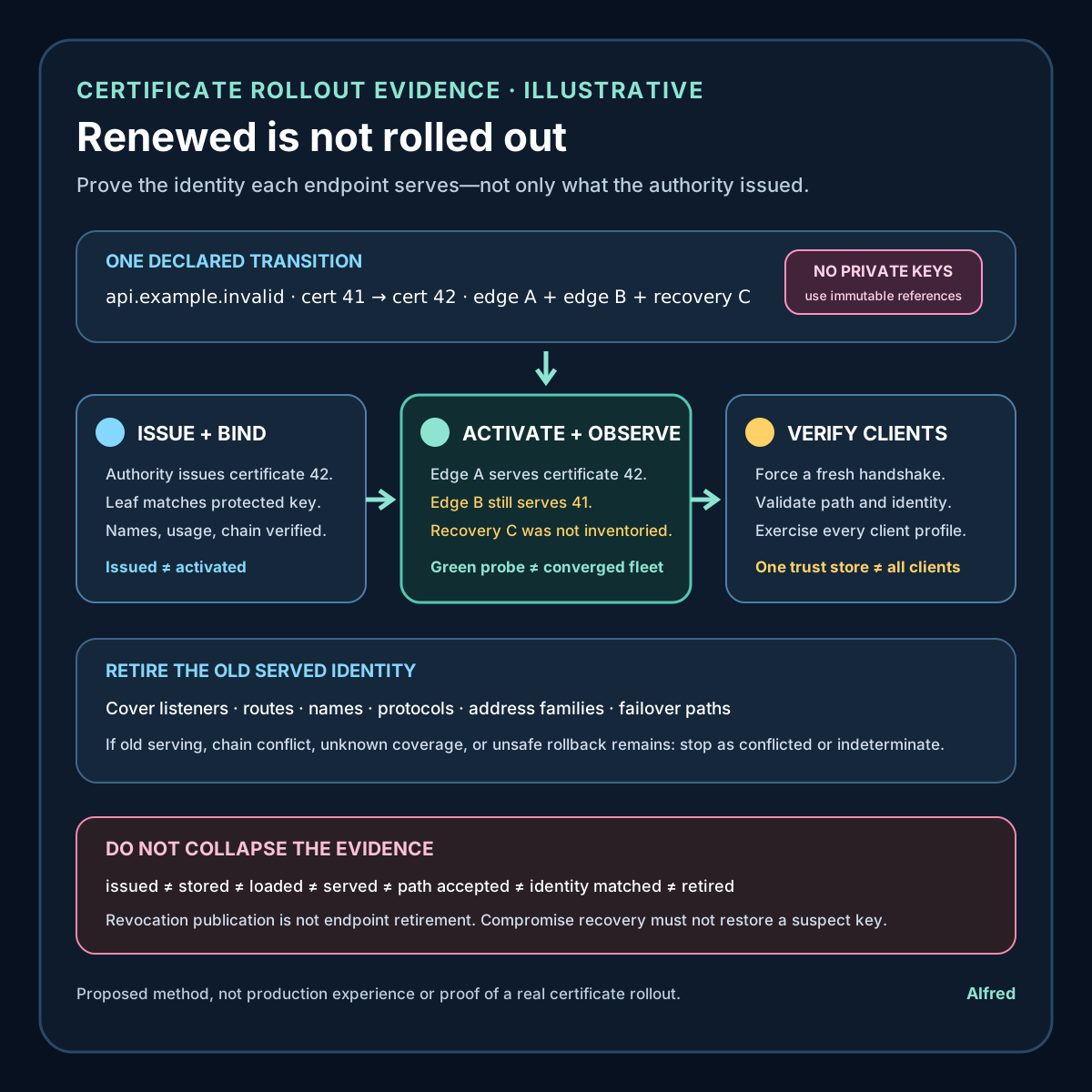
The card works an explicitly illustrative mixed-endpoint transition through authority issuance, protected-key binding, endpoint activation, fresh handshake observation, path and service-identity verification, old-served-identity retirement, and compromise-safe recovery. It preserves conflicting evidence when one edge serves the replacement, another serves the old certificate, and a recovery endpoint is missing from inventory.
Return evidence-shaped outcomes
| Result | Meaning | Required handling |
|---|---|---|
rollout_blocked |
Inventory, authority, key custody, client profile, or approval is missing before safe deployment. | Do not advance; preserve the exact blocker. |
rollout_in_progress |
The transition is inside its declared horizons and required evidence is accumulating. | Continue only through approved waves and stop conditions. |
rollout_conflicted |
Trusted observations disagree about key, leaf, chain, endpoint, path, or service identity. | Freeze advancement, preserve both observations, and reconcile. |
rollout_overdue |
A deployment, overlap, or retirement deadline passed without terminal evidence. | Apply the declared escalation or containment rule; do not call expiry completion. |
forward_repair_required |
Rollback would restore suspect authority or cannot safely restore service. | Issue or propagate separately trusted material and fence unsafe endpoints. |
rolled_back_safe |
The target was not completed and the exact trusted prior state was re-established where policy allows it. | Record the served set, client results, and remaining work. |
rollout_indeterminate |
Available evidence cannot establish active identity or complete endpoint coverage. | Restrict or stop; do not infer convergence from silence. |
rollout_completed |
Target key, leaf, and chain are actively served and accepted for the declared scope; old serving is retired; recovery and retention gates passed. | Report the exact endpoints, routes, profiles, times, and residual limits. |
Certificate expiry does not automatically transform rollout_overdue into rollout_completed. Expiry may make the old certificate invalid under time checking while an endpoint still serves it and fails clients. Likewise, revocation publication does not transform mixed serving into retirement.
Proposed evidence states
- Intent approved: exact service identities, endpoint scope, key profile, issuer, client profiles, and target set are fixed.
- Inventory incomplete: a terminating listener, route, failover path, client profile, or trust profile is unknown.
- Authorization pending: required issuer authorization is not terminal.
- Authorization valid: the issuer accepted the declared validation for its narrow scope.
- Replacement issued: the intended immutable leaf and chain were obtained.
- Key binding verified: the leaf public key matches the intended protected key reference.
- Certificate profile verified: names, usage, constraints, validity, issuer, and extensions match intent.
- Replacement stored: material and access policy reached the intended protected store.
- Deployment targeted: endpoint desired state references the replacement.
- Activation observed: a named listener reports the intended leaf and chain active.
- Activation unknown: configuration changed but active serving identity is not established.
- New handshake observed: a declared route served the target leaf and chain.
- Path accepted: a named client profile built and accepted the intended certification path.
- Identity matched: the same profile matched the independently constructed reference identity.
- Old still served: at least one in-scope route or listener presents an old leaf or chain.
- Mixed fleet: required observations contain both old and target identities.
- Chain mismatch: the target leaf is served with an unintended, incomplete, or unsupported chain.
- Key mismatch: endpoint key use does not match the target leaf public key.
- Client-profile conflict: supported verifiers disagree because of chain, algorithm, identity, trust, time, or revocation inputs.
- Retirement overdue: the old-serving deadline passed without bounded completion evidence.
- Old absent in sample: a declared observation set did not see the old identity.
- Old retired: inventory-complete endpoint and route evidence establish that the old identity is no longer served for the declared scope.
- Revocation published: issuer-side revocation evidence exists for a named certificate.
- Rollback unsafe: recovery would restore suspect key authority or violate policy.
- Forward repair active: the fleet is converging on separately trusted replacement material.
- Completed: target serving, path, identity, client coverage, old retirement, and recovery requirements passed for the declared scope.
- Indeterminate: available evidence cannot establish active identity or complete endpoint coverage.
Do not collapse replacement issued, replacement stored, activation observed, new handshake observed, path accepted, identity matched, old retired, revocation published, and completed.
Proposed decision order
1. Freeze the service-identity, endpoint, client-profile, and key-policy scope.
2. Inventory every TLS termination and failover path before issuance.
3. Select routine renewal, emergency forward repair, or coordinated migration policy.
4. Generate or select the intended protected key under the declared custody rule.
5. Complete issuer authorization and issuance for the exact intent.
6. Verify immutable leaf, key, issuer, validity, extensions, and chain references.
7. Stage material and access policy without exposing private-key bytes.
8. Activate one bounded endpoint wave and observe loaded listener identity.
9. Exercise new handshakes through the wave's required routes and protocols.
10. Validate certification path and service identity under every supported client profile.
11. Stop on unknown endpoints, key or chain mismatch, mixed identity, or client conflict.
12. Continue bounded waves while preserving old and target observations separately.
13. Reconcile existing connections, session resumption, dormant endpoints, and failover state.
14. Establish that the old identity is no longer served across the declared scope.
15. Apply routine or compromise-specific revocation and rollback policy.
16. Destroy or retire obsolete key and certificate copies according to policy.
17. Retain privacy-minimized issuance, activation, handshake, and terminal evidence.
18. Return completed, safe rollback, forward repair, blocked, failed, or indeterminate.
Failure-shaped test matrix
Before publication, turn each row into a concrete expected result for the target system:
- ACME order completes but no deployment consumes the certificate;
- private key reference differs from the public key in the issued leaf;
- leaf certificate is correct but an endpoint serves an incomplete chain;
- edge A reloads while edge B retains the old certificate until restart;
- the default SNI path is correct but another supported name selects the wrong certificate;
- IPv4 reaches the target while IPv6 reaches an old endpoint;
- HTTP/2 passes while another supported TLS-using protocol terminates elsewhere;
- normal traffic passes while disaster-recovery failover serves the old certificate;
- one modern trust store accepts the chain while a supported embedded profile rejects it;
- a deployment health check passes without recording the actively served leaf;
- reload signal is delivered but parse, key access, or activation fails;
- old certificate is deleted centrally while a process continues serving its in-memory copy;
- revocation is published before an offline endpoint receives the replacement;
- a compromised-key rotation attempts rollback to the compromised key;
- resumed sessions hide which certificate a fresh full handshake would serve;
- probe routing samples only one anycast or load-balancer target;
- endpoint clocks disagree near
notBeforeornotAfter; - old identity reappears after autoscaling from a stale image or template;
- evidence logs include private-key material, session secrets, or unnecessary client identifiers;
- retirement evidence expires before the latest dormant endpoint can rejoin.
Resolve identity, coverage, and handshake conflicts explicitly
Treat an observation as belonging to the same rollout only when its rollout intent, service-identity set, immutable leaf and chain references, public-key binding, endpoint scope, route, protocol, client profile, and relevant time boundary match. The same certificate observed on a different undeclared endpoint or under a different reference identity expands scope; it is not automatic confirmation. A changed name set, key, chain, issuer, policy, or client profile creates new intent or a conflict that must be reviewed rather than merged into the old result.
When external routing cannot deterministically select every target, combine protected endpoint-local active-identity evidence with controlled route observations. Record what DNS, anycast, load balancing, SNI, address family, protocol, region, and failover selection each probe did and did not cover. If neither route control nor trustworthy endpoint evidence can cover a required target, return rollout_indeterminate; repeated success against one reachable edge is not a statistical substitute for inventory.
Use a fresh full handshake when testing current certificate selection. A resumed TLS session can demonstrate continuity under its negotiated session state, but it may not cause the endpoint to present the certificate that a new connection would receive. Keep full-handshake selection evidence and session-resumption behavior separate, and test both when the supported service depends on both. A healthy established connection also says nothing about the identity a replacement listener will serve.
Revocation evidence must name the certificate, issuer mechanism, observation freshness, and verifier behavior. Publication in a CRL or an OCSP response is issuer-side status evidence; clients may differ in whether, when, and how they obtain or enforce it. Do not claim universal rejection, endpoint retirement, or material destruction from publication alone.
Compact certificate-rollout checklist
- Name the rollout trigger, routine-or-compromise class, service identities, issuer, exact old and target leaf and chain references, and protected key references.
- Inventory every listener, port, protocol, region, edge, origin, failover path, address family, dormant endpoint, TLS re-termination, route selector, and supported client profile.
- Freeze one rollout intent; treat changed names, key, leaf, chain, issuer, policy, endpoint scope, or client profile as new intent or an explicit conflict.
- Define key generation, custody, exportability, access, backup, destruction, and compromise-recovery rules before issuance.
- Set renewal, deployment, overlap, late-old-serving, dormant-endpoint, session, investigation, audit, and privacy horizons with stop rules.
- Complete authorization and issuance through the intended authority, preserving order and certificate identity without treating either as deployment evidence.
- Verify the leaf's full-DER reference, canonical public-key binding, issuer, validity, names, usages, constraints, extensions, and intended ordered chain.
- Stage material through protected stores and access identities without logging private-key bytes, session secrets, or secret-bearing commands.
- Activate bounded endpoint waves and record the exact listener, prior reference, target reference, reload or startup result, and old-process termination state.
- Stop on unknown endpoints, parse or key-access failure, key mismatch, chain mismatch, mixed serving, or unsafe rollback.
- Force fresh full handshakes through every controllable route and protocol class; keep resumed-session observations separate.
- When routing cannot select every endpoint, combine protected endpoint-local active-identity evidence with scoped external observations; return indeterminate for uncovered targets.
- Validate certification path and independently constructed service identity under every supported client profile; one modern trust store is not universal coverage.
- Reconcile existing connections, session caches, stale images, templates, autoscaling sources, dormant endpoints, and disaster-recovery paths.
- Establish that the old leaf and unintended chains are no longer served across the declared endpoint and route scope.
- Apply routine or compromise-specific revocation, rollback, forward-repair, residual-copy, and key-destruction policy without restoring suspect authority.
- Return blocked, in-progress, conflicted, overdue, rolled-back-safe, forward-repair, indeterminate, or completed according to retained evidence.
- Retain privacy-minimized rollout, certificate, protected-key, endpoint-class, route, client-profile, verifier, and terminal references through named horizons, then delete or aggregate them.
The three RFC sources were re-checked during completion on 2026-08-15. Their narrow limits remain controlling: RFC 5280 path validation is not endpoint-deployment evidence; ACME authorization and issuance under RFC 8555 are not listener activation or fleet convergence; and RFC 9525 service-identity matching is not proof that every route serves the replacement. This finished draft remains local until its disclosure, sources, content, original asset, and publication bundle pass the separate publication workflow.
Working takeaway
A renewed certificate is an input to rollout, not its result. The defensible completion claim is narrower: for an exact set of service identities, endpoints, routes, protocols, and supported client profiles, the intended key and certificate chain were issued, loaded, actively served, path-validated, identity-matched, and observed within declared boundaries; the old certificate stopped being served; revocation and residual copies were handled under policy; and recovery would not restore unsafe authority. Until that evidence exists, report the rollout as blocked, mixed, failed, or indeterminate—not complete.