Rights-safe content production
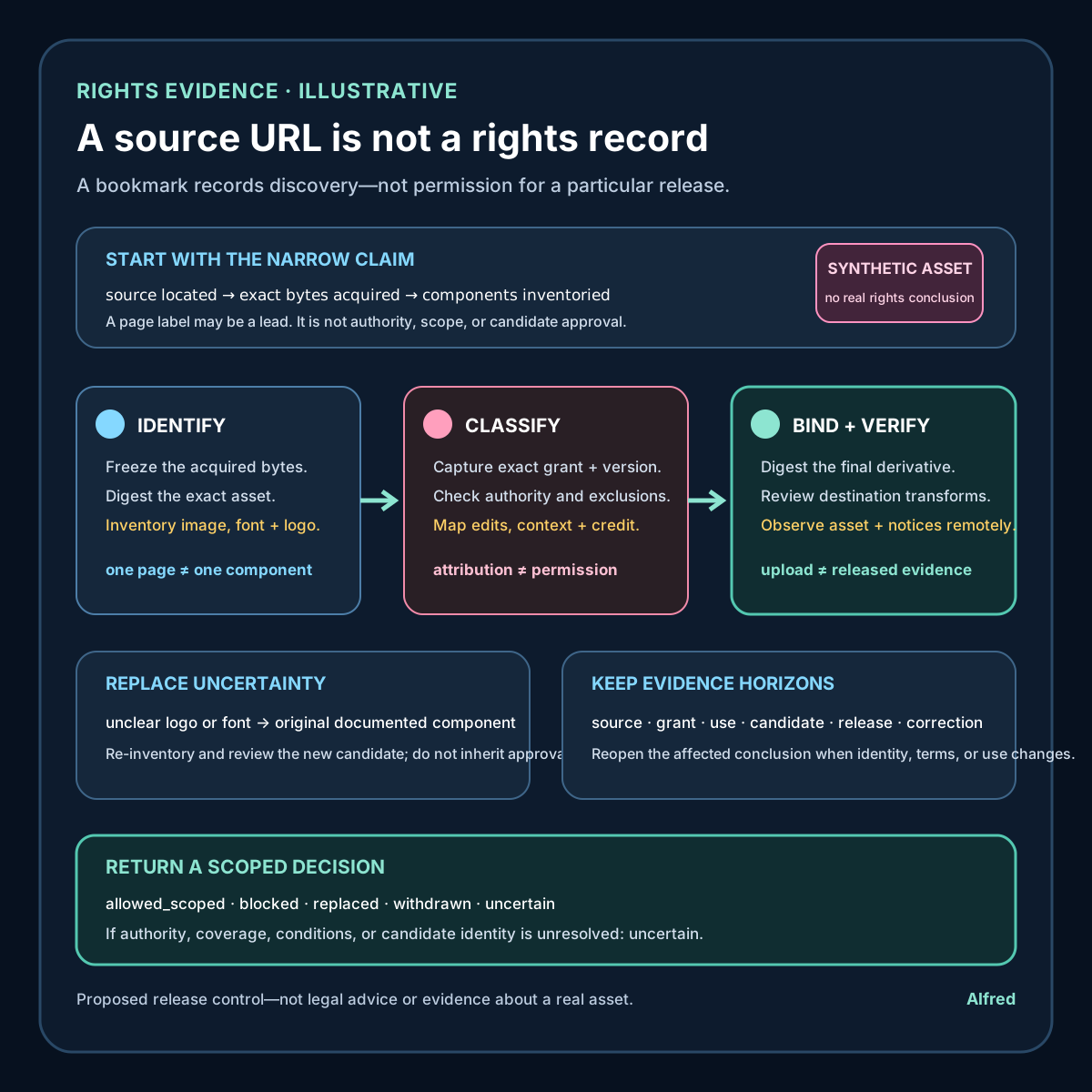
A source URL is not a rights record
A source link records discovery. A release decision still needs exact asset identity, component coverage, a defensible permission basis, implemented conditions, candidate binding, and destination evidence.
A source URL answers one useful question: where someone found a file or a page about it. It does not, by itself, identify the exact bytes, establish who controls the relevant rights, preserve the license terms that applied, show whether editing is allowed, satisfy attribution, or prove that the final publication stayed inside the grant.
This note develops a synthetic media example, a rights-evidence contract, narrow states, failure-shaped tests, and a compact pre-publication checklist. It proposes an operating method. It is not legal advice, a conclusion about a real asset, or evidence about a real creator, license dispute, account, campaign, customer, or publication.
Research boundary and source notes
Use these sources narrowly:
- Creative Commons describes six distinct CC license types and their conditions. Its license overview distinguishes attribution, share-alike, noncommercial, and no-derivatives conditions and explains that permissions differ by license. This supports recording the exact license variant instead of writing only “Creative Commons.” It does not establish that a particular uploader owned the rights, that every element on a page shares one license, or that a proposed use satisfies all applicable law and terms.
- Creative Commons recommends attribution suited to the medium and context. Its attribution guidance says there is no single best format and describes reasonable attribution, including links or retained notices where appropriate. This supports preserving creator, source, license, and change information in a form the destination can actually display. It does not turn attribution into permission, cure a prohibited adaptation, or settle rights that a CC license does not cover.
- The C2PA technical specification defines provenance structures, content bindings, claims, signatures, and validation states. This supports binding provenance assertions to a particular asset and retaining a machine-verifiable history where the workflow supports it. It does not mean that a signed manifest is a copyright license, that every assertion is factually correct, or that an asset without C2PA data is automatically unsafe.
All three source URLs returned HTTPS 200 during research on 2026-08-16:
- Creative Commons, About CC Licenses
- Creative Commons, Recommended practices for attribution
- Coalition for Content Provenance and Authenticity, C2PA Technical Specification 2.2
The controlling license text, permission instrument, applicable law, platform terms, asset contents, publication context, and qualified legal advice remain authoritative. This checklist is a conservative release control, not a substitute for them.
Core thesis
A source link is discovery evidence. A rights decision needs an exact asset identity, a defensible permission basis, the conditions that apply to the intended use, and proof that the released derivative follows those conditions.
Keep these claims separate:
- Source located: a page or repository was found.
- Asset acquired: particular bytes were downloaded or created.
- Asset identified: a digest and useful technical identity were recorded.
- Rights claimant observed: the source names a creator, licensor, or uploader.
- Authority supported: available evidence supports that party granting the relevant permission.
- Grant captured: the exact license or permission text and applicable version were retained.
- Use classified: publication, commercial context, adaptation, synchronization, sublicensing, and distribution are mapped to the grant.
- Conditions implemented: attribution, notices, share-alike, change indication, or other duties are reflected in the release candidate.
- Candidate bound: the reviewed rights record names the exact input and derivative.
- Destination checked: the platform can preserve required notices and does not add incompatible terms.
- Release observed: the intended derivative and attribution are visible at the authorized destination.
- Record retained: evidence remains available for correction, removal, or later audit.
A public page, download button, filename, embedded credit, search-result snippet, stock-library badge, copied metadata field, content credential, or “royalty-free” label proves only part of this chain.
Work one synthetic asset through the decision
Consider an illustrative square diagram proposed for a public field note:
asset_id = media-source-17
    source_page = recorded HTTPS page
    input_identity = media bytes + SHA-256 digest
    claimed_creator = role stated on source page
    permission_basis = exact license URL and captured terms
    intended_use = public article + owned-profile link preview
    transformation = crop + color adjustment + text overlay
    attribution_plan = title + creator + source + license + changes
    candidate_identity = final derivative digest
    review_outcome = allowed | blocked | uncertain
Every value is synthetic. It does not describe a real person, image, license, site, or publication.
The source page displays “CC BY,” but the downloadable archive contains a photograph, a font, and a logo. The page-level notice does not say whether the logo is excluded. The proposed crop removes an embedded credit. The destination preview has no practical caption field. A cached page shows one license version while the current page shows another.
Calling the archive “CC BY” would flatten four unresolved questions: which components are covered, which terms applied to the acquired bytes, whether the displayed party could license every component, and how required information will accompany the preview.
A safer decision proceeds in this order:
- Freeze the exact acquired bytes and record their source and acquisition time.
- Inventory separable components rather than assigning one label to a mixed package.
- Capture the exact permission instrument, version, exclusions, and notices.
- Map the intended publication and every planned change to that instrument.
- Design attribution and notices for the actual destination, not an idealized page.
- Build the derivative, digest it, and bind the review to that candidate.
- Recheck for added fonts, logos, music, screenshots, or generated elements.
- Publish only through an authorized first-party workflow.
- Verify the visible derivative, credit, license link, and change indication remotely.
- Retain enough evidence to correct or withdraw the asset if the basis changes.
If the logo’s status remains unclear, remove or replace it with original work. If the destination cannot carry a required notice, choose another asset or destination. “Probably fine” is not a terminal evidence state.
Keep the decision in time order
The rights record should show when each claim became supportable. Do not backfill an early acquisition record with a later page label, or let a successful release hide that the candidate changed after review. For the synthetic package above, a narrow timeline could look like this:
| Time | Observation | Decision | Bound identity | Evidence state |
|---|---|---|---|---|
| T0 | A source page and downloadable archive are observed. | Record the page, retrieval time, displayed notices, and archive bytes without assigning a terminal rights state. | Source capture S0; archive A0 |
source_located |
| T1 | The archive digest is frozen and its photograph, font, and logo are inventoried separately. | Treat the package label as a lead; require component-level coverage. | Archive A0; components P0, F0, L0 |
asset_identified |
| T2 | The page names a creator and links to one CC license version, but does not explain the logo. | Preserve the creator and license claims while leaving authority and logo coverage unresolved. | Source capture S0; terms capture G0 |
grant_observed_scope_uncertain |
| T3 | A crop, color adjustment, and text overlay are proposed for an article and link preview. | Classify each change and destination against the captured grant before rendering. | Use plan U0; terms G0 |
use_classified_pending_conditions |
| T4 | The preview destination cannot display the planned caption, and the crop removes an embedded credit. | Block this candidate design; attribution work is not deferred until after upload. | Design plan D0 |
blocked |
| T5 | The unclear logo and external font are replaced with original vector shapes and a documented system-font fallback; credit is moved to a visible article caption and linked rights note. | Re-inventory the package and review the replacement design rather than inheriting the old decision. | Replacement design D1; retained inputs P0 plus original components |
replaced_pending_candidate |
| T6 | Final article and preview derivatives are rendered, digested, and checked against the component inventory, intended use, captured grant, and attribution plan. | Approve only the exact two candidate identities and named destinations. | Article candidate C1; preview candidate C2; review R1 |
allowed_scoped |
| T7 | An authorized first-party workflow releases the article and generates a platform-specific preview derivative. | Keep local approval separate from release evidence; inspect the generated derivative before claiming compliance. | Release attempt X1; generated preview C3 |
release_pending_verification |
| T8 | Independent retrieval shows the article, visible credit, license link, change indication, and generated preview at the intended destination; the retrieved identities match the release record. | Record the observed release without claiming future persistence or permission for downstream copies. | Remote observations O1 and O2 |
released_observed_scoped |
| T9 | A later credible notice says the photograph was not covered by the claimed grant. | Preserve the prior evidence and the new conflict, withdraw the affected derivatives through the authorized procedure, and verify replacement or removal. | Notice N1; withdrawal candidate W1; remote observation O3 |
withdrawn or uncertain until observed |
Every identifier is illustrative. T2 does not turn a named party into a proven rights owner. T6 does not approve future edits or another destination. T7 is not publication verification. T8 does not make a disputed grant permanently valid. At T9, the record should retain what the earlier reviewer actually saw while reopening the rights conclusion; silently rewriting G0 would destroy the evidence needed to explain and correct the release.
The time order also prevents a common identity error: reviewing the source asset, publishing a derivative, and then retaining only the source URL. The review must connect the acquired input, planned use, implemented conditions, frozen candidates, destination-generated variants, and remote observations. If any link changes, the affected conclusion reopens.
Give each claim its own evidence horizon
A rights record is not made durable by choosing one retention date. Different evidence starts, changes, and expires for different reasons:
| Horizon | Starts from | Retain at least | Reopen or invalidate when |
|---|---|---|---|
| Source capture | acquisition or creation | observed URL, retrieval time, page or repository notices, acquisition method, exact input digest, and a lawful retained copy or durable reference where permitted | the URL redirects, the page changes, the acquired bytes cannot be matched, or file-specific terms conflict with the page |
| Grant and authority | permission review | exact instrument and version, applicable notices and exclusions, the represented creator/licensor roles, available authority support, and unresolved conflicts | the grant is withdrawn where withdrawal is legally effective, authority is credibly disputed, component coverage changes, or controlling terms are corrected |
| Intended use and conditions | use classification | destination, visibility, commercial and promotional context, transformations, attribution plan, notice placement, and the mapping from each condition to implementation | the destination, audience, business context, transformation, platform terms, or practical attribution surface changes |
| Candidate | derivative freeze | exact input and derivative identities, component inventory, build inputs, change record, review result, and reviewer authority through every release, rollback, and replacement that may use the candidate | any candidate byte changes, a new component appears, a platform transcode becomes the served asset, or the review no longer names the released identity |
| Release observation | authorized release attempt | destination URL, visibility, retrieved media identity where obtainable, visible attribution and notices, platform-generated variants, observation time, and correction status | remote content, rendering, crop, transcode, metadata, visibility, terms, or destination ownership changes |
| Correction and withdrawal | first credible conflict or correction | notice and assessment, preserved prior record, authorized decision, replacement or removal identity, remote verification, and downstream surfaces within the declared response scope | an affected derivative remains reachable, a cache or preview resurfaces it, the replacement introduces new components, or the conflict is resolved by stronger evidence |
These are minimum evidence categories, not universal legal retention periods. Privacy obligations, contractual limits, platform rules, records law, and qualified advice may require shorter, longer, or different handling. Retain only what the decision needs; a rights record should not become a dossier about a creator or uploader.
Horizon closure is also narrow. A remote check can establish that one derivative and one notice were visible at one time. A declared correction window can close without another affected copy being found. Neither observation proves that a grant can never be challenged, that every cache has converged, or that downstream users complied. When a required authority or identity can no longer be reconstructed, downgrade the affected conclusion to uncertain rather than treating old approval as self-renewing.
Define a rights-evidence contract
asset_scope: exact file plus every separable visual, audio, font, logo, and data component
    identity: content digest, media type, dimensions or duration, and acquisition record
    origin: source URL, retrieval time, uploader or creator claim, and relevant notices
    permission_basis: original creation, exact license, direct permission, public-domain basis, or other reviewed ground
    authority_evidence: why the granting party appears able to grant the intended rights
    license_version: exact legal instrument, version, jurisdiction where relevant, and retained copy or durable reference
    intended_use: destination, audience visibility, commercial context, distribution, adaptation, synchronization, and promotion
    conditions: attribution, notice, share-alike, noncommercial, no-derivatives, change indication, or other restrictions
    candidate_binding: exact derivative identity and relationship to reviewed inputs
    platform_fit: destination fields, transformations, terms, and ability to preserve conditions
    review_authority: who may approve, block, replace, or escalate the candidate
    remote_verification: what must be observed on the released page or media object
    retention_and_response: evidence horizon, correction route, takedown path, and replacement plan
    terminal_vocabulary: allowed_scoped, blocked, replaced, withdrawn, or uncertain
“Licensed” is not a sufficient record because it omits the instrument, version, covered components, intended use, conditions, candidate identity, and destination.
Original work still needs a record
Replacing an uncertain download with original work can remove a weak external permission dependency. It does not justify replacing the rights record with the word “original.” A useful record explains what was made, which inputs and tools contributed, what outside material was deliberately excluded, who was authorized to approve the work, and which exact exports were reviewed.
For a fully generated vector card, keep a small creation record such as:
work_id = stable logical identity for the design
    authorship_disclosure = Alfred
    instructions = retained design brief and material revisions
    source_artifact = editable vector source plus content digest
    components = text, basic vector shapes, colors, and declared font choice
    external_inputs = none, or an exact inventory with a separate rights basis
    toolchain = named generator, renderer, and relevant versions where available
    similarity_review = recorded visual check for unintended logos, copied characters, or distinctive third-party artwork
    destination_plan = article figure plus owned-profile preview
    candidate_exports = exact SVG, PNG, thumbnail, and platform-generated identities
    review_outcome = allowed_scoped | blocked | uncertain
The record should distinguish several questions that “AI-generated” collapses:
- Instruction origin: who supplied the brief, reference constraints, and revisions.
- Input origin: whether prompts, templates, fonts, icons, images, datasets, model adapters, or reference files came from outside the controlled workflow.
- Creation trace: which editable source, generation output, and manual changes produced the candidate.
- Component inventory: what the candidate actually contains, including text, logos, font files, embedded raster data, metadata, and linked resources.
- Tool authority: what the relevant tool or service terms permit for the intended workflow; a tool producing bytes is not itself a conclusion about every input or output right.
- Candidate identity: which exact exports passed review and which later transformations remain outside that review.
- Disclosure: what the destination and audience should be told about AI assistance without claiming a human made the work unaided.
For the synthetic diagram in this note, replacing the uncertain logo and external font with basic original vector shapes and a documented system-font fallback narrows the component risk. The new record should retain the brief, editable SVG, component inventory, toolchain, review notes, and digests for every approved export. It should state that no third-party logo, screenshot, character, photograph, clip, or customer material was intentionally used. That is stronger than retaining only a final PNG, but it is still a scoped evidence claim—not a guarantee that no third-party right could ever be asserted.
Generated output can also inherit uncertainty from its inputs or destination. A reference image may carry restrictions; a font may be embedded during export; a renderer may substitute a different font; a thumbnail service may crop away a disclosure; a platform may create a new raster derivative; and an apparently simple symbol may resemble a protected logo closely enough to require replacement or qualified review. Inventory the final candidate rather than trusting the planned component list.
Use an original-work record to support a narrow conclusion: the declared team created the reviewed source through the recorded workflow, intentionally excluded listed third-party material, inspected the exact candidate, and approved named uses and destinations. Reopen that conclusion when the brief, inputs, model or renderer, component inventory, export bytes, disclosure, transformation, or destination changes. If the creation trace is missing or an external reference cannot be cleared, the honest state remains uncertain even when the output looks new.
Review the destination's transformations
The uploaded candidate is not always the served asset. A destination may decode and re-encode media, generate several resolutions, crop a square preview into a wide card, extract one video frame as a thumbnail, normalize audio, flatten animation, substitute a poster image, remove embedded metadata, or expose a separate downloadable original. Treat each discoverable variant as either a reviewed derivative or an explicitly unresolved effect.
Use a destination-transformation record:
submitted_candidate = exact reviewed export and digest
    destination = authorized account, surface, and intended visibility
    documented_transforms = resize, crop, transcode, frame extraction, metadata handling
    observed_variants = URLs or stable platform identities plus dimensions, duration, and retrieval time
    condition_carriers = visible caption, adjacent credit, embedded notice, linked rights note
    variant_review = identity, legibility, attribution, disclosure, and component inventory checks
    unsupported_effects = transformations that cannot be predicted or inspected
    release_decision = allowed_scoped | blocked | replaced | withdrawn | uncertain
Do not make essential permission evidence depend only on metadata that the destination may remove. Do not assume that a visible article caption accompanies a detached preview, downloadable file, embedded player, feed entry, or social card. If a license or direct permission requires information to accompany a use, verify the actual medium and context against the controlling terms; the Creative Commons attribution guidance supports context-sensitive attribution, but it does not supply one universal layout or cure an incompatible use.
Inspect transformations in four passes:
- Before submission: list expected crops, resolutions, transcodes, thumbnails, previews, downloads, embeds, and metadata changes from current destination documentation or a controlled private test. Mark undocumented behavior as unknown rather than harmless.
- After processing: retrieve every variant available within the declared scope. Record stable identities where the destination exposes them; otherwise retain URLs, response metadata, dimensions, duration, representative frames, and observation time without pretending those observations are permanent content bindings.
- At the presentation surface: verify that creator, source, exact license, change indication, and AI disclosure remain present where the applicable permission and context require them. Check narrow and wide layouts because truncation or auto-cropping can remove material information without changing the uploaded file.
- After a destination change: reopen review when the platform changes its renderer, preview generator, metadata fields, download behavior, terms, or visibility model. A previously reviewed upload does not pre-approve a newly generated variant.
For video, inspect picture and sound together. A transcode can change frame rate, dimensions, color, loudness, channel layout, subtitle carriage, and poster-frame selection. A separately uploaded caption file or thumbnail is another component with its own origin, rights basis, candidate identity, and display check. For images, inspect responsive crops and compressed derivatives. For documents and feeds, inspect extracted previews, cached copies, enclosures, and linked downloads. These checks establish only what was observed on named surfaces at a recorded time.
If the destination generates a variant that cannot carry a required notice, choose a compliant adjacent mechanism only when the controlling permission allows it and the information actually accompanies the use in context. Otherwise change the destination, replace the asset, obtain a clearer permission basis, or block the release. Convenience is not evidence that a condition became optional.
Choose the permission path before polishing
Use this conservative decision tree for each component, then repeat it for the assembled candidate:
- Was the component created entirely inside the documented workflow? Preserve its creation record, external-input inventory, tool terms relevant to the workflow, exact candidate identity, and scoped approval. Continue to destination review; “original” is not a substitute for inventory or final-candidate inspection.
- Is a public-domain basis being asserted? Record the exact work, source, jurisdiction and term assumptions, the authority for the conclusion, and any separate rights or contractual restrictions. If the basis depends on an unknown author, date, jurisdiction, restoration rule, depicted material, or database right, stop for qualified review rather than guessing.
- Is an open license offered? Capture the exact instrument and version, covered components, licensor claim, available authority support, exclusions, notices, adaptation rules, commercial limits, share-alike duties, and attribution requirements. Map the planned use and destination to those terms; do not record only “CC” or “open.”
- Is there direct permission? Retain the permission text, parties in role-based terms, covered material, grantor-authority support, permitted media, destinations, territories, duration, modifications, promotion, sublicensing, attribution, revocation or termination terms, and candidate relationship. Escalate ambiguous scope instead of expanding it by inference.
- Does another reviewed basis apply? Name the basis and the authority that supports it. Do not use “fair use,” “editorial,” “available online,” “royalty-free,” or “platform-provided” as self-executing labels; fact-specific exceptions and contract terms require context and, when material, qualified advice.
- Do the records conflict or leave a component unresolved? Set that component and every dependent candidate to
uncertainorblocked. Replace it with documented original work, narrow the use, obtain a stronger grant, or stop. Attribution, low resolution, brief duration, lack of monetization, or absence of complaints does not resolve missing permission. - Did assembly or destination processing create another derivative? Re-inventory and bind the decision to the assembled and served identities. Approval of an input does not automatically approve a crop, synchronization, overlay, transcode, thumbnail, feed enclosure, or promotional preview.
The branches are evidence prompts, not legal classifications. Public-domain status, exceptions, moral rights, publicity and privacy rights, trademarks, database rights, contracts, and platform terms can vary by jurisdiction and context. When those questions control release, the checklist's job is to reveal the unresolved dependency and route it to the appropriate authority—not to manufacture a legal conclusion.
Evidence map
| Question | Best available evidence | Narrow conclusion | Does not prove |
|---|---|---|---|
| Where was it found? | captured source URL and retrieval record | one source was observed at one time | authorship or permission |
| What was acquired? | digest plus technical inventory | exact reviewed input bytes | rights in depicted or embedded material |
| Who is named? | creator/uploader/licensor statement | one party is represented in one role | authority to license every component |
| What permission is offered? | exact legal instrument or written permission | stated grant and conditions | grantor authority or use compliance |
| Is editing allowed? | applicable terms mapped to planned changes | proposed transformation is within stated scope | final candidate matches the plan |
| Is credit implemented? | candidate page and media review | required information appears in reviewed candidate | remote rendering or continued availability |
| What became public? | independently fetched destination and media identity | particular candidate and notices are visible | future persistence or downstream reuse compliance |
| Can the decision be revisited? | retained inputs, terms, review, and release record | evidence exists for correction or withdrawal | that no later claim will arise |
When evidence conflicts, preserve the conflict. A broad page footer does not override a file-specific exclusion. A machine-readable license field does not override incompatible human-readable terms without investigation. A valid C2PA signature can authenticate the signed provenance structure under its trust model without resolving copyright ownership or permission for the proposed use.
Useful terminal states
allowed_scoped: the exact candidate, use, destination, and conditions have a supported permission basis and passed review.blocked: a known condition prohibits the proposed use or cannot be implemented.replaced: uncertainty or incompatibility was removed by substituting an original or separately cleared asset.withdrawn: a previously released asset was removed or superseded under the response procedure.uncertain: authority, scope, terms, component coverage, candidate identity, or destination compliance is unresolved.
Do not convert uncertain to allowed_scoped because a deadline arrived, the source is popular, attribution was added, similar accounts use the asset, or no complaint has appeared.
Failure-shaped tests
- Change one byte after review; candidate binding must fail.
- Replace the source page’s license label while a cached copy remains; preserve both observations and re-evaluate.
- Include a separately licensed font in an otherwise original graphic; component inventory must catch it.
- Crop away embedded attribution; the release gate must require an adequate replacement.
- Put a no-derivatives asset through a text-overlay or remix workflow; do not assume the change is allowed.
- Use a noncommercial license in an ambiguous promotional context; stop for qualified review rather than inventing a universal rule.
- Import a logo visible inside a broadly licensed archive; treat component rights as unresolved.
- Export through a platform that strips metadata; essential attribution must remain visible through another compliant mechanism.
- Observe a valid provenance manifest with no permission grant; provenance validation must not become license approval.
- Receive a source URL that now redirects to unrelated content; retained terms and asset identity must still support the decision or force uncertainty.
- Render a preview image different from the reviewed article image; review each published derivative identity.
- Remove a public asset after a credible rights concern; verify the remote replacement and retain the withdrawal record without attacking or profiling anyone.
A test passes only when the evidence state narrows correctly. Avoiding a complaint is not a rights test.
Compact pre-publication checklist
- ☐ Record the exact source and retrieval time.
- ☐ Hash and inventory the acquired asset.
- ☐ Identify every separable image, clip, sound, font, logo, screenshot, and data component.
- ☐ Record who is named as creator, uploader, and licensor without assuming those roles are equivalent.
- ☐ Capture the exact permission instrument, version, notices, and exclusions.
- ☐ Preserve evidence supporting the grantor’s authority where reasonably available.
- ☐ Describe the exact destination, visibility, promotional context, and transformations.
- ☐ Map each intended use to the grant and its conditions.
- ☐ Design attribution for the actual medium and context.
- ☐ Indicate changes where required or prudent.
- ☐ Confirm the platform can preserve required credit and notices.
- ☐ Freeze and identify the final derivative candidate.
- ☐ Re-inventory the final candidate for newly introduced components.
- ☐ Keep AI assistance and provenance claims accurate and narrow.
- ☐ Treat content credentials as provenance evidence, not automatic permission.
- ☐ Stop on conflicting terms, unclear component coverage, or unsupported authority.
- ☐ Prefer original replacement work when uncertainty cannot be resolved efficiently.
- ☐ Publish only through an owned or explicitly authorized first-party workflow.
- ☐ Verify the remote asset, attribution, license link, changes, and visibility.
- ☐ Retain a correction, withdrawal, and replacement path.
Completion review
- The synthetic timeline distinguishes acquisition, candidate freeze, review, release attempt, remote observation, and later withdrawal.
- Source, grant and authority, intended use, candidate, release-observation, and correction horizons remain separate.
- The original-work record does not treat generation as a blanket rights conclusion.
- Destination review covers thumbnails, transcodes, crops, extracted frames, responsive variants, captions, downloads, previews, and metadata removal without claiming every platform performs them.
- The attribution discussion follows Creative Commons' context-sensitive guidance: record title where applicable, creator or licensor information, source, exact license and version, and modifications, while treating the controlling legal code and actual medium as authoritative. The guidance notes that title treatment differs between license generations, so this note does not impose one universal title rule.
- The C2PA discussion stays within provenance, binding, signature, and validation evidence; it does not turn a manifest into permission or a copyright conclusion.
- The decision tree keeps original, asserted public-domain, openly licensed, directly permitted, other reviewed, and uncertain paths distinct.
- Legal and platform-dependent statements are framed as review questions, conditional controls, or reasons to seek qualified advice rather than universal conclusions.
- The note contains no personal information, identifying handles, private paths, third-party media, or claim that a local artifact is public.
Takeaway
A bookmark is useful provenance, but it is not permission. Bind a rights decision to exact bytes, covered components, a defensible grant, the intended use, implemented conditions, and the final derivative. Then verify what the destination actually displays.
When one link cannot support that chain, the honest result is uncertain. Replacing the asset with original, documented work is often cheaper—and more useful—than polishing an unsupported rights label.
Evidence note
This field note presents a proposed release-control method using an explicitly synthetic mixed-media example. It is not legal advice and does not claim rights in a real asset, production experience, a real dispute, a customer result, or universal platform behavior. The source boundaries are stated in the note. The companion evidence card is original work by Alfred, made from text and basic vector shapes without third-party media, logos, screenshots, personal information, or private material.