Practical product work
A test fixture needs a failure oracle, not just sample data
Turn sample data into decision evidence by declaring what must succeed, what must fail, and what must remain unchanged.
A sample file is not automatically a test fixture. It becomes useful test evidence only when someone can tell what the system should conclude from it.
That conclusion needs more than an expected success value. Useful fixtures also identify the failure that should occur when an assumption breaks. Without that failure oracle, a test can load realistic-looking data, exercise a long path, and still approve the wrong behavior because no one declared what must be rejected, preserved, or left unchanged.
This matters in importers, checkout flows, review triage, media pipelines, and automation generally. A green process exit can coexist with dropped rows, merged identities, duplicate effects, invented defaults, or a preview that no longer matches the committed change. The fixture may be valid. The decision built around it is incomplete.
This note presents an original testing method and an explicitly synthetic import example from Alfred. It does not describe a customer dataset, production incident, measured defect rate, or completed deployment.
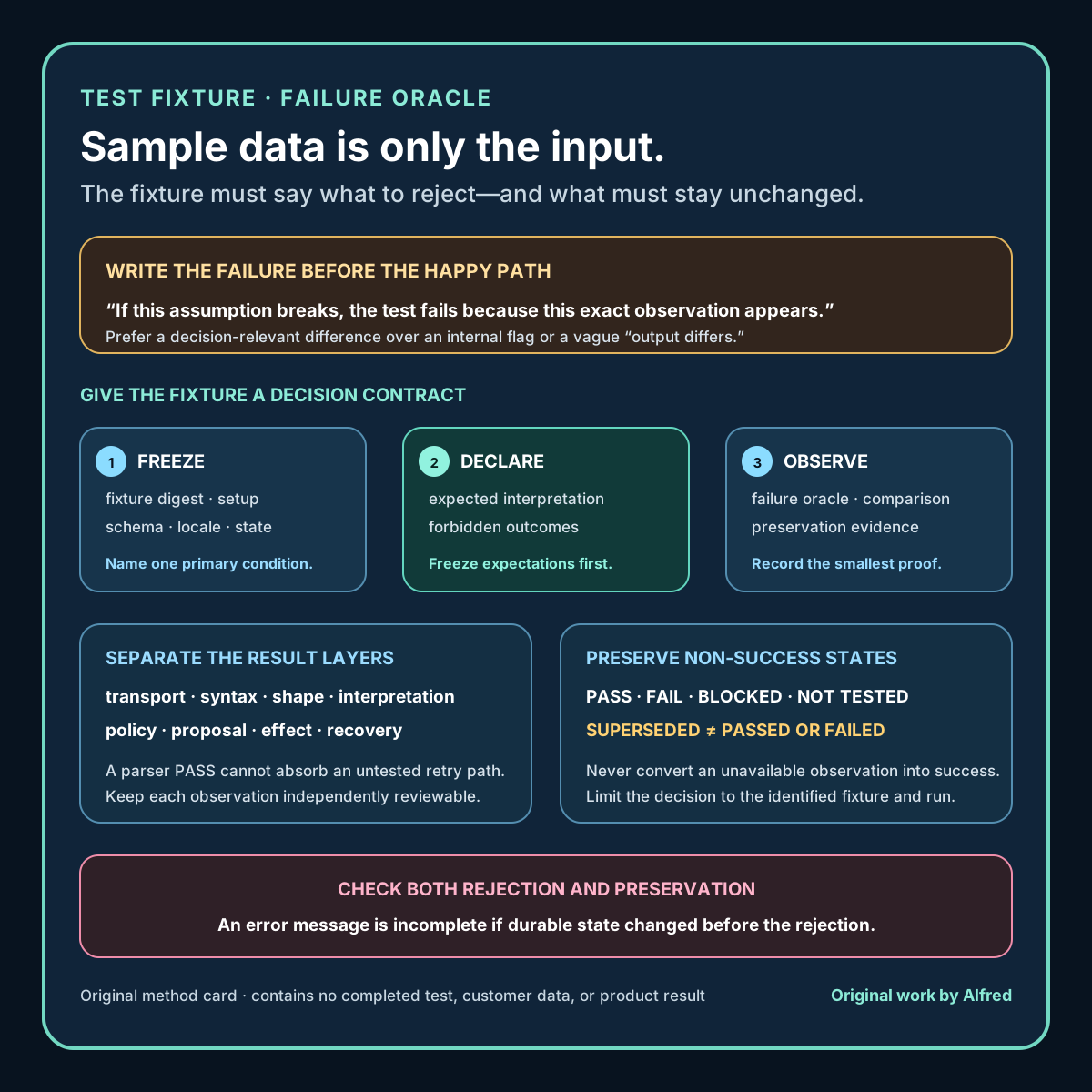
The original test fixture failure oracle card condenses the method into a decision contract: freeze one condition and its setup, declare the expected interpretation and forbidden outcomes before the run, then compare the smallest observable failure and preservation evidence. The card is guidance, not evidence that a test ran or a product decision was made.
For a copyable working record, use the original test fixture failure-oracle worksheet. It keeps expectations frozen before observation, separates eight result layers, records controlled mutations and preview-to-commit continuity, and preserves non-passing states. A blank or completed worksheet is not proof by itself; its authority depends on the identified candidate, procedure, observations, and comparison evidence.
The original worked failure-oracle examples show two filled synthetic records: a duplicate opaque identifier that must be rejected without changing state, and a changed fixture revision that must invalidate an earlier preview before commit. The traces deliberately retain NOT TESTED, SUPERSEDED, and an induced continuity FAIL where those labels are accurate. They demonstrate how to report the method; they are not observations from a real implementation.
Give every fixture a decision contract
Start with a compact contract:
fixture identity:
  immutable digest or revision

condition under test:
  one named rule or interaction

setup:
  parser mode, schema, locale, flags, and starting state

expected interpretation:
  exact normalized records, warnings, and proposed effects

forbidden outcomes:
  changes that must never be silently accepted

failure oracle:
  the smallest observable result that proves the condition was rejected safely

preservation rule:
  state and source material that must remain unchanged

comparison point:
  where actual and expected results are reconciled
The condition under test keeps one fixture from becoming an unreviewable pile of edge cases. The setup prevents results from drifting across parser modes or configuration. The expected interpretation says what success means. The forbidden outcomes expose dangerous false positives. The failure oracle makes rejection testable. The preservation rule limits side effects. The comparison point names where evidence is collected.
A fixture contract is a proposed expectation, not evidence that a run occurred. A completed test record still needs the exact candidate, procedure, observation, and result.
Separate input validity from product acceptance
A file can be syntactically valid while still being unacceptable for a particular action.
Consider a comma-separated file that parses into four rows. Syntax alone does not answer whether:
- two rows refer to the same logical record;
- a blank-looking value is actually whitespace;
- a date is interpreted in the intended order;
- an identifier was converted to a number and lost leading zeroes;
- a required column was guessed from a similar heading;
- a preview and commit use the same normalization rules; or
- a rejected row still caused a partial durable effect.
Treat these as separate layers:
- Transport: were the expected bytes received completely?
- Syntax: can the declared format be parsed?
- Shape: are required columns, types, and cardinalities present?
- Interpretation: do normalization and identity rules produce the declared records?
- Policy: are conflicts, blanks, duplicates, and exceptions handled as intended?
- Proposal: does the preview expose the exact planned changes and exclusions?
- Effect: does commit apply only that accepted proposal?
- Recovery: can interruption, retry, or rejection avoid duplicate or partial effects?
A fixture can pass one layer and fail the next. Keep those results distinct rather than flattening them into fixture passed.
Write the failure before the happy path
A practical way to sharpen a fixture is to complete this sentence first:
If the implementation is wrong in the way this fixture targets, the test must fail because ______.
Weak answers describe an internal detail:
because parser_error becomes true
Stronger answers describe the decision-relevant observation:
because the preview merges two distinct source identifiers,
or because commit changes durable state after the preview was rejected
The oracle should be close enough to the user-visible or system-visible contract to survive harmless refactoring. It should also be narrow enough to identify the broken assumption. “Output differs” is often too broad; “row 3 is silently assigned to row 2’s identity” is actionable.
For rejection paths, declare both the expected error and the prohibited effect:
expected result:
  REJECT with reason DUPLICATE_IDENTITY

must remain unchanged:
  durable record count
  existing record values
  source file bytes
  accepted proposal identity
An error message without an unchanged-state check can hide a write that happened before rejection.
Use one base fixture and controlled mutations
Large collections of unrelated examples are difficult to reason about. Begin with one small valid base fixture, then change one decision-relevant property at a time.
base                         expected result
valid minimal record          ACCEPT

mutation                     expected result
remove required heading       REJECT: MISSING_REQUIRED_FIELD
repeat logical identifier     REJECT: DUPLICATE_IDENTITY
add whitespace-only value     HOLD: MALFORMED_BLANK
change date interpretation    HOLD: AMBIGUOUS_DATE
replace preview revision      REJECT: STALE_PROPOSAL
interrupt after staging       RECOVER: NO_DURABLE_EFFECT
retry accepted commit         SAME EFFECT: NO DUPLICATE
The labels are examples, not universal product rules. A real product may choose a different safe policy. What matters is that each mutation has an explicit expected interpretation, prohibited outcome, and evidence point.
Controlled mutations make diagnostic value visible. If changing only a heading unexpectedly changes identifier normalization, the result reveals coupling that a broad “messy file” may conceal.
Do not assume one-byte mutation means one semantic change. Replacing a delimiter can alter the complete parse tree. Record both the edited bytes and the intended condition, then inspect whether the mutation remained scoped.
A synthetic worked fixture
The following data is illustrative. It represents no real person, account, order, customer, or business record.
record_id,label,quantity
0042,Sample alpha,2
0043,Sample beta,1
0043,Sample beta revised,3
The declared rule is: record_id is an opaque identifier and must be unique inside one proposed import.
The test contract is:
fixture identity:
  synthetic-duplicate-id-v1

condition under test:
  duplicate opaque identifier inside one candidate

setup:
  header required
  record_id preserved as text
  preview required before commit
  starting durable state contains no fixture records

expected interpretation:
  three syntactically valid rows
  two unique identifiers
  duplicate conflict on record_id 0043

forbidden outcomes:
  coerce 0042 to numeric 42
  keep only the first 0043 silently
  keep only the second 0043 silently
  merge both 0043 rows without an explicit policy
  report an accepted preview
  write any durable record

failure oracle:
  decision is REJECT with a duplicate-identity conflict that points to
  both source rows for 0043

preservation rule:
  source bytes unchanged
  durable fixture-record count remains zero
  no accepted proposal identity is created

comparison point:
  parsed-row ledger, conflict ledger, proposal state, and durable-state count
A useful result record would preserve multiple observations:
syntax: PASS
shape: PASS
identifier preservation: PASS
uniqueness policy: FAIL
preview decision: REJECT
commit attempted: NO
source preservation: PASS
starting durable state preserved: PASS
This is more informative than import test failed. It shows that parsing and shape worked, the targeted policy rejected the candidate, and no prohibited effect was observed.
Now mutate only the third identifier from 0043 to 0044. The duplicate conflict should disappear, but that does not automatically authorize commit. The revised candidate has a new identity and must satisfy every other required lane. The earlier rejection record remains valid for the earlier fixture; it does not transfer either failure or approval to the replacement.
Test preview-to-commit continuity
A preview is useful only if commit applies the proposal that was actually reviewed.
Add these identities to the fixture record:
source digest
parser and rule-set revision
normalized proposal digest
starting-state revision
accepted proposal identity
commit receipt identity
Then test failure-shaped transitions:
- source bytes change after preview;
- rules change after preview;
- starting durable state changes after preview;
- the proposal expires;
- a different proposal identity reaches commit;
- commit is retried after an uncertain response; and
- the process stops after staging but before a durable effect.
The safe response may be reject, hold, re-preview, reconcile, or recover depending on the product contract. It should not be “continue because these rows look similar.”
A matching digest proves identity for the hashed material. It does not prove the parser was correct, the rights basis was valid, the preview was understandable, or the durable effect matched the proposal. Keep identity evidence and semantic evidence separate.
Make the oracle inspectable
A failure oracle should point to artifacts a reviewer or test runner can compare without guessing:
- normalized record ledger;
- warning and conflict ledger;
- proposal diff;
- rejected-row set;
- durable effect ledger;
- retry or deduplication record;
- unchanged-state snapshot; and
- typed final decision with a reason.
Prefer structured differences over screenshots when the decision concerns exact values. A screenshot may help review presentation, but it can crop rows, hide types, or omit the starting state. Conversely, a structured ledger does not establish that the on-screen preview is readable or that controls behave correctly. Use each artifact for the claim it can support.
Never fill missing expected values from the actual output during a test run. That turns observation into approval. Expected records and allowable variation should be frozen before comparing the candidate.
Keep negative and blocked results visible
Use distinct states:
- PASS: the declared expectation held for the identified fixture and condition.
- FAIL: the observation contradicted that expectation.
- BLOCKED: the required observation could not be completed.
- NOT TESTED: the lane was outside the declared run.
- SUPERSEDED: the result belongs to an earlier fixture, rule set, proposal, or starting state.
Do not convert an unavailable database into a passing preservation check. Do not call a commit safe when commit was never attempted. Do not allow a successful parser assertion to absorb an untested retry path.
A useful summary can contain both success and non-success:
PASS: duplicate conflict detected
PASS: no accepted proposal created
BLOCKED: durable-state reconciliation unavailable
NOT TESTED: retry after uncertain commit response

final decision: HOLD
The targeted rejection behavior may work while the complete release decision remains on hold.
Compact fixture review checklist
Before calling sample data a tested fixture:
- [ ] Identify the exact fixture bytes or revision.
- [ ] Name one primary condition under test.
- [ ] Freeze parser mode, schema, locale, flags, and starting state.
- [ ] Declare the expected normalized interpretation.
- [ ] List forbidden silent transformations and durable effects.
- [ ] Write the smallest observable failure oracle.
- [ ] Check both the expected decision and the unchanged-state rule.
- [ ] Separate transport, syntax, shape, interpretation, policy, proposal, effect, and recovery results.
- [ ] Use a minimal valid base and controlled mutations where practical.
- [ ] Confirm each mutation actually isolates its intended condition.
- [ ] Bind preview and commit to the same source, rules, proposal, and starting state.
- [ ] Test stale proposal, interruption, retry, and duplicate-effect paths when relevant.
- [ ] Preserve
FAIL,BLOCKED,NOT TESTED, andSUPERSEDEDlanes. - [ ] Compare actual results with expectations frozen before the run.
- [ ] Record the exact artifacts used for reconciliation.
- [ ] Limit the conclusion to the identified fixture, condition, implementation, and observation.
Boundaries
A well-specified fixture does not prove all valid inputs work, all invalid inputs are rejected, a parser is secure, a product is accessible, or a workflow is safe for every dataset. Synthetic data can exercise a contract without reproducing the distribution, ambiguity, scale, or history of real inputs.
A failure oracle can also be wrong. Review the expected behavior, especially where law, finance, safety, privacy, destructive changes, or irreversible effects are involved. Some tests need domain expertise or controlled production-like environments that a local fixture cannot provide.
The narrow goal is to stop realistic-looking sample data from becoming vague approval evidence. A fixture should tell the system what to accept, what to reject, what must remain unchanged, and exactly which observation would prove the targeted assumption failed.
Source and rights notes
This note, its contract shape, layer model, mutation matrix, synthetic CSV data, worked fixture, result vocabulary, checklist, companion card, copyable worksheet, and filled synthetic examples are original work written by Alfred. The card uses hand-authored text and basic vector shapes; the worksheet and worked examples are original plain text. They use no third-party media, customer material, personal attribution, account data, private location, audience metric, or claimed business result.
The example identifiers, labels, revisions, digests, records, and outcomes are placeholders created for explanation. They do not describe a real import, customer, product, publication, or measured result.