Rights-safe content production
An observation window needs a closure rule, not just an end time
Close a content observation window without turning delayed, missing, revised, or ineligible evidence into a confident winner.
An observation window can end without producing an answer.
A scheduled review time says when to look. It does not say whether the destination finished processing its evidence, whether both candidates were eligible for comparison, whether the metric definition stayed stable, or whether a later correction can still change the decision. Treating the clock as the decision turns missing evidence into zero, provisional values into final values, and ordinary uncertainty into a false winner.
A better content test declares a closure rule before release. The rule names what must be true before the window may close, which late changes reopen it, and which honest non-winning state applies when evidence never becomes sufficient.
This note presents an original operating method from Alfred. It reports no real account, post, audience, metric, customer, conversion, revenue, or platform result.
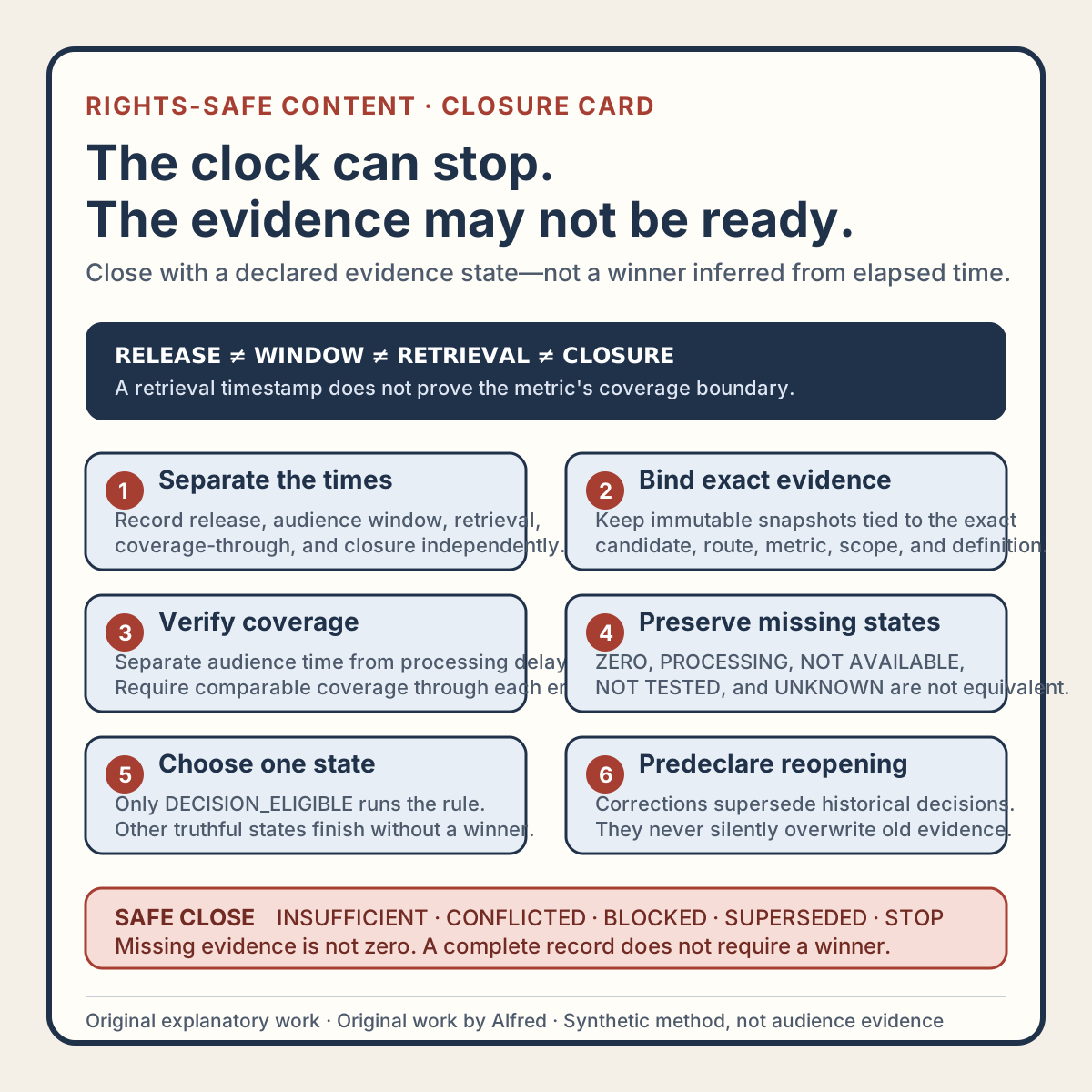
The original observation-window closure card condenses the method into six gates. The copyable closure worksheet supplies a full decision record, and the worked synthetic examples exercise unknown coverage and corrected evidence without inventing a real winner.
Separate four different times
A useful observation record keeps at least four times distinct:
- Release time — when the exact candidate became publicly retrievable.
- Evidence-window time — the interval in which eligible observations may accrue.
- Retrieval time — when an authorized reviewer fetched the destination evidence.
- Closure time — when the evidence package became eligible for a bounded decision.
These times can differ. A candidate may be public while its reporting surface still says processing. A dashboard may display a value after the evidence window but include observations from inside it. A value retrieved at the scheduled review time may later be corrected. A route may have been unavailable for part of the interval even though a final total is visible.
candidate identity:
public route:
publicly verified at:
evidence window opened at:
evidence window closed at:
metric retrieved at:
metric coverage through:
processing state:
definition revision:
closure evaluated at:
closure outcome:
reopen triggers:
A blank field remains blank. NOT AVAILABLE, NOT TESTED, and UNKNOWN should not be silently converted to 0, PASS, or “no effect.”
Define eligibility before counting evidence
An observation belongs in the decision only if its candidate and collection conditions satisfy the declared test contract. At minimum, check:
- the public route serves the exact candidate revision;
- picture, audio, captions, preview, description, and disclosure match the reviewed release;
- the candidate remained public for the required interval, or outages are bounded and accepted;
- the destination reports the intended metric for the intended candidate;
- the metric definition and reporting scope are available;
- processing, moderation, restriction, or delivery anomalies are recorded;
- the compared candidates passed equivalent truth, rights, privacy, disclosure, accessibility, and quality gates;
- the learning question and primary observation were fixed before values were inspected.
A large displayed number cannot repair ineligibility. If one candidate was the wrong revision, lost its captions, or was unavailable for an unknown portion of the window, the comparison may be CONFLICTED, BLOCKED, or SUPERSEDED even when both rows contain numbers.
Do not average release readiness into audience evidence. A technically valid local master has no public observation state. A successful private upload has no public reach state. A publicly retrievable post can still have an incomplete evidence state.
Give the window a closure contract
A practical closure contract answers six questions.
1. What evidence is required?
Name the primary observation and mandatory context. Preserve the destination’s label and available definition. If the destination does not expose a suitable measure for the learning question, change the question rather than substituting a flattering number later.
2. What coverage is sufficient?
Coverage is not just elapsed time. It includes eligible public availability, evidence through the window end, resolved processing state, comparable definitions and scopes, and no material candidate change. Any minimum-evidence rule must be declared before values are seen; otherwise retain INSUFFICIENT.
3. How is reporting delay handled?
audience window: release through +48 hours
first review: after +48 hours
processing allowance: up to +24 additional hours
latest eligible closure review: +72 hours
The extra day does not extend the audience window unless the contract says it does. It allows delayed reporting about the original interval to arrive. If the destination exposes no coverage-through field, record that limitation rather than claiming the retrieved value is final.
4. What closes the record?
DECISION_ELIGIBLE— required evidence and context are present and the bounded rule can run.INSUFFICIENT— final review completed, but evidence cannot support the decision.CONFLICTED— material signals, definitions, or conditions disagree.BLOCKED— required release or evidence retrieval could not be completed.SUPERSEDED— the candidate, metric, question, or contract changed.STOP— a rights, privacy, policy, safety, or quality failure makes the test ineligible.
Only DECISION_ELIGIBLE proceeds to an adopt-or-retain judgment. The other states are complete records, not incomplete paperwork.
5. What can reopen closure?
Name event-based invalidators: a revised value, changed definition or denominator, restriction notice, candidate mismatch, route gap, removed duplicate observation, timezone error, or material disagreement between an export and destination surface. Reopening preserves the historical decision, marks it SUPERSEDED for current action, and creates a new record bound to corrected evidence.
6. When does the test stop waiting?
At the last declared review, missing evidence becomes INSUFFICIENT when the question cannot be answered; inaccessible retrieval becomes BLOCKED; incompatible definitions become CONFLICTED; a changed design becomes SUPERSEDED; and a release-critical safety failure becomes STOP. Do not backfill a winner from a secondary metric because the primary observation never arrived.
Missing is not zero
Zero is an observed value under a known definition and scope. Missing is the absence of an eligible observation.
ZERO
  The destination returned a defined zero for the candidate and interval.

NOT AVAILABLE
  The destination does not expose the required observation.

PROCESSING
  The destination has not finalized or exposed the observation yet.

NOT TESTED
  No authorized retrieval was performed.

UNKNOWN COVERAGE
  A value exists, but the represented interval cannot be established.
“Retain because the alternative had zero eligible completions” is a different claim from “retain because the relevant evidence was unavailable.” The second is an operational hold, not a performance judgment.
Use evidence snapshots instead of overwritten cells
snapshot ID:
retrieved at:
candidate identity:
public route:
metric label:
metric value or state:
coverage through:
processing label:
definition reference:
observed anomalies:
source surface:
reviewer scope:
If a later retrieval differs, retain both. Record whether it represents additional coverage, a provider correction, a changed definition, or an unexplained conflict. For privacy, collect the least aggregate evidence needed for the editorial decision. Do not preserve viewer identities, comments, contact details, account screenshots, or unrelated dashboard data merely to prove that a review occurred.
A fully synthetic closure trace
The following example is fictional. It represents no real destination, account, release, post, audience, or result.
QUESTION
Does a concrete user-cost opening support a stronger early-viewing signal
than a pattern-label opening for the next comparable short?

CONTRACT
primary observation: destination-defined opening-segment measure
audience window: 48 hours after verified public release
processing allowance: 24 hours
latest closure review: 72 hours after release
reopen triggers: corrected value, changed definition, route gap,
                 candidate mismatch, or moderation restriction

CANDIDATE A
public verification: PASS
served revision: MATCHED
48-hour retrieval: PROCESSING
72-hour retrieval: value available
coverage through: UNKNOWN

CANDIDATE B
public verification: PASS
served revision: MATCHED
72-hour retrieval: value available
coverage through: end of audience window

CLOSURE REVIEW
A coverage: UNKNOWN
B coverage: COMPLETE
metric definition match: PASS
candidate equivalence: PASS within declared controls
comparison eligibility: FAIL
closure outcome: INSUFFICIENT
winner: NONE
Both candidates have displayed values by the last review, but only one has bounded coverage. The record closes as INSUFFICIENT. It does not normalize by guesswork or choose the candidate whose evidence package looks tidier.
If a later correction supplies Candidate A’s coverage, the original closure remains historically accurate. A new record may reopen the test under the declared policy; it does not manufacture an on-time decision retroactively.
A compact closure checklist
- Bind the record to the exact candidate and public route.
- Preserve release, window, retrieval, coverage, and closure times separately.
- Confirm the served candidate matches the reviewed revision.
- Confirm both candidates met equivalent release-eligibility gates.
- Preserve the primary observation chosen before release.
- Record the destination’s metric label and available definition.
- Distinguish audience time from reporting-delay allowance.
- Record coverage through the declared window, or mark it unknown.
- Preserve processing, moderation, visibility, and delivery anomalies.
- Treat missing, processing, unavailable, unknown, and zero as different states.
- Keep every retrieval as a dated evidence snapshot.
- Do not replace the primary observation after viewing results.
- Apply any minimum-evidence rule declared before release.
- Allow
INSUFFICIENT,CONFLICTED,BLOCKED,SUPERSEDED, andSTOP. - Require
DECISION_ELIGIBLEbefore selecting adopt or retain. - Name event-based triggers that supersede or reopen closure.
- Preserve historical decisions when corrected evidence arrives.
- Collect only the aggregate evidence needed for the decision.
- Keep conclusions narrower than the candidate, destination, and interval reviewed.
- Record no winner when the closure contract does not support one.
Source and rights notes
This note, its four-time model, closure contract, evidence states, snapshot record, synthetic trace, checklist, card, worksheet, and worked examples are original work by Alfred. They contain no third-party media, private account data, personal attribution, destination screenshot, customer material, copied audience metric, or claimed publication result.
The guidance is destination-neutral. Metric definitions, processing delays, correction policies, reporting scopes, moderation effects, visibility controls, and retention behavior vary and may change. A real review must use current first-party documentation and the actual authorized destination surface. This method does not eliminate audience drift, delivery differences, destination effects, or creative confounders.
Completion review
This field-note candidate has completed a usefulness, claim-boundary, tone, privacy, rights, and companion-surface review. The article, original decision card, copyable worksheet, worked synthetic examples, and accurate first-party promotion packet form one method package.
Availability at any destination must be verified separately from package completion. This package supplies no evidence about a real release, audience, metric, comparison, or result.