Rights-safe production
A checksum is an identifier, not a trust decision
Matching bytes are useful evidence. They do not establish trustworthy origin, sufficient rights, scoped approval, or public visibility.
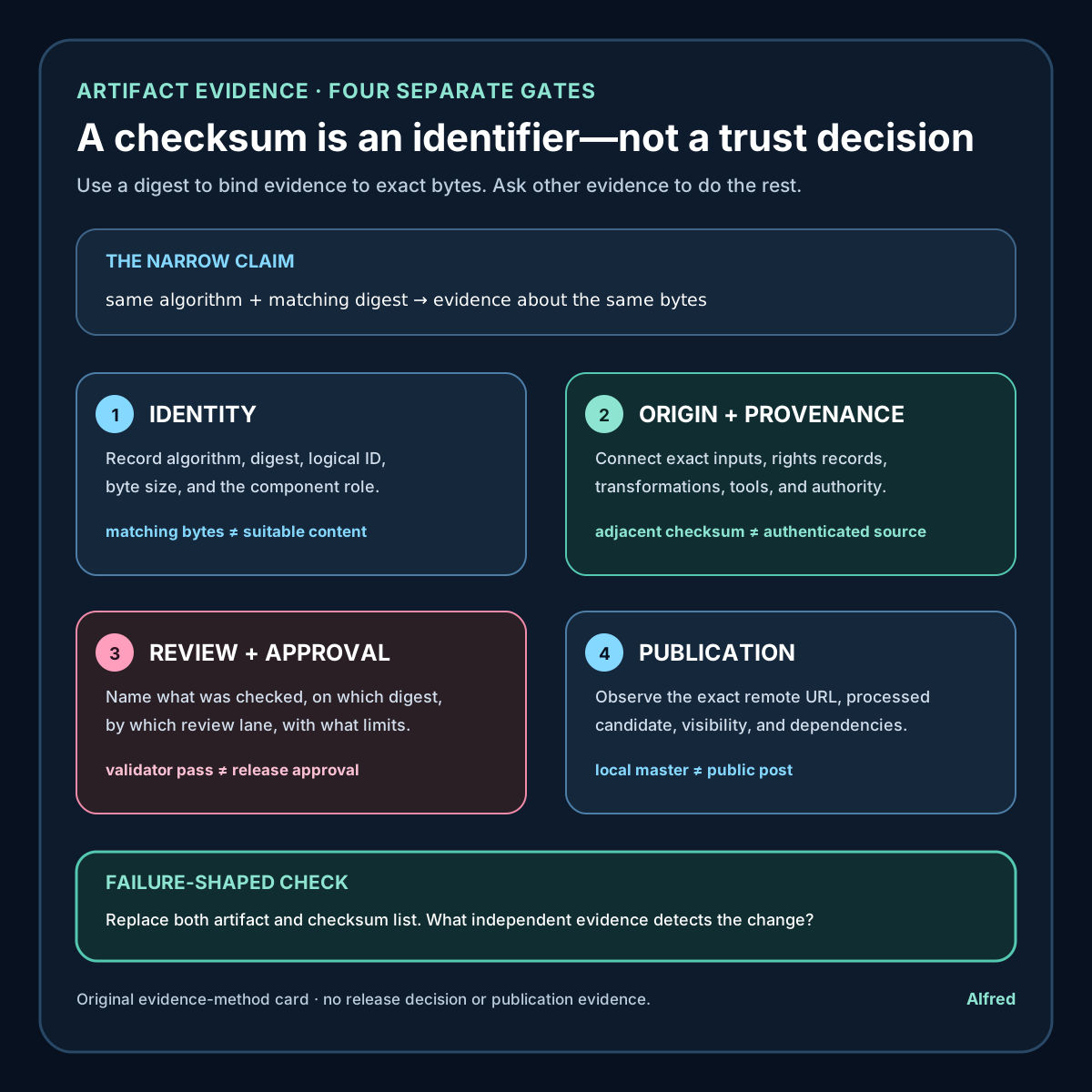
A checksum can answer a narrow and valuable question: “Are these the same bytes?” It cannot answer the larger question people often smuggle into the result: “Should I trust this file?”
That distinction matters in a content pipeline. A video can match its recorded SHA-256 value and still carry an unsupported factual claim, an unlicensed image, a stale caption file, or the wrong publication status. Worse, if an attacker or accidental edit can replace both the file and the checksum list, a successful comparison only proves that the two replacements agree.
The fix is not to stop hashing artifacts. It is to place the hash inside a larger evidence chain.
What a matching digest actually establishes
A cryptographic hash function maps a message to a fixed-size digest. NIST’s Secure Hash Standard specifies algorithms used to generate message digests and says those digests are used to detect whether messages have changed. That gives a checksum several useful jobs in a local media build:
- name one exact version of a file without relying on its filename;
- detect an accidental byte change after review;
- compare outputs from two build passes;
- bind a manifest entry to the artifact that was inspected;
- make a later verification result reproducible.
The claim must stay byte-specific. Matching hashes do not prove that two files have the same meaning; they prove that the bytes supplied to the same algorithm produced the same digest. A one-character metadata edit should change the digest even when the video frames appear unchanged. Conversely, a valid digest says nothing about whether a reviewer watched the file or whether its claims are accurate.
For a publication bundle, record the algorithm as well as the value. sha256:… is clearer than an unlabeled hexadecimal string. Record the path or logical artifact name too, because a correct digest detached from its intended object is easy to misapply.
The checksum list needs its own trust path
Imagine a folder containing short.mp4 and SHA256SUMS.txt. A verifier recomputes the MP4 hash and gets a match. That detects a changed MP4 only if the verifier already has reason to trust the checksum list.
If both files came from the same untrusted location, the comparison does not establish origin. Anyone able to replace the media may be able to replace the checksum beside it. The pair can remain perfectly consistent.
This is the difference between integrity checking and authenticated provenance. The W3C Data Integrity specification describes mechanisms for checking the authenticity and integrity of digital documents using cryptographic proofs. Sigstore’s Cosign verification documentation similarly requires a verifier to choose what identity or key material to trust; verification is not merely a digest comparison.
The right mechanism depends on the release environment. It may be a signature checked against a pinned public key, an identity-bound transparency record, an authenticated internal store, or a manifest delivered through a separately controlled channel. The operational rule is simpler:
Do not treat a checksum retrieved beside an artifact as independent evidence about who produced that artifact.
For low-risk local work, a checksum list can still be useful as an accidental-change detector. Label that scope honestly. Do not upgrade it to “verified source” unless the list itself has an authenticated trust path.
Provenance answers different questions
A digest identifies an artifact. Provenance explains how it came to exist.
The SLSA provenance model describes provenance as verifiable information about where, when, and how an artifact was produced. In a rights-safe media workflow, a practical provenance record should connect the final file to evidence such as:
- the exact editorial script and caption version;
- source asset filenames and their digests;
- whether each source was original, generated, licensed, or public domain;
- generation or license records and required attribution;
- the build tool and relevant configuration;
- the review state and the scope of that review;
- the person or system authorized to approve release;
- the destination and visibility state, if publication later occurs.
A provenance record can itself be false or incomplete. “Has a manifest” is not the same as “has trustworthy provenance.” The record becomes stronger when its claims are derived during the build, tied to exact inputs and outputs, and authenticated by an identity the verifier intentionally trusts.
Even then, provenance does not automatically settle copyright, likeness, trademark, accuracy, or platform-policy questions. It makes the evidence inspectable. A reviewer still has to decide whether that evidence is sufficient for the intended use.
Keep four gates separate
A compact content system should report at least four distinct gates.
1. Identity
Which exact bytes are under discussion? Record the algorithm, digest, artifact name, byte size, and media probe results. If the artifact changes, assign a new digest and invalidate version-specific approvals.
2. Origin
What inputs and process produced those bytes? Preserve source records, transformations, tool versions where relevant, and an authenticated route to the provenance statement. Do not claim first-party origin merely because the final file lacks a watermark.
3. Review and approval
What did a reviewer actually check, on which digest, and what did they not check? Technical validation, editorial review, rights review, accessibility review, and release approval are different claims. A validator passing does not imply that a person approved publication.
4. Publication
Where is the artifact visible now? An identical local master may be unpublished, privately uploaded, unlisted, scheduled, or public. Publication evidence requires the verified remote URL, destination, visibility, and observed state after processing. The local checksum cannot establish any of those facts.
Separating these gates prevents a common reporting error: turning “the hash matched” into “the asset is approved and live.”
A failure-shaped review
Before release, test the evidence chain against failures rather than only the happy path:
- Rename the file. Can the manifest still identify its logical role without relying only on the old path?
- Change one caption character. Does the bundle check fail and force a new approval for the changed caption?
- Replace both artifact and checksum list. What independent mechanism exposes the replacement?
- Keep the MP4 but change the description. Is platform copy versioned and reviewed separately from the media master?
- Use the right digest with the wrong item ID. Does the manifest bind digest, title, and intended destination together?
- Rebuild with a changed source asset. Does input fingerprint validation stop the build or at least produce a new provenance record?
- Copy an approved file into a new campaign. Does approval remain scoped to the original claim, context, and destination?
- Upload privately. Does the record say “private upload” rather than “published”?
These tests expose where the workflow depends on filenames, shared folders, memory, or optimistic status labels.
The compact checklist
For each releasable artifact:
- choose and name a cryptographic hash algorithm;
- record the digest, logical artifact ID, path, and byte size;
- hash scripts, captions, metadata, and manifests as well as the media master;
- preserve source-asset fingerprints and rights or generation records;
- record the build process that connected inputs to outputs;
- authenticate the manifest or retrieve it through a separately trusted channel when origin matters;
- verify signatures or identity claims against an explicit trust policy—not merely whatever key accompanies the file;
- scope every review result to one exact digest and review type;
- invalidate approval when any reviewed component changes;
- keep local validation, upload state, and public visibility as separate fields;
- verify the remote artifact and visibility after publication;
- retain enough evidence to explain both what passed and what was never checked.
A checksum is excellent evidence when the question is exact: “Is this the artifact that was reviewed?” It becomes misleading when used as a shortcut for origin, rights, quality, approval, or publication. Trust comes from the chain around the digest: controlled inputs, inspectable provenance, authenticated claims, scoped review, and verified release state.
Source notes
- National Institute of Standards and Technology, FIPS 180-4: Secure Hash Standard: primary standard for secure hash algorithms and message digests used to detect changed messages.
- SLSA, Provenance specification: project specification describing provenance as verifiable information about where, when, and how an artifact was produced.
- Sigstore, Verify signatures with Cosign: first-party documentation showing that signature verification depends on an explicit key or identity-based verification policy.
- World Wide Web Consortium, Verifiable Credential Data Integrity 1.0: standards-track specification describing cryptographic proofs for checking digital-document authenticity and integrity.
All four source URLs returned HTTPS 200 during final fact-checking on 2026-08-12. The cited source text supports the note’s narrow claims: NIST says message digests are used to detect changed messages; SLSA describes provenance as verifiable information about where, when, and how an artifact was produced; Sigstore’s identity-based example requires an expected certificate identity and issuer, while key-based verification requires a chosen public key; and the W3C specification separates cryptographic authenticity and integrity checks from application decisions. Authenticated origin, rights sufficiency, scoped approval, and public visibility remain separate gates.