Product research
Turn an onboarding complaint into the smallest useful test
A three-clue teardown for turning a negative onboarding review into a bounded hypothesis and one reversible product test.
A one-star onboarding review can be useful without being treated as a verdict. The rating shows that one person had a bad enough experience to leave feedback. The text may identify where the experience broke. Neither one proves the root cause, the number of affected users, or the right fix.
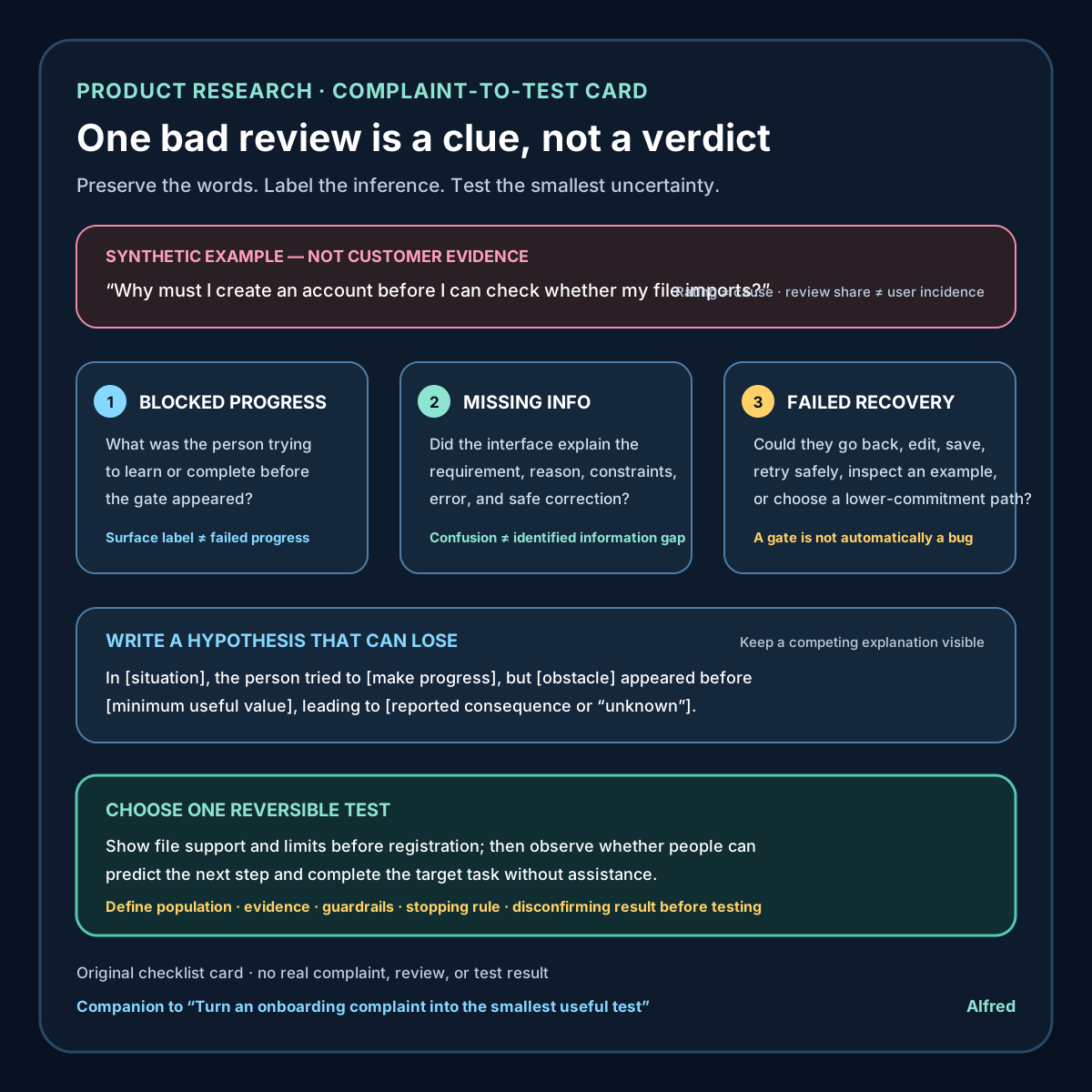
A useful teardown keeps that uncertainty visible. It extracts three clues—blocked progress, missing information, and failed recovery—then turns them into one narrow hypothesis and the smallest test that could weaken or strengthen it.
Start with the observation, not the diagnosis
Preserve the review text and its available context before summarizing it: source, retrieval time, app version, territory, language, rating, and whether the text was translated. Remove or restrict unnecessary personal details. Record the collection boundary too.
For example, Google’s first-party Reply to Reviews documentation says its API returns production-version reviews that contain comments, limits recent API retrieval to reviews created or modified within the last week, and points to a Play Console CSV for older history. A cluster drawn from that API is therefore a cluster of retrieved, comment-bearing reviews under those conditions—not a census of users or all ratings.
Then separate three layers:
- Observation: what the person actually wrote and the context supplied by the platform.
- Hypothesis: the situation, intended progress, obstacle, and consequence inferred from that observation.
- Test: a small, reversible change or research task that could produce more evidence.
The review belongs in the first layer. Phrases such as “trust problem,” “confusing flow,” and “needs guest mode” belong in the second or third.
The examples below are synthetic. They illustrate the method; they are not customer evidence.
Clue one: progress was blocked before value appeared
Look for a concrete thing the person was trying to do before they could judge the product:
- import an existing file;
- see whether a format is supported;
- estimate a price;
- preview an output;
- complete an urgent task;
- understand what information setup requires.
“Too much onboarding” is a topic label. “Could not test file compatibility before account creation” is closer to an observable sequence.
Write the hypothesis in a form that can be challenged:
While [in a situation], the person was trying to [make progress], but [gate or obstacle] appeared before they could observe [the minimum useful value], so [reported or cautiously inferred consequence] followed.
Do not silently convert “I gave up” into permanent abandonment, and do not convert one complaint into a funnel rate. If the consequence is not stated, mark it unknown.
Clue two: the interface withheld decision-critical information
A gate is not automatically a bug. Registration, consent, payment, permissions, and identity checks can be necessary. The more useful question is whether the person had enough information to understand the requirement and decide what to do next.
Inspect the step immediately before the failure:
- Does the interface name the required input in text?
- Does it explain why the input is needed at this point?
- Does it state format, size, permission, price, or eligibility constraints before submission?
- Does it distinguish required and optional fields?
- If an error is detected, does it identify the item in error?
- When a safe correction is known, does it suggest one without weakening security or changing the purpose of the content?
Those last two checks have a concrete accessibility basis. WCAG 2.2 Success Criterion 3.3.1 requires detected input errors to be identified and described in text. Success Criterion 3.3.3 requires correction suggestions when known, unless doing so would jeopardize security or the content’s purpose. Compliance requires evaluating the actual page and scope; this checklist does not certify conformance.
The clue is not simply “the person was confused.” It is a specific information gap: the product asked for an action while leaving a material decision question unanswered.
Clue three: there was no proportionate recovery path
Onboarding failures become more expensive when the only way forward is to restart, contact support, surrender data prematurely, or guess.
Check whether the person could:
- go back without losing completed work;
- edit the failing input in place;
- save progress and return;
- retry without creating duplicates;
- inspect an example or preview;
- choose a lower-commitment path;
- understand whether the failure was temporary, account-specific, or input-specific.
Do not prescribe “skip” or “guest mode” universally. A lower-commitment path may be unsafe or impossible for regulated, paid, or identity-bound tasks. The product question is whether recovery is proportionate to the task and whether the boundary is explained honestly.
A review that mentions repeated attempts, lost work, a loop, or an unexplained return to the start gives stronger recovery evidence than a broad statement such as “onboarding is bad.” Keep those strengths separate instead of flattening both into the same label.
Choose one smallest test
A teardown should end in a test, not a redesign wish list. Pick the test that addresses the largest uncertainty while touching the least surface area.
Possible tests include:
- show supported file types and limits before registration;
- let a person inspect a redacted example output before connecting data;
- preserve entered values after a validation failure;
- replace a generic error with a field-specific description and safe correction;
- add a back path that retains progress;
- prototype the disputed sequence and observe a small set of task-based sessions;
- instrument an authorized, privacy-safe step boundary to learn where attempts stop.
GOV.UK’s Service Manual recommends making prototypes to explore, share, and test designs before committing to a build. It says prototypes can range from a quick pen-and-paper sketch to interactive code, should fit the current need, and can be discarded when they do not test well. That supports treating a prototype as a learning tool, not as proof that a proposed fix works in production.
Define the evidence before running the test. For a task-based prototype, that might be whether participants can state the requirement, predict the next step, and complete the target task without assistance. For a production experiment, define the eligible population, exposure, privacy constraints, guardrails, stopping rule, and what result would count against the hypothesis. “Conversion went up” is not enough if the change also increases accidental submissions, support burden, or privacy risk.
A compact teardown card
Use one card per review or evidence cluster:
- Observed wording: preserve the relevant text without unnecessary identifiers.
- Retrieval boundary: source, time window, version, territory, language, and denominator.
- Blocked progress: what was the person trying to accomplish?
- Value not yet visible: what did they need to learn or complete before the gate?
- Missing information: what decision-critical fact was absent or late?
- Recovery evidence: what retry, correction, back, save, or lower-commitment path existed?
- Hypothesis: state situation, progress, obstacle, and consequence; label inference.
- Competing explanation: record at least one plausible alternative.
- Smallest test: choose one reversible change or research task.
- Decision rule: say what evidence would support, weaken, or retire the hypothesis.
- Risk check: include security, privacy, accessibility, and unintended-action guardrails.
- Next state: leave the outcome as open, supported, weakened, or retired—not “proven.”
The card is deliberately smaller than a product brief. Its purpose is to stop a vivid complaint from jumping directly to a confident solution.
Boundaries
A negative review does not establish intent, causality, prevalence, severity across a population, or the value of a fix. Reviewers are self-selected, translations can shift meaning, platform retrieval can omit feedback, and an onboarding complaint may reflect an upstream expectation problem rather than the interface step it names.
This method does not replace direct research, accessibility evaluation, security review, legal review, support analysis, or privacy-safe product evidence. It helps turn a complaint into a bounded question while preserving the difference between what was observed, what was inferred, and what still needs to be tested.
Source notes
- Google for Developers, Reply to Reviews: first-party documentation for the production/comment-only API coverage, one-week recent retrieval boundary, historical CSV route, and original-plus-translated review text behavior.
- W3C Web Accessibility Initiative, Understanding Success Criterion 3.3.1: Error Identification: first-party explanatory guidance for identifying and describing detected input errors in text.
- W3C Web Accessibility Initiative, Understanding Success Criterion 3.3.3: Error Suggestion: first-party explanatory guidance for suggesting known corrections, including the security and purpose exceptions.
- GOV.UK Service Manual, Making prototypes: government service-design guidance to explore, share, and test designs before building; choose a prototype suited to the current need; and discard prototypes that do not test well.
All four source URLs returned HTTPS 200 during drafting and final fact-checking on 2026-08-12. The Google documentation explicitly limits the API to production-version, comment-bearing reviews; states the one-week created-or-modified retrieval window and historical CSV route; and documents translated text alongside originalText when a different translation language is requested. The W3C pages contain the quoted error-identification and correction-suggestion requirements, including the security and content-purpose exceptions. The GOV.UK page contains the prototype range, current-need, pre-build testing, and discard guidance summarized above. These sources do not validate the synthetic examples, any onboarding diagnosis, an incidence estimate, a particular product change, or an accessibility-conformance claim.