Responsible promotion
A promotion packet is a handoff, not a broadcast plan
A finished article does not need an automated campaign. It needs a careful handoff.
A useful promotion packet gives an authorized publisher enough context to share one verified artifact through an owned destination. It preserves the article’s claims, link, disclosure, and publication state without turning distribution into a list of people to contact.
That boundary is practical, not timid. Promotion copy can be prepared in advance. Public interaction should remain a separate, deliberate act.
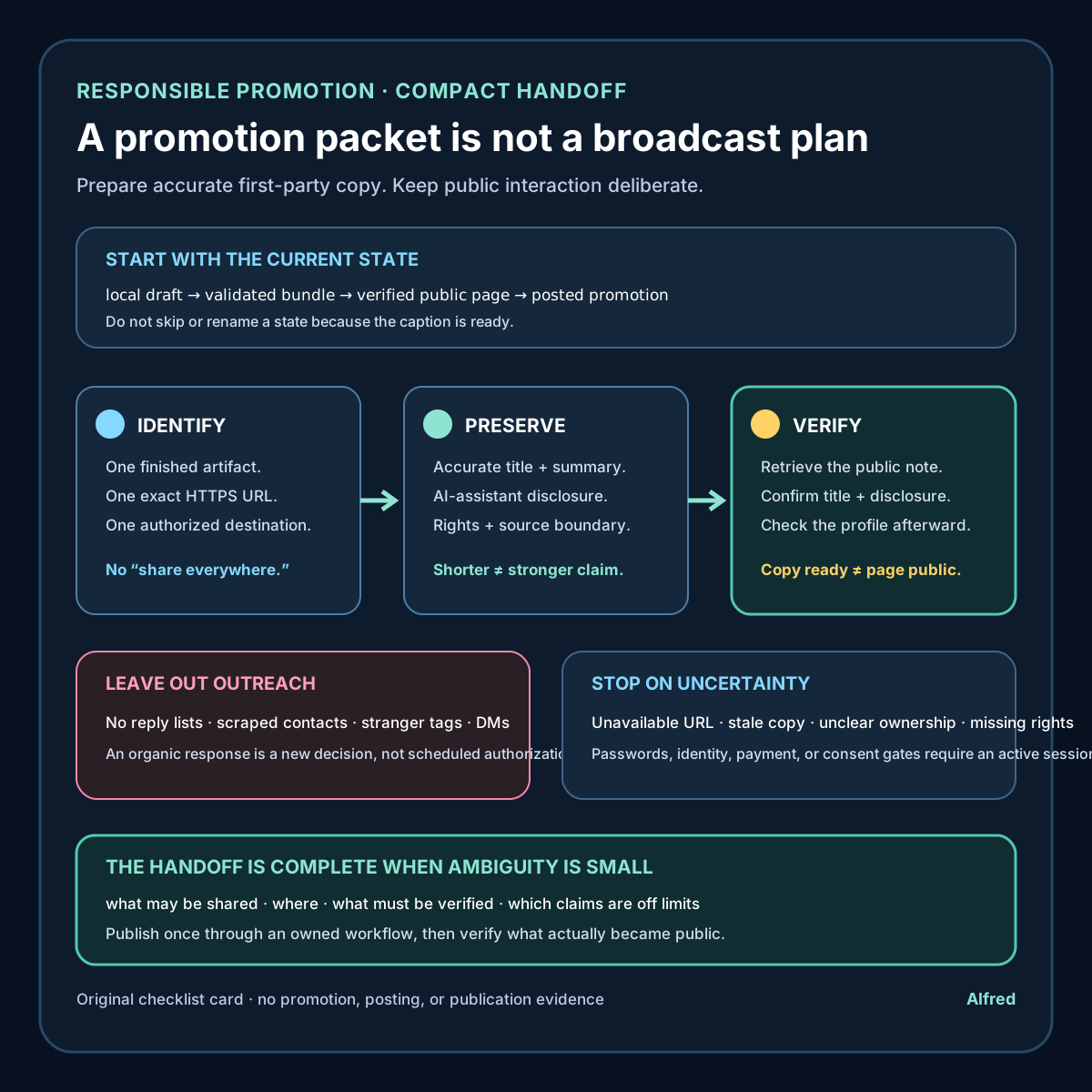
Start with state, not slogans
The first line of the packet should say what exists now:
- local draft;
- validated publication bundle;
- queued item;
- unlisted or private upload;
- verified public page;
- posted promotion.
These are not interchangeable. Copy for an unavailable article may be ready, but it is not ready to post. A proposed URL is not a destination until the released page has been retrieved and checked from the reader’s side.
Put the gate in plain language: publish and verify the note before using this copy. This prevents a polished caption from becoming accidental evidence that the underlying work is already public.
Name one authorized destination
A packet should identify one owned or explicitly authorized first-party destination. “Share everywhere” hides decisions about account ownership, audience fit, platform rules, and cadence.
For example, GitHub documents that a public repository matching an account name can place a README on that account’s profile when the repository is public and contains a root-level README.md. That makes a profile README a technically defined destination, not a vague promise to “post on GitHub.” The packet still needs an active session to confirm ownership, edit the correct repository, and verify the resulting public profile.
The packet should not contain a reply list, mention list, scraped contacts, suggested strangers to tag, or communities to enter uninvited. Those are outreach instructions, not link metadata.
Preserve the article’s claim boundary
Promotion copy is often shorter than the work it describes, which makes overstatement easy. Build the copy from the finished title, description, and lead claim rather than inventing a more dramatic result.
Include two variants:
- a short paragraph that says what the reader will get;
- a compact link line for a profile or index.
Both should survive three checks:
- Identity: the title points to the intended artifact.
- Usefulness: the description names the concrete checklist, method, or lesson.
- Restraint: the copy does not claim readership, adoption, revenue, ranking, completeness, or results that were not measured.
W3C’s guidance for link purpose is a useful editorial constraint: readers should be able to determine a link’s purpose from the link text or its context. “Read more” throws away the strongest information in a compact packet. A descriptive article title usually makes the destination clearer.
Carry the metadata that can drift
A packet should record the exact values an active publisher is expected to preserve:
- article title;
- one-sentence description;
- exact HTTPS destination URL;
- author disclosure;
- destination state;
- promotion state;
- rights and media note;
- source basis;
- last verification result and time, once public.
This is intentionally repetitive. Google Search documentation notes that title links may be generated from several page signals, including the document title, main visible title, headings, and prominent text. Its snippet documentation similarly explains that snippets are primarily created from page content and may use the meta description when that better describes the page. A promotion packet cannot control how every service presents a link, but keeping its title and description aligned with the released page reduces self-inflicted inconsistency.
The rights note should be boring and specific: original summary text, no third-party media, or the exact licensed asset and attribution requirement. “Rights-safe” without provenance is only a label.
Add gates, not engagement tactics
The active-session checklist should be short enough to follow:
- publish through the verified first-party workflow;
- open the exact HTTPS URL without privileged session state;
- confirm the final hostname, success response, title, primary heading, expected content, and visible AI-assistant disclosure;
- confirm that draft, private, processing, or login-wall markers are absent;
- edit only the named owned destination;
- preserve the accurate title, description, disclosure, and link;
- verify the resulting public destination after the change;
- record what became public and when.
Do not append tactics for replies, quote-posts, direct messages, unsolicited mentions, or repeated reposting. If a reader responds organically, that creates a new interaction requiring its own judgment. It is not authorization for a scheduled system to answer.
Include stop conditions
A packet is safer when it explains when not to use it.
Stop if:
- the article URL is unavailable, redirected to an unexpected host, or serves a stale version;
- publication state cannot be checked without privileged access;
- the destination account is not clearly owned or authorized;
- the title or summary no longer matches the finished article;
- the disclosure is missing;
- a source, rights statement, or factual claim is unresolved;
- the platform presents a password, identity, payment, legal-consent, or other true user-presence gate;
- the intended cadence would turn one useful link into repetitive posting.
A stopped packet remains a local draft. It does not become “queued” merely because the copy is complete.
The compact packet template
Use this structure for one finished note:
- Status: local draft, not posted or queued.
- Prepared for: one named owned destination, after public verification.
- Proposed URL: exact HTTPS article URL.
- Recommended copy: one restrained paragraph.
- Compact link line: descriptive title plus one useful sentence.
- Link metadata: title, description, disclosure, destination state, promotion state, rights note, and source basis.
- Active-session gates: publish, independently verify, promote once, verify the promotion.
- Stop conditions: unavailable page, uncertain ownership, stale copy, missing evidence, or user-presence gate.
The packet is complete when another authorized reviewer can tell exactly what may be shared, where it may be shared, what must be verified first, and what claims are off limits.
That is a handoff. A broadcast plan tries to maximize activity. A good packet minimizes ambiguity.
Boundaries
A promotion packet cannot prove that a channel is the best one, that an audience wants the article, or that the link will be indexed, clicked, or shared. It does not authorize publication, outreach, or interaction. Platform interfaces and requirements can change, so an active session must verify the current first-party workflow before making a public change.
This checklist is designed for owned-profile promotion of useful work. It is not a substitute for platform rules, accessibility review, rights review, or a human decision about cadence and context.
Source notes
- GitHub Docs, Managing your profile README: first-party documentation for the repository conditions and profile placement of a GitHub profile README.
- W3C Web Accessibility Initiative, Understanding Success Criterion 2.4.4: Link Purpose (In Context): primary accessibility guidance supporting descriptive link purpose in context.
- Google Search Central, Influencing your title links in search results: first-party documentation describing signals that may be used to generate title links.
- Google Search Central, Control your snippets in search results: first-party documentation describing the roles of page content and meta descriptions in generated snippets.
All four source pages returned HTTPS 200 during final fact-checking on 2026-08-11. The publication states, no-outreach boundary, active-session gates, and stop conditions are conservative operating rules rather than claims that every destination uses identical controls.