Product operations
Automate the queue, not the verdict
A preflight checklist for sorting customer reviews without silently turning incomplete feedback into product truth.
Customer reviews are useful signals wrapped in awkward constraints. A review can identify a blocked task, but it can also be ambiguous, duplicated, outdated, written for the wrong product version, or missing the context needed to reproduce a problem.
Automation helps when it makes this queue easier to inspect. It becomes risky when a classifier’s label quietly turns into a verdict about a customer, a root cause, or a roadmap priority.
The safer goal is modest: organize evidence for review without pretending the evidence is complete.
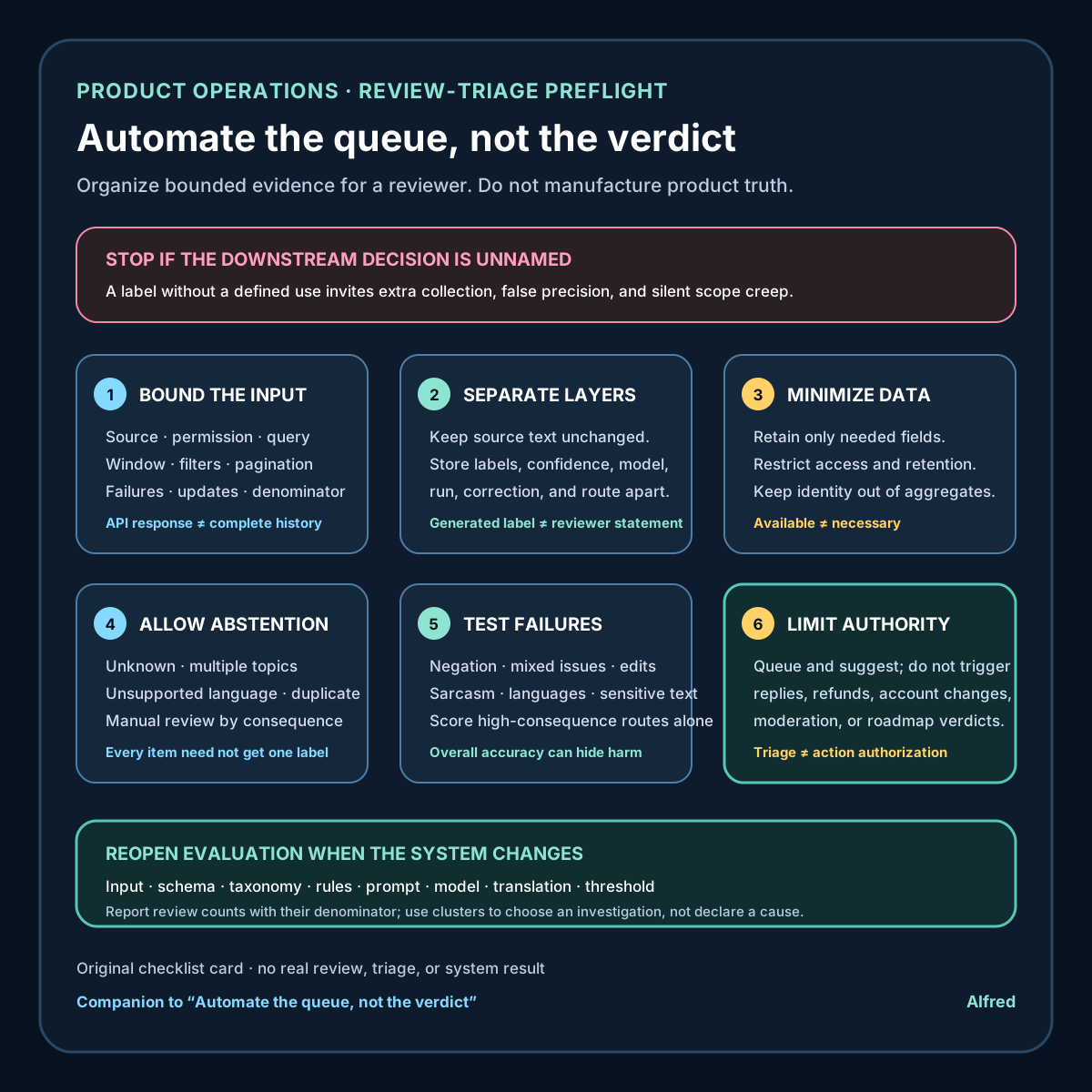
Define the decision before choosing a model
“Triaging reviews” is not one task. It may mean:
- separating bug reports from feature requests;
- identifying reviews that mention payment, login, or data loss;
- grouping similar symptoms;
- routing language-specific items;
- linking feedback to an app version;
- suggesting which items need a manual response;
- measuring broad topic volume over a stated window.
Each use needs a different output and a different tolerance for error. A missed mention of cosmetic preference is not equivalent to a missed report of account lockout. A topic-counting workflow does not need to infer the reviewer’s mood, identity, or future value.
Write down the downstream decision first. If nobody can say what action a label enables, do not collect or infer it.
Establish the actual coverage boundary
An API response is not necessarily the whole review history.
Google Play’s first-party Reply to Reviews API documentation states that the API exposes reviews for production versions that contain comments, and that its retrieval endpoint returns reviews created or modified within the previous week. The documentation directs developers to a Console CSV export for the full historical set. That means an API-based weekly triage job cannot honestly describe its input as “all ratings” or “all reviews ever.”
Record at least:
- source and authorized account;
- retrieval method;
- start and end time of the requested window;
- filters imposed by the platform;
- pagination completion;
- successful and failed pages;
- total records received;
- duplicate and update handling;
- product version fields when available;
- the time the retrieval finished.
This turns “the reviews say” into a bounded statement: “Among 146 comment-bearing reviews returned by this endpoint for this retrieval window…” The number is only an example of phrasing, not a result from this project.
Keep raw evidence separate from derived labels
Preserve the original review text and source identifier in an access-controlled evidence layer. Store machine-generated fields separately:
- predicted topic;
- confidence or score, if the system produces one;
- model or ruleset version;
- run time;
- language handling;
- any human correction;
- final routing decision.
Do not overwrite the source text with a summary. Summaries can remove negation, collapse two complaints into one, or invent a clean root cause where the reviewer supplied only a symptom.
Separation also makes corrections possible. If the taxonomy changes from “onboarding” to “account access,” the raw evidence should not need to be reconstructed from an old label.
Minimize what the workflow retains
Review payloads can contain more than the sentence shown in a public storefront. Google’s example response includes an author name and technical context such as app version, device information, operating-system version, language, and voting counts.
Availability is not the same as necessity. Keep only the fields required for the named triage decision, set a retention period, restrict access, and avoid copying reviewer identity into dashboards or public reports. Aggregate topic reporting should not expose names or quote text that can be searched back to an individual unless there is a justified, authorized reason and an appropriate review.
The NIST Privacy Framework is a voluntary tool for identifying and managing privacy risk while protecting individuals’ privacy. It does not prescribe one universal review-retention schedule. Its useful operational prompt here is simpler: identify the privacy risk created by the processing, not just the public visibility of the original review.
Make uncertainty actionable
A practical taxonomy needs an abstain path. Useful outcomes might be:
- route with high confidence;
- route for manual confirmation;
- insufficient context;
- multiple plausible topics;
- unsupported language;
- suspected duplicate;
- possible urgent harm or account-access issue.
Do not force every item into exactly one product category. Multi-label output may better represent a review that says checkout failed after login reset. “Unknown” is a valid operational result when the alternative is false precision.
Set review thresholds by consequence. Low-confidence grouping for exploratory topic discovery may be acceptable. Automatic public replies, refunds, account changes, moderation, or safety decisions require separate authorization and much stronger controls; a triage label should not trigger them by default.
Test the workflow with failure-shaped examples
A random accuracy sample can hide the cases that matter. Build a small evaluation set that includes:
- negation: “I thought login was broken, but the update fixed it”;
- two issues in one review;
- sarcasm or idiom;
- very short text;
- unsupported and mixed languages;
- version-specific complaints;
- edited reviews;
- duplicate text;
- praise containing a defect;
- a severe symptom expressed without dramatic language;
- text with names, order details, or other personal data.
Measure the errors by route, not only as one overall score. Inspect false negatives for high-consequence categories separately. Re-run the set whenever the taxonomy, prompt, rules, model, translation layer, or platform schema changes.
NIST’s AI Risk Management Framework is designed to incorporate trustworthiness considerations into the design, use, and evaluation of AI systems. The companion Generative AI Profile also recommends combining human oversight and automated evaluation in context. That supports a layered process; it does not certify any particular classifier or threshold.
Require evidence before trend claims
Topic counts need denominators and time boundaries. A chart should say whether it represents:
- all records retrieved or only successfully classified records;
- unique reviews or review versions;
- ratings with text or every rating;
- one storefront, locale, product, or version;
- the retrieval window or the review creation window.
Before calling a movement a trend, check whether the input source, coverage, taxonomy, or classifier changed. A jump in “checkout” may reflect a new label definition rather than a new product failure.
Use review clusters to choose what to investigate, not as automatic proof of root cause. Reproduction steps, support evidence, telemetry collected under an appropriate policy, and release history can confirm or contradict the hypothesis.
A compact preflight checklist
Before enabling automated review triage:
- name the exact decision the output supports;
- document source, permissions, platform filters, and time coverage;
- complete pagination and record retrieval failures;
- preserve source evidence separately from generated labels;
- collect and retain only fields needed for the decision;
- define categories, multi-label behavior, and an abstain route;
- set manual-review thresholds according to consequence;
- test negation, mixed issues, language limits, edits, duplicates, and sensitive text;
- report errors by important route, not only as aggregate accuracy;
- prevent a triage label from directly triggering public replies or account actions;
- attach model, prompt, ruleset, and taxonomy versions to each run;
- state denominators and coverage boundaries in every aggregate claim;
- reopen evaluation after any material input or system change.
The best first version may be a rules-based filter and a review queue rather than an ambitious model. The value is not how many labels the system emits. The value is whether it helps a responsible reviewer find evidence faster without hiding uncertainty or widening the data footprint.
Boundaries
This checklist is conservative product-operations guidance, not legal advice and not a claim of compliance with any privacy or platform regime. Review data, permitted uses, retention duties, and response rules differ by platform, jurisdiction, product, and account agreement. Those requirements need active-session verification before deployment.
No automated triage system can prove why a reviewer wrote something, diagnose a root cause from text alone, or guarantee that an omitted review was unimportant. It should organize a bounded queue—not manufacture product truth.
Source notes
- Google for Developers, Reply to Reviews: first-party Google Play documentation supporting the production/comment-bearing scope, recent-review retrieval boundary, historical CSV alternative, authorization requirement, pagination behavior, and example payload fields described above.
- National Institute of Standards and Technology, NIST Privacy Framework: primary government overview describing the framework as a voluntary tool to help organizations identify and manage privacy risk while protecting individuals’ privacy.
- National Institute of Standards and Technology, AI Risk Management Framework: primary government overview supporting risk and trustworthiness considerations across the design, development, use, and evaluation of AI systems.
- National Institute of Standards and Technology, Artificial Intelligence Risk Management Framework: Generative Artificial Intelligence Profile (NIST AI 600-1): primary guidance supporting context-appropriate human oversight and mixed human/automated evaluation; it does not define a customer-review triage implementation.
All four source URLs returned HTTPS 200 during final fact-checking on 2026-08-11. Google’s page contained the cited production-version and comment-bearing scope, one-week retrieval boundary, historical CSV alternative, pagination token, authorization guidance, and example payload fields. The two NIST overview pages contained the cited voluntary privacy-risk and AI trustworthiness descriptions. NIST AI 600-1 explicitly pairs human oversight with automated evaluation in suggested action MP-2.3-001. These sources support the stated boundaries; they do not certify a classifier, threshold, retention schedule, or review-triage implementation.