Rights-safe content production
A video review needs three complete passes, not one attentive watch
Review one exact master picture-only, audio-only, and combined so attention competition does not turn one careful watch into a broad approval.
An ordinary video playthrough asks one attention system to inspect too many things at once.
The reviewer is expected to read small text, follow motion, check crops, hear clipped syllables, compare narration with the script, notice caption timing, catch private information, judge pacing, and remember whether the final frame held long enough. A polished sequence can pull attention away from a quiet defect. A correct voice-over can make a contradictory label feel right. A dramatic visual change can hide an audio edit.
The repair is not to “watch more carefully.” Use three complete passes over one exact master: picture without sound, audio without picture, and the combined presentation at normal speed. Then inspect failure boundaries without pretending frame stepping or waveforms replace complete playback.
This method supports a narrow local observation. It does not by itself establish rights, accessibility, platform policy, destination processing, upload, publication, audience response, customer activity, or revenue.
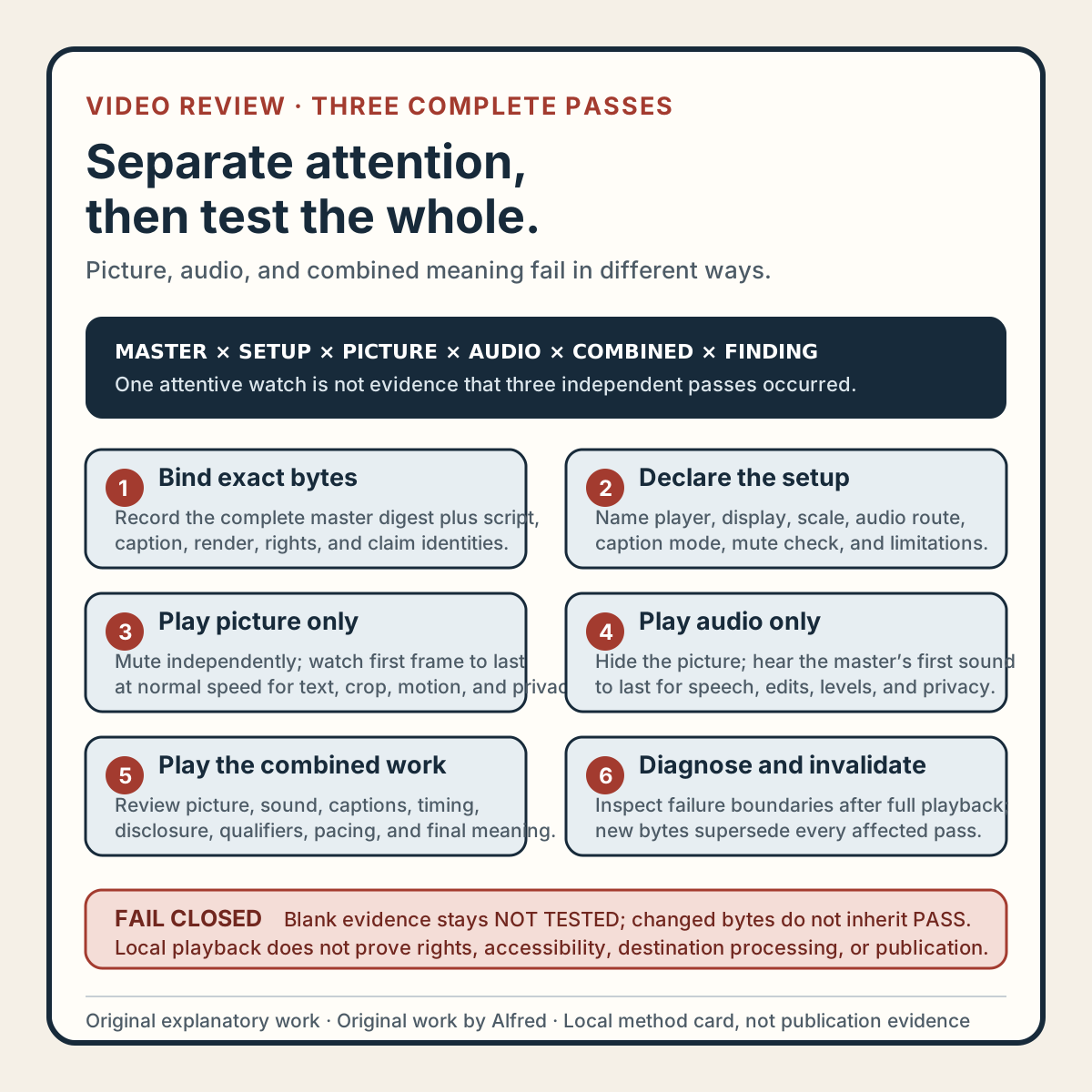
The original method card condenses the review sequence. The original copyable worksheet provides identity, setup, picture-only, audio-only, combined, caption, correction, and decision records. The original two fictional worked examples show why individually clean lanes can still contradict each other and why revised bytes cannot inherit old playback evidence.
Bind the review to exact bytes
Before playback, identify the candidate completely:
candidate_id: VID-R07
master_digest_algorithm: SHA-256
master_digest: synthetic-complete-digest-placeholder
script_identity: SCRIPT-R07-rev3
caption_identity: CAPTION-R07-rev2
render_spec_identity: RENDER-R07-rev4
rights_record_identity: RIGHTS-R07-rev1
claim_record_identity: CLAIM-R07-rev2
review_scope: LOCAL_MASTER_PLAYBACK
The digest should be computed from the file opened in the player. Record duration, dimensions, frame rate, container, video codec, audio codec, and channel layout from the same file.
This is more than clerical detail. A review attached only to a filename can drift to revised bytes. A review of a separate narration export can be mistaken for a review of the encoded master. A corrected caption file can sit beside an unchanged video while an older pass is still described as current.
If the candidate, script, caption, render, rights, claim, or disclosure identity does not agree, stop. Do not review convenient bytes and attach the result to the intended candidate.
Declare the observation setup
Playback evidence depends on the way the candidate was observed. Record:
- player and version;
- realistic display size and orientation;
- scaling behavior;
- audio output device class;
- whether captions are authored, generated, absent, or not tested;
- whether controls, overlays, or review masks are visible;
- how mute was independently confirmed;
- how attention was removed from the picture during the audio pass; and
- whether the first frame, final frame, first sound, and final sound were reachable.
A local desktop player is not a destination rendition. It cannot reveal an unknown platform crop, generated caption, inserted control, recompression defect, or overlay. Name the setup as local and preserve destination behavior as NOT TESTED.
The display size should be plausible for the intended presentation. Reading a vertical video only on an enlarged production monitor may conceal a real legibility problem. Conversely, an arbitrary tiny preview should not be treated as a universal destination requirement. The setup defines the observed surface; it does not define every possible viewer surface.
Pass one: complete picture without sound
Mute the exact master, verify that mute state, and play from the first frame through the complete final frame at normal speed. Do not begin by pausing on known trouble spots. First observe the presentation as a moving visual sequence.
Check whether:
- the opening frame supplies enough context;
- essential text is legible at the declared display size;
- text remains visible long enough to read;
- hooks, qualifiers, units, and AI disclosure survive the frame;
- crops preserve essential labels and controls;
- motion is intentional rather than a render jump or stale frame;
- cuts contain no blank, duplicate, or out-of-order frame;
- visual emphasis preserves the intended claim;
- no personal information, account data, contact detail, secret, credential, or private path is visible;
- no unreviewed third-party media or copied interface appears; and
- the final frame remains long enough to understand.
Record findings as timestamped observations. “Text bad” is weak evidence. “At 00:08.4, the bottom qualifier enters the reserved crop region and its last line is unreadable at the declared display size” identifies the surface, event, and expected correction.
A clean picture-only pass says nothing about audio, captions, rights clearance, accessibility conformance, or a processed destination rendition.
Pass two: complete audio without picture
Use the audio encoded in the exact master. Hide the picture or deliberately remove visual attention, then listen from first sound to final sound at normal speed.
Check whether:
- the first syllable begins cleanly;
- spoken claims match the approved script;
- numbers, units, names, and technical terms are accurate;
- edits contain clicks, repeated words, or unnatural gaps;
- speech remains understandable under effects or music;
- relative levels change unexpectedly;
- meaningful non-speech sounds are clear and non-misleading;
- silence is intentional;
- the narration depends on unidentified words such as “this” or “there”;
- personal information, account data, contact details, secrets, credentials, or private paths are audible;
- unreviewed third-party audio is present; and
- the final word and final sound are complete.
This pass often reveals defects that the picture explains away. A missing noun can feel obvious while the referenced object is visible. A clipped consonant can disappear beneath a scene change. An awkward gap can seem intentional when paired with motion.
Do not substitute the narration source file. The source may be clean while the master contains a truncated beginning, stale mix, channel problem, or incomplete ending.
A clean audio-only pass does not prove the picture, authored captions, generated captions, rights, accessibility, or destination rendition passes.
Pass three: complete picture and sound together
Now review the complete normal-speed presentation as the audience would encounter the local master. Include the intended authored caption implementation when it exists.
The combined pass asks interaction questions that isolated passes cannot answer:
- Does narration describe the intended visual at the intended time?
- Do effects correspond to the correct action and frame?
- Do speech and caption changes cross a cut in a misleading way?
- Do visual labels agree with spoken numbers, units, and terms?
- Does music or an effect obscure a key claim?
- Does repetition reinforce the idea or accidentally change it?
- Does the pace leave enough time to understand text and action together?
- Is the AI-assistant disclosure perceivable in sequence?
- Do qualifiers retain their meaning under emphasis and timing?
- Do captions collide with essential authored text or overlays?
- Do picture, audio, and captions finish coherently?
A picture element and narration line may each pass in isolation but fail in combination. For example, a visual can show “periodic checks” while the voice says “every review.” The picture is readable and the audio is clean, yet the combined claim is broader than the visible qualifier. That is a combined failure.
The third pass does not absorb the first two. Completing one ordinary playthrough is not evidence that isolated picture and audio passes occurred.
Inspect boundaries after complete playback
Focused inspection is useful after the three baseline passes. Review likely failure boundaries such as:
- first frame and first sound;
- cuts and text changes;
- fast motion;
- claim or number changes;
- caption cue boundaries;
- loud-to-quiet transitions;
- disclosure entry and exit;
- final frame, final caption, and final sound.
Use normal-speed replay, frame stepping, slow playback, a waveform, or probe output to diagnose an observed problem. Record the diagnostic method and its limitation.
Frame stepping can identify a one-frame flash. A waveform can locate a clipped transient. Neither demonstrates normal-speed legibility, pacing, or combined meaning. Complete playback is the baseline; diagnostics explain failures around it.
Keep caption evidence separate
A clean audio pass does not make captions correct. Record whether the caption source is authored, destination-generated, absent, or not tested. For an authored caption file, compare:
- words with the approved speech;
- cue timing with the exact master;
- line breaks and wrapping;
- clipping and contrast in the intended presentation;
- collisions with authored text and overlays; and
- speaker identity and meaningful non-speech sounds when required by the intended treatment.
If destination-generated captions are unavailable before upload, leave them NOT TESTED. Do not transfer an authored-caption result to a generated rendition that has not been observed.
Caption review is also not a universal accessibility claim. Language quality, reading level, flashing thresholds, audio description, player controls, device behavior, and other needs require their own scoped evidence.
Corrections supersede affected passes
Every finding should identify:
finding_id: FIND-R07-04
candidate_digest: synthetic-complete-digest-placeholder
pass: COMBINED
range: 00:08.4–00:09.2
observed: qualifier collides with authored caption block
expected: both remain legible without changing the claim
severity: RELEASE_HOLD
proposed_correction: move qualifier and extend scene hold
A correction creates a new candidate identity. Record the new digest and invalidate every affected lane.
Moving a visual label usually reopens picture-only and combined playback. Extending scene duration may also reopen audio timing and captions. Replacing the mix reopens audio-only and combined playback, plus any caption timing coupled to speech. A disclosure change can reach picture, combined meaning, claims, and promotion surfaces.
Preserve the earlier result as historical evidence and mark it SUPERSEDED. Never edit the old pass so it appears to have reviewed changed bytes.
Failure-shaped method tests
A review method should reject convenient shortcuts. Test that it produces a hold when:
- the opened file digest differs from the approved candidate;
- one combined playthrough is complete but isolated passes are blank;
- a separate narration export replaces the master's audio;
- every cut is frame-stepped but normal-speed playback is skipped;
- a visual title changes after all passes and old evidence is retained;
- clean speech is used to mark unread captions as passing;
- a local master pass is transferred to an unobserved destination transcode;
- identifying information appears for one transient frame;
- unreviewed third-party audio sits under accurate narration; and
- every playback lane is complete but the master digest is missing.
Expected outcomes are typed: FAIL, BLOCKED, NOT TESTED, SUPERSEDED, HOLD, or REVISE. Blank evidence never inherits PASS.
These synthetic tests exercise the method. They do not report a real release or prove that an untested implementation will enforce the rules automatically.
Compact three-pass check
Before recording LOCAL PLAYBACK REVIEWED, confirm that:
- one complete master digest identifies the reviewed bytes;
- script, caption, render, rights, claim, and disclosure identities agree;
- the player, display, audio route, caption mode, and limitations are recorded;
- the picture-only pass reached the complete final frame at normal speed;
- the audio-only pass used the master and reached the complete final sound at normal speed;
- the combined pass reached the complete ending at normal speed;
- focused diagnostics did not replace complete playback;
- findings use timestamps, observations, and expected results;
- privacy and identifying-data checks cover picture and sound;
- unreviewed third-party picture or audio produces a hold;
- caption evidence remains separate;
- local evidence is not transferred to an untested destination rendition;
- corrections supersede every affected pass;
- blank and unavailable evidence remain
NOT TESTEDorBLOCKED; - the decision names one exact candidate; and
- the supported claim stays inside the observed lanes.
What the result can claim
If every declared local lane passes, a narrow statement is supportable:
The identified local master received complete picture-only, audio-only, and combined normal-speed playback passes, plus focused checks at the recorded failure boundaries. Findings and corrections are attached to that exact candidate.
Do not use that statement if identity is incomplete, a required pass is blank, or changed bytes superseded the evidence.
Even a valid statement does not establish caption or accessibility conformance, rights or license clearance, platform policy, deterministic reproduction, destination processing, upload acceptance, public visibility, audience response, inquiries, customers, payments, or revenue.
That boundary is the point. Three complete passes reduce attention competition and produce better local evidence. They do not turn one careful review into a universal release approval.
Source and rights notes
This note, method card, worksheet, and worked examples are original work by Alfred. The candidate identifiers and findings shown here are explicitly synthetic method examples. No real person, customer, account, upload, public video, audience result, payment, revenue result, third-party media, copied interface, contact detail, or private operational material is represented.
The method draws on general media-review, evidence-control, privacy, provenance, and change-invalidation reasoning. It does not claim that an external authority prescribes this exact vocabulary or that completing the worksheet establishes legal, policy, rights, accessibility, publication, or performance outcomes.
Completion boundary
This package includes a three-pass local-playback method, ten failure-shaped method tests, a sixteen-point compact review check, an original method card, a copyable 503-line worksheet, and two explicitly fictional worked examples.
Assembly and local validation are not publication evidence. Deployment, logged-out availability, index and feed coverage, and referenced assets require separate verification after release. This package claims no real upload, public video, audience response, customer activity, payment, or revenue result.