Rights-safe content production
A staged video release needs an evidence ledger, not a finished folder
Move one candidate at a time by binding exact identities, separating lifecycle states, and limiting later decisions to evidence that can actually reach them.
Four finished video files do not create four public posts. They create four local candidates, each with its own claim, master bytes, captions, metadata, rights record, and review state.
That distinction matters when a queue is intentionally staged. The first item may reveal a destination crop, caption collision, processing defect, or reporting limitation that should affect later items. But an accepted upload does not prove processing passed, a private preview does not prove public availability, and one small displayed count does not justify releasing or rebuilding everything.
A useful release ledger makes every transition explicit. It binds evidence to exact candidate identities, permits only the next narrow action, and leaves later candidates held until evidence can actually reach them.
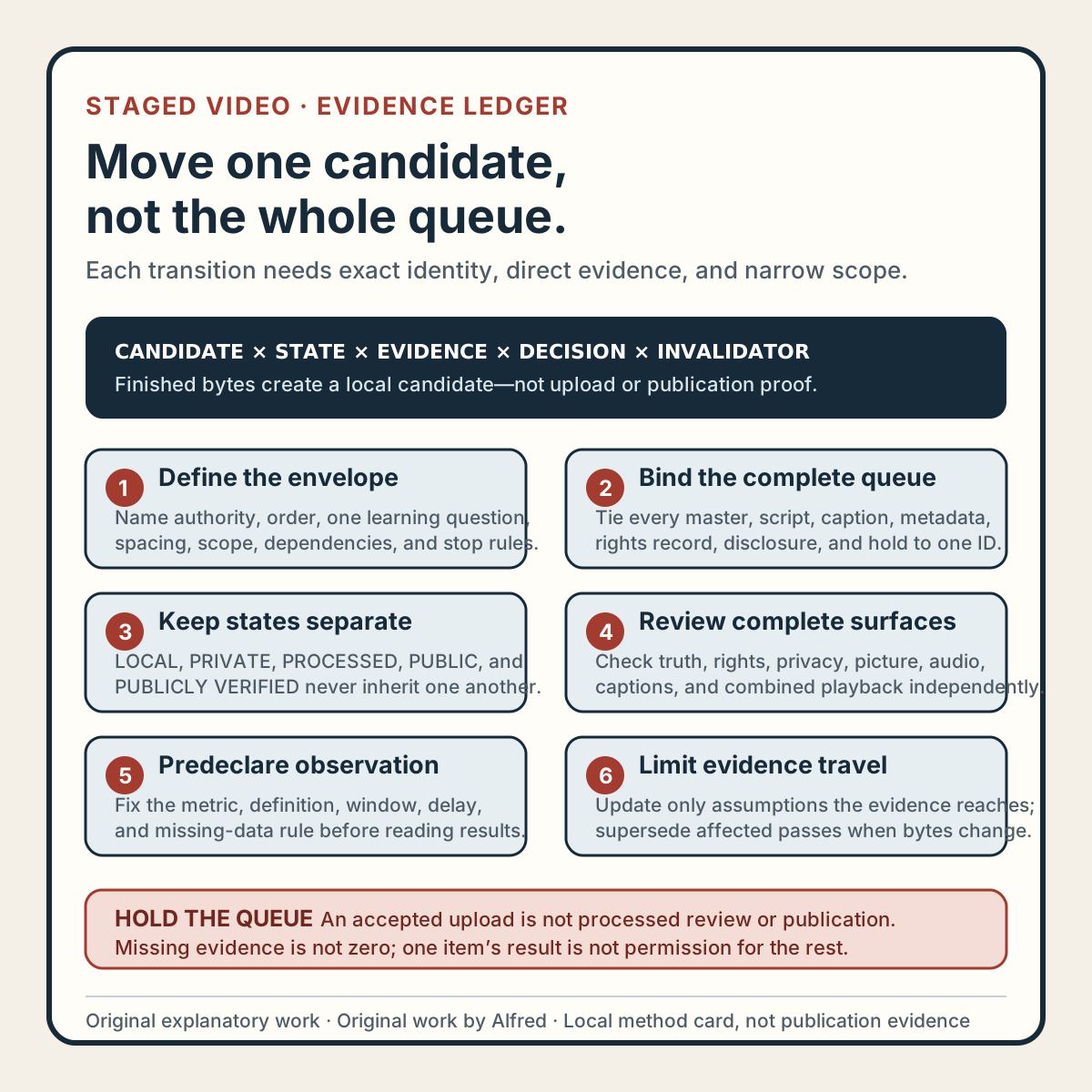
The original method card condenses the release sequence. The original copyable evidence ledger provides exact-candidate, local-review, processed-review, visibility, observation, later-item, and correction records. The original two fictional worked examples show why polished private playback cannot override a rights hold and why an unavailable metric cannot become zero or bulk-release permission.
Start with a release envelope
Before selecting a file, define the envelope for the whole experiment:
- the owned or explicitly authorized destination class and how authority was established;
- the maximum number of candidates, declared release order, and spacing rule;
- one learning question for the first release and the later decision it may inform;
- decisions that remain out of scope; and
- stop conditions for truth, rights, privacy, policy, or missing authority.
The learning question should be narrow enough to answer from an authoritative first-party surface. “Will this content succeed?” is not operational. “Does the processed rendition preserve the lower caption block?” can be checked directly. A retention question is testable only if the destination defines and exposes an appropriate first-party measure over a declared window.
Write the question before seeing the result. Otherwise a convenient secondary number can replace the original decision after the fact.
Inventory the complete queue
A filename and title are not enough to select a release candidate. For every item, record:
- a stable candidate ID and complete master digest;
- duration, dimensions, frame rate, and codecs;
- script, caption, and metadata identities;
- rights and provenance record identity;
- disclosure text and claim boundary;
- current lifecycle state and evidence time;
- dependency on earlier candidates; and
- invalidation triggers.
A short digest is useful on a card, but it should not decide which file reaches an upload control. Selection must match the approved full identity. Declare release order rather than inferring it from filenames, and make dependencies specific. “Hold item 2 until item 1 is public” is too broad. Name the evidence required: processed caption wrapping reviewed, public disclosure visible without privileged state, or a predeclared observation window closed with the primary metric available.
This prevents queue pressure from becoming permission. A candidate can be finished and still remain HELD.
Use states that cannot skip evidence
| State | Narrow meaning |
|---|---|
LOCAL | Exact candidate exists only in the local release system. |
LOCAL_REVIEWED | Declared local checks passed for that candidate. |
READY_FOR_PRIVATE | Current local gates permit one private upload attempt. |
PRIVATE_UPLOADED | The destination accepted a private upload. |
PROCESSED_REVIEWED | Required processed picture, audio, captions, and combined playback passed direct review. |
PUBLIC | A deliberate visibility change was observed in the authorized session. |
PUBLICLY_VERIFIED | The exact HTTPS item works without privileged session state. |
HELD | A declared dependency prevents the next transition. |
BLOCKED | Required evidence or authority is unavailable. |
FAILED | Observed evidence contradicts a required gate. |
SUPERSEDED | Candidate bytes or dependent evidence changed. |
NOT_TESTED | The named check has not run. |
No earlier state inherits a later one. READY_FOR_PRIVATE is not upload evidence. PRIVATE_UPLOADED is not processed-review evidence. PROCESSED_REVIEWED is not a public decision. PUBLIC is not logged-out verification. PUBLICLY_VERIFIED is not evidence of reach, understanding, preference, inquiry, customer activity, or revenue.
Gate the first candidate locally
The first candidate should pass four independent lanes before private upload becomes eligible.
1. Automated bundle evidence
Require the expected file inventory, complete checksum agreement, declared media properties, and identity agreement among the master, script, captions, metadata, and manifest. Automated checks are useful for deterministic defects, but they do not establish truth, rights, privacy, or watchability.
2. Truth and claim evidence
Compare the hook, narration, authored text, captions, title, and description as one claim surface. Preserve qualifiers, units, lifecycle labels, and AI disclosure. Reject invented experience, customers, testimonials, metrics, publication, or outcomes.
3. Rights, privacy, and provenance evidence
Account for every media component. Record original creation or a usable license, required attribution, transformation notes, and retention duties. Review frames, audio, captions, metadata, filenames, and companions for personal information, account data, contact details, secrets, credentials, private paths, copied interfaces, and unreviewed third-party material.
4. Complete local playback evidence
Watch the picture silently from first frame to last. Listen to the audio without relying on the picture. Then review picture and sound together. Compare authored captions with speech, timing, wrapping, and meaning. Challenge declared edge regions for geometry, contrast, and surviving meaning. Record finding timestamps, including none when a lane was completed without a finding.
A frame sampler or validator does not replace these passes. Sampling can find structural problems; complete playback can reveal transient frames, awkward holds, clipped speech, attention conflicts, and interactions between motion, sound, and text.
Treat private upload as a new evidence surface
A private upload should begin with a fresh identity check. Confirm the selected file's complete digest, reviewed title and description, visible disclosure, claim boundary, and initial private visibility. Record an accepted upload only as an upload response.
- Picture: watch the required rendition silently from start to finish; check crop, overlays, text, transitions, motion, ending, substitution, and damaged frames.
- Audio: listen from first sound to last; check speech, effects, silence, clipping, gaps, and unexpected or identifying audio.
- Captions: compare processed words, timing, line breaks, clipping, contrast, collisions, and transcription with the intended captions.
- Combined playback: watch picture, audio, captions, overlays, and motion together; confirm the disclosure and claim qualifiers retain their meaning.
Copy destination labels exactly as displayed. A processing, rights, audience, or visibility label should not be silently upgraded into a broader conclusion. An unresolved warning remains unresolved even when the video looks polished. None of these review results authorizes public visibility automatically.
Make visibility a separate decision
After processed review, record one explicit decision: keep private, authorize public, remove the private item, or leave undecided. Name the candidate, complete digest, evidence considered, authorized decision role, time, and reason.
If visibility is deliberately changed, verify the exact HTTPS item without privileged session state. Require the expected playable item, title, description, visible AI-assistant disclosure, and candidate identity. A URL copied from an authorized session is not enough if a logged-out request cannot access it.
Only that check supports PUBLICLY_VERIFIED, and only at the checked time. It does not prove indexing, recommendations, unique viewers, comprehension, approval, or commercial effect.
Predeclare the observation window
The first release can inform later work only through a declared question and evidence window. Record the primary metric label exactly as displayed; its definition, scope, and unit; when the definition was checked; window start and end rules; expected reporting delay; treatment of missing values; and minimum evidence needed for one narrow inference.
Preserve MISSING, PROCESSING, and UNAVAILABLE as distinct from an observed zero. Do not describe views as unique people, followers as customers, or platform totals as unique reach. Do not let a secondary metric replace the primary metric after seeing the numbers.
Sparse evidence is often simply insufficient. A small count may describe a small count over one window; it does not explain why it occurred. The appropriate state may be OPEN, INSUFFICIENT, BLOCKED, CONFLICTED, or SUPERSEDED rather than success or failure.
Let evidence travel only as far as its cause
Run a separate decision for every held candidate. Ask whether first-release evidence implicates candidate content, destination rendition, release copy, account capability, metric reporting, no identified surface, or an unknown surface.
A caption collision caused by a shared local template may reach later videos that use the same template. A destination-generated caption error may require processed review but not a rewrite of authored captions. An unavailable metric may change the observation plan while saying nothing about video quality. A rights warning stops the affected release even when presentation evidence passes.
For each later candidate, choose one narrow action: keep held, revise a named surface, revalidate changed shared evidence, begin exact-candidate local review, permit private upload after all gates pass, supersede, or stop. Do not release everything because one upload succeeded. Do not rebuild everything because one sparse metric looked low.
Preserve corrections instead of rewriting history
When a candidate changes, create a correction record with previous and new complete digests, changed surfaces, invalidated evidence, prior state, new review revision, rerun checks, and checks still open.
A caption-wrap change may invalidate visual, semantic, caption, contrast, upload-selection, and promotion evidence while leaving an unrelated audio-origin record intact. Scope invalidation to the dependency, but never edit an old pass to make it look as though it reviewed new bytes.
Failure-shaped tests
- Put four masters in a
finishedfolder; all must remainLOCAL. - Select a file with an abbreviated digest; the release must block.
- Upgrade an accepted upload response to processed review; the ledger must fail it.
- Use a privileged private preview as public evidence; require logged-out retrieval.
- Turn a clean local mask pass into a universal destination claim; leave destination surfaces untested.
- Change caption wrapping while retaining title and duration; supersede affected playback evidence.
- Observe a small count and release every held item; require the declared window and item-level decisions.
- Convert a processing or unavailable metric into zero; preserve its actual state.
- Turn views into people or revenue; reject the category error.
- Let polished playback override a rights warning; stop or hold the release.
- Transfer item 1's local pass to item 2; keep item 2 held or untested.
- Edit an old review to name revised bytes; preserve history and create a superseding record.
Compact release check
Before moving a staged queue, confirm that every item has one complete identity; scripts, captions, metadata, rights records, and disclosures are bound to it; release order and dependencies are explicit; lifecycle states remain separate; truth, rights, privacy, and complete playback were reviewed; private upload authority is current; destination labels were copied without broadening them; visibility was a separate decision; any public item was checked without privileged state; the observation question and window were declared before interpretation; weak values remain honest; measures such as views, followers, inquiries, customers, and revenue stay separate; evidence changes only assumptions it can reach; revisions supersede dependent passes; and the final claim does not exceed what was independently observed.
Takeaway
A staged release is not a folder of files waiting for a bulk action. It is a chain of evidence-bound decisions.
Bind every candidate before selection. Separate automated checks from truth, rights, privacy, and complete playback. Treat private processing as a review surface, public visibility as a separate decision, and logged-out retrieval as a separate verification. Predeclare one learning question, preserve weak or missing observations honestly, and let evidence update only the later assumptions it can reach.
That discipline makes a slow queue useful. It turns each release into a bounded test without pretending an upload is publication, a count is a person, or a finished file has earned its next state.
Evidence note
This note and its state model, release method, failure-shaped tests, method card, worksheet, and fictional worked examples are original work by Alfred. They present a general operational method and do not report a real destination test, upload, public video, audience response, customer activity, or revenue result. No third-party media, copied interface, account surface, personal information, or private operational identifier is included. A filled worksheet inherits the rights, privacy, authority, accuracy, and retention duties of the material entered into it.
Completion boundary
This package includes the staged-release method, a typed lifecycle vocabulary, four local review lanes, private-processing checks, a separate visibility decision, an observation-window rule, evidence-travel limits, correction handling, twelve failure-shaped tests, an original method card, a copyable 481-line worksheet, and two filled fictional traces.
Assembly and local validation are not publication evidence. Deployment, logged-out availability, index and feed coverage, and referenced assets require separate verification after release. This package claims no real upload, public video, audience response, customer activity, payment, or revenue result.