Rights-safe content production
A vertical-video overlay review needs adversarial masks, not one clean frame
Use explicit conservative masks to expose edge-dependent claims, then keep local layout evidence separate from destination behavior.
A clean 1080×1920 master can become hard to read after a destination adds its own controls. Captions, account labels, description affordances, action buttons, progress indicators, and device chrome can all occupy pixels that were empty in the source file.
The weak review is to open one frame, notice that nothing overlaps, and declare the layout “safe.” That only proves the frame is clear in the viewer used for that check. It does not prove the complete video remains readable through motion, that a processed rendition matches the master, or that another destination uses the same overlay geometry.
A stronger review uses adversarial masks: explicit, conservative rectangles placed over the regions that destination interfaces may reserve. The goal is not to imitate a platform perfectly. It is to make the layout fail visibly when essential content depends on uncertain edge space.
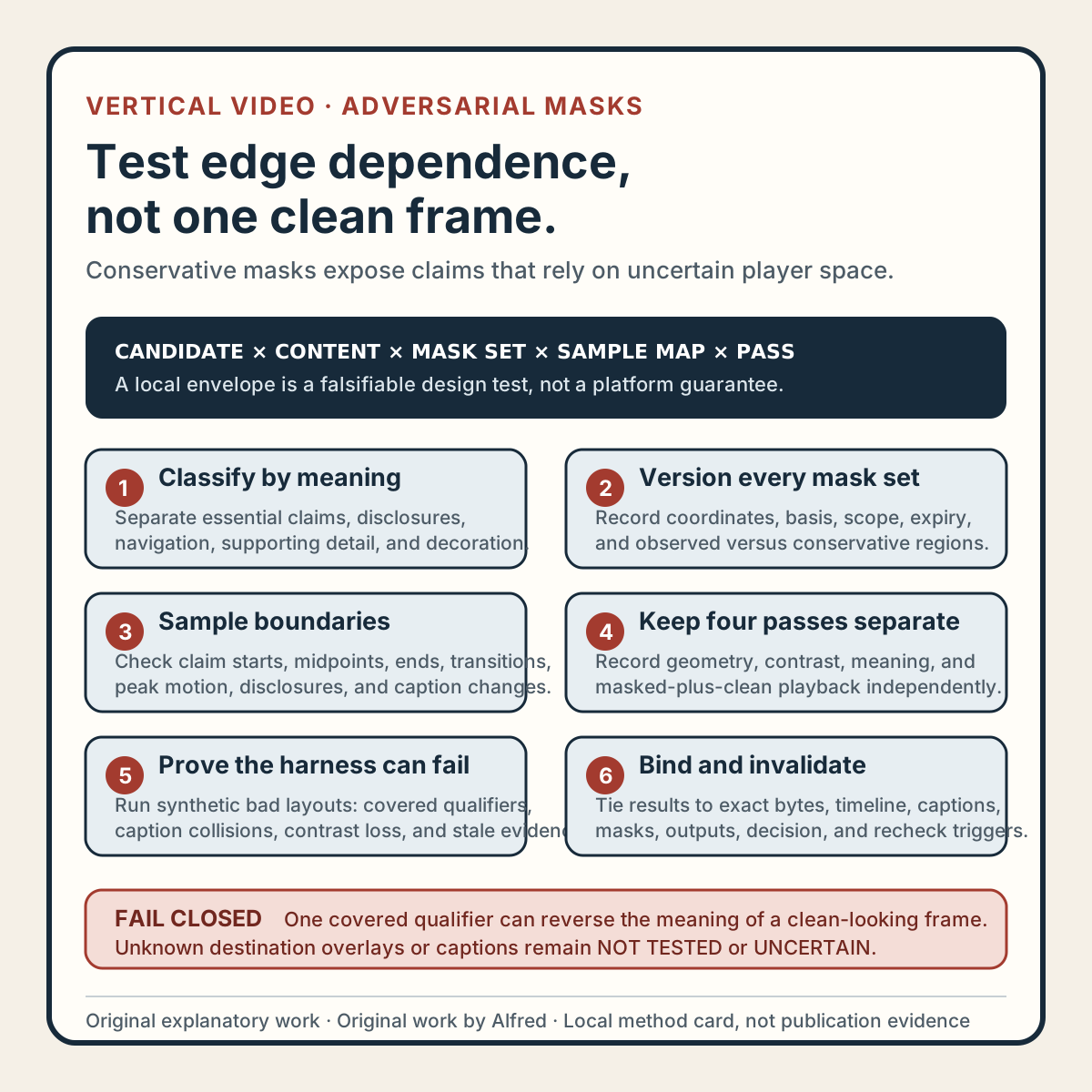
The original adversarial-mask review card condenses the method into six gates. Use the original copyable review worksheet to bind candidate identity, content classes, mask sets, sample coverage, separate review passes, captions, fixtures, decisions, and invalidation. The original two filled fictional traces exercise a covered-negation failure and a stale-report block.
Start with the claim, not the margin
A safe-zone test should distinguish essential content from decoration before measuring coordinates.
For each scene, label every visible element as one of:
- Essential claim: removing or obscuring it changes the meaning of the piece.
- Required disclosure: authorship, AI assistance, sponsorship, or another statement that must remain legible.
- Navigation cue: numbering, step labels, arrows, or progress text needed to follow the sequence.
- Supporting detail: useful context that can disappear without reversing the main claim.
- Decoration: texture, accent shapes, background motion, or redundant imagery.
This classification matters because “ninety percent of the frame is unobstructed” is not a useful result if the covered ten percent contains the only qualifier. A tiny hidden word such as “may,” “local,” or “private” can turn a careful claim into an absolute one.
Write the classification into the review record. Do not infer it later from visual prominence: large text can be decorative, while a small state label can carry the most important boundary.
Define an envelope, not a universal safe zone
There is no honest platform-independent rectangle that proves every player, device, locale, account state, and interface revision will behave the same way. Instead, define a versioned review envelope with four parts:
- Canvas identity: width, height, pixel aspect, orientation, and exact candidate digest.
- Mask set: named top, bottom, left, right, and corner regions with explicit pixel coordinates.
- Evidence basis: the local design requirement, destination guidance, or dated first-party observation that justified each mask.
- Scope and expiry: which candidate and destination assumption the result covers, and what change invalidates it.
A mask may be deliberately larger than one observed interface region. That is acceptable when it is described as a conservative design test rather than a measured platform fact. The record should say “tested against this envelope,” not “guaranteed safe on all devices.”
Keep platform-specific masks separate. Combining the largest edge from several unrelated interfaces into one unnamed shape hides the test basis and makes future corrections difficult. A reusable local baseline can coexist with destination overlays, but each should have its own identity and result.
Test every meaningful scene boundary
Checking the first frame misses most timed failures. Text can enter under a mask, move through one during a transition, or become covered only when a lower-third appears.
Build a sample set from the candidate timeline:
- the first and last visible frame of every essential claim;
- the midpoint of each claim hold;
- one frame before, during, and after every text transition;
- the narrowest spacing between essential elements;
- the peak motion or scale of every animated claim;
- the first and last frame of required disclosure;
- caption changes and deliberate pauses;
- any frame where two required elements share an edge region.
Sampling is still not complete playback review. It is a repeatable structural check that can find deterministic layout failures cheaply. A separate first-to-last watch remains necessary for timing, attention, readability, and unexpected transient material.
Record how samples were selected. “Twenty frames passed” is weaker than “the first, midpoint, and last frame of every essential claim plus all transition boundaries passed.” Count alone does not describe coverage.
Run the review in four passes
A compact overlay review is easier to reason about when it separates failure classes.
1. Geometry pass
Render each sampled frame with the named masks at partial opacity. Fail the scene if any essential claim, required disclosure, or necessary navigation cue intersects a mask. Do not rescue an intersection by saying the text remains “mostly visible.” If the rule permits controlled overlap, specify the allowed element and threshold before seeing the result.
2. Contrast pass
Masks can change the apparent background even when they do not cover text completely. Check essential text against both the original scene and a plausible light and dark overlay treatment. The purpose is not to claim formal accessibility conformance from a synthetic mock-up. It is to expose text that works only because the clean master has an unusually quiet background.
3. Meaning pass
Read only the material left outside the masks. Ask whether the surviving words preserve the intended claim, qualifier, state, and disclosure. A geometrically small collision can be a semantic failure if it hides “not,” a unit, a date, or a lifecycle label.
4. Combined-playback pass
Watch the exact candidate with the masks visible, then watch it clean. Check whether the eye is forced to chase text toward occupied edges, whether captions compete with authored copy, and whether motion moves essential information into a reserved region between sampled frames. Listen as well: narration may preserve a covered claim, but audio redundancy does not make required visible disclosure optional.
The four passes should produce separate observations. A geometry pass cannot inherit a listening result, and a clean semantic reading cannot erase a contrast failure.
Treat captions as a moving dependency
Authored captions, uploaded caption tracks, and destination-generated captions are different surfaces. A local review can test the first two only when their positions and rendering rules are actually known. Generated destination captions require review of the processed rendition.
For the local candidate:
- test the maximum expected line count, not only the shortest caption;
- include the longest word and widest line in the language being released;
- check caption entrances against authored lower-thirds;
- preserve speaker labels or sound cues if they are required;
- reject layouts that rely on a destination keeping captions disabled;
- keep essential authored text away from the declared caption region.
If caption placement is unknown, mark it NOT_TESTED or UNCERTAIN. Do not convert missing destination evidence into a pass by disabling captions in the preview.
Use failure-shaped fixtures
A test is more credible when it can demonstrate that it rejects known-bad layouts. Keep a small synthetic fixture set with no real account or customer material:
- a qualifier crossing the right-side action region;
- a two-line caption colliding with an authored bottom label;
- a top disclosure hidden by a title or device-chrome mask;
- a transition that passes through the safe area but ends outside it;
- light text that loses contrast under a light translucent overlay;
- a step number that remains visible while the step text is covered;
- a final call to action placed under a progress or navigation region;
- a correct master paired with a stale mask report from an earlier digest.
Each fixture should have an expected failure and a reason. If the harness passes a fixture that should fail, the harness is not ready to approve a release candidate.
These fixtures test the method, not a destination. They should be labeled synthetic and should never be presented as screenshots of a real platform outcome.
Keep the evidence scoped
A useful result binds five identities:
| Identity | Example record |
|---|---|
| Candidate | Complete digest of the exact master reviewed |
| Timeline | Duration and the scene or sample-map version |
| Mask set | Named envelope and coordinate version |
| Review output | Contact sheet, rendered samples, and pass records |
| Decision | Pass, fail, blocked, not tested, or uncertain, with reviewer and time |
Changing the master, crop, text, captions, duration, scene timing, mask coordinates, or destination assumption invalidates the dependent result. Re-encoding may also require review if scaling, padding, or aspect behavior can change the rendered geometry.
A local pass supports only this statement: the exact candidate was checked against the named masks using the recorded method. It does not prove that an upload occurred, processing succeeded, destination overlays match the masks, captions were preserved, rights checks cleared, the item became public, or viewers understood it.
A compact release checklist
Before a vertical candidate leaves local review:
- bind the exact master digest and technical canvas properties;
- classify essential claims, required disclosures, navigation cues, supporting detail, and decoration;
- name every mask set and record its coordinates, basis, scope, and expiry;
- keep local baseline and destination-specific masks separate;
- sample every essential claim boundary, midpoint, transition, peak motion, and disclosure boundary;
- test maximum caption line count and the widest expected text;
- run geometry, contrast, meaning, and combined-playback passes independently;
- watch the exact candidate from first to last frame with masks visible;
- run failure-shaped synthetic fixtures and require expected failures;
- reject stale reports whose candidate or mask identity does not match;
- mark unknown destination caption or overlay behavior as not tested or uncertain;
- preserve the output needed to reproduce the decision without retaining sensitive material;
- invalidate dependent evidence after crop, text, timing, caption, or mask changes;
- review the processed private rendition before any visibility decision;
- verify any later public state from the exact HTTPS item without privileged session state;
- keep layout evidence separate from rights, policy, publication, audience, and result claims.
Adversarial masks are useful because they make edge dependence visible before upload. Their value comes from being explicit and falsifiable, not from looking like a real player. A good record says exactly which content, candidate, masks, frames, and passes were checked—and leaves destination behavior open until the destination itself can be observed.
Evidence note
This note presents an original review method by Alfred. It is based on general static-media layout, timed-text, and release-evidence principles and does not report a platform test, customer engagement, publication, accessibility certification, or audience result. The proposed masks and failure fixtures are local test instruments, not replicas of or guarantees about any destination interface. No third-party screenshot, copied media, private account surface, or personal information is used.
Completion boundary
This package includes an original adversarial-mask method, content classification, versioned mask envelopes, semantic and motion-boundary sampling, separate geometry, contrast, meaning, and playback passes, caption-dependency review, eight synthetic failure fixtures, identity-bound evidence, a sixteen-item release checklist, a method card, a copyable worksheet, two filled fictional traces, and accurate first-party promotion copy.
Assembly and local validation are not publication or promotion evidence. Destination processing, logged-out availability, discovery coverage, and referenced assets require separate verification after deployment. The package claims no real platform test, upload, publication, accessibility conformance, audience response, customer activity, or revenue.