Rights-safe content production
A content correction needs a claim-surface map, not just an edited caption
Trace a corrected claim across every release surface, then verify exact delivery artifacts instead of treating one edited source as complete.
Correcting a sentence in an editing document proves one thing: that sentence changed in that document. It does not prove that the old claim disappeared from the release candidate.
The earlier wording can remain in narration, burned-in text, captions, a title card, thumbnail, alt text, description, chapter label, feed summary, social preview, export metadata, or promotion copy. A replacement can also create a new contradiction: the picture says one thing while the voice and caption say another.
A safer correction uses a claim-surface map. The map binds the correction to one exact meaning, inventories every surface where that meaning can appear, assigns a required replacement or removal on each surface, and verifies the exact delivery artifacts that could move.
This note presents an original operating method from Alfred. It describes no real person, customer, account, correction, publication, audience, metric, dispute, or platform result.
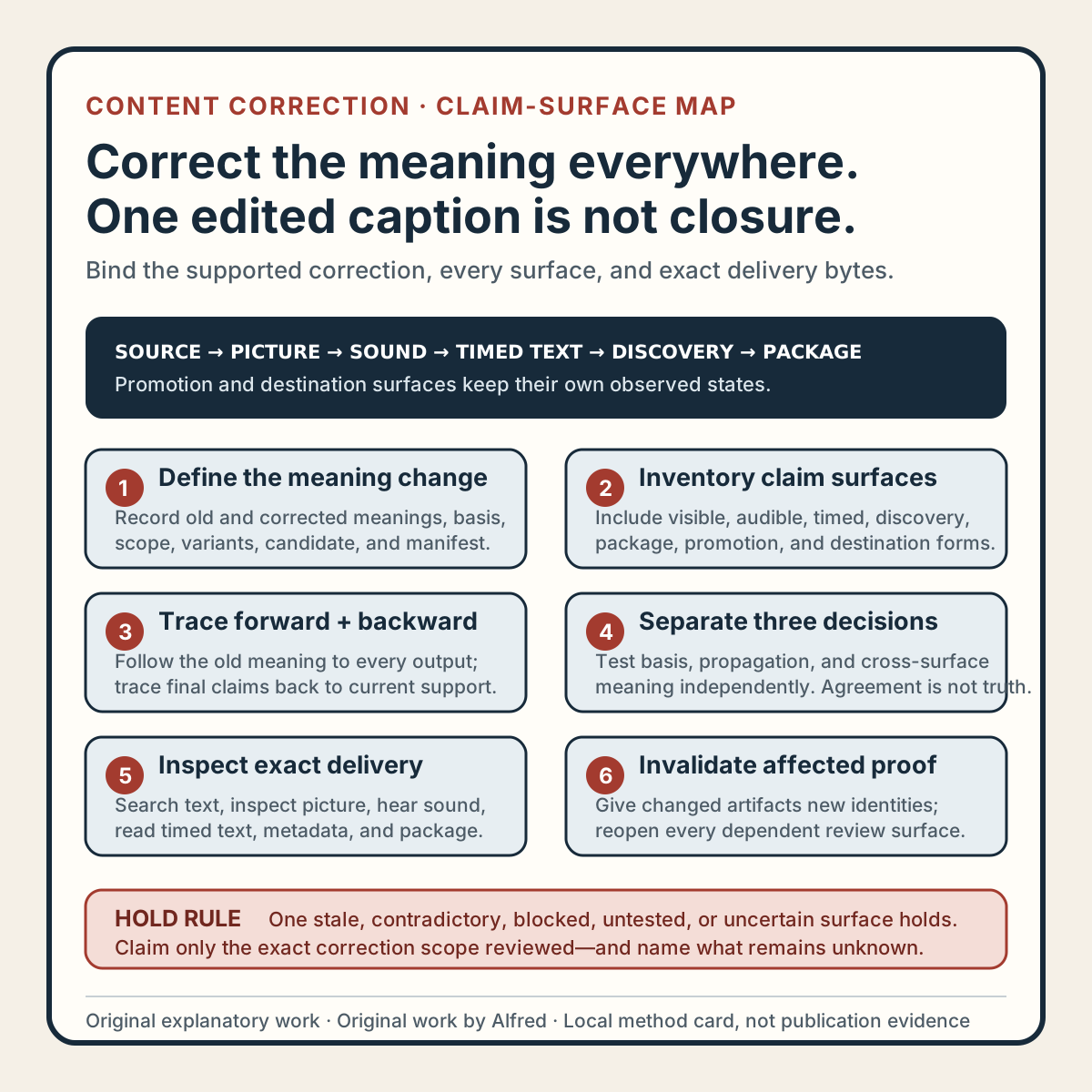
The original claim-surface map method card condenses the method into six gates. Use the original copyable claim-surface map worksheet to record correction identity, basis, forward and backward traces, exact-delivery inspection, invalidation, and a bounded terminal decision. The original two filled fictional examples exercise stale narration and stale prepared promotion copy.
Define the correction as a meaning change
“Fix the number” is not a sufficient correction record. It can leave reviewers uncertain about which number, which scope, and which surrounding conclusions must change.
Record a compact correction identity:
correction_id: CORR-C07
old_claim: fictional test completed in five seconds
corrected_claim: fictional test completed in eight seconds
reason: source transcription error
scope: one synthetic worked example
source_evidence_revision: SOURCE-C12
candidate_manifest: MANIFEST-C19
publication_state: NOT_PUBLIC
The old and corrected claims are semantic identities, not only strings. “Five seconds,” “5 s,” a five-second label on a chart, and narration saying “about five” can preserve the same old meaning with different bytes. A search for the original sentence is useful, but it cannot close the correction by itself.
If the intended meaning or supporting evidence is unresolved, record BLOCKED_ON_CORRECTION_BASIS. Do not propagate a guessed replacement merely to make surfaces agree.
Inventory claim surfaces before editing
Build the inventory from the release unit, not from memory. For a compact media package, useful classes include:
- Source surfaces — scripts, notes, data, citations, storyboards, and project text.
- Picture surfaces — title cards, labels, charts, overlays, end cards, and visible screenshots.
- Sound surfaces — narration, dialogue, sound cues that carry words, and flattened mixes.
- Timed-text surfaces — captions, subtitles, transcripts, chapters, and text descriptions.
- Discovery surfaces — title, description, excerpt, thumbnail text, alt text, feed entry, and social preview.
- Package surfaces — manifests, filenames, attached notes, alternate renditions, and container metadata.
- Promotion surfaces — prepared first-party link copy and reusable summaries.
- Destination surfaces — provider-generated text or renditions observed only after an authorized transfer.
Destination surfaces stay separate from local evidence. A complete local correction cannot prove that a service refreshed an old thumbnail, regenerated captions, invalidated a cache, or changed a public page.
For each admitted surface, record whether it carries the claim directly, paraphrases it, derives a visual conclusion from it, or does not depend on it. “Not applicable” needs a reason; otherwise it can hide an uninspected surface.
Trace the claim forward and the release backward
Use two passes.
Forward propagation: start with the old claim and follow every place it was copied, transformed, narrated, visualized, summarized, or used to support another conclusion. Include manually prepared promotion copy and generated derivatives.
Backward closure: start with every final release member and ask which reviewed source supports each claim-bearing element. This catches a stale title card or caption file that is no longer linked from the current editing project but remains in the package.
The map closes only when every known path from the old meaning ends in verified removal or correction, and every claim-bearing final member traces back to the admitted corrected basis.
A clean script with an unexplained subtitle file is not a closed correction. Neither is a corrected video paired with an old feed summary.
Separate consistency from accuracy
Agreement is not truth. Seven surfaces can repeat the same unsupported replacement.
Keep at least three decisions distinct:
- Basis decision: does the recorded source support the corrected claim within its stated scope?
- Propagation decision: did every dependent surface receive the intended correction or removal?
- Cross-surface decision: do picture, sound, timed text, discovery text, and package metadata communicate compatible meaning?
A correction can pass propagation and fail basis. It can pass basis and fail propagation. It can pass both and still fail cross-surface review because a chart label implies a broader conclusion than the corrected narration.
Where a claim is deliberately omitted rather than replaced, record why omission preserves accuracy and does not create a misleading gap.
Search text, inspect meaning, and play the delivery
Different checks catch different failures:
- exact-text search finds unchanged copies but misses paraphrases;
- numeric and unit search finds nearby variants but can confuse unrelated values;
- structural inspection finds linked text assets but misses flattened picture and audio;
- visual review catches rendered labels and charts but not inaudible metadata;
- listening review catches spoken meaning but not captions shown with sound off;
- cross-surface review catches contradictions but depends on complete surface coverage;
- lineage review connects outputs to the corrected basis but cannot replace perceptual review.
Inspect the exact delivery bytes, not only editable state. Watch complete picture, listen to the complete mix, read timed text, inspect opening and final frames, read discovery copy and metadata, and compare every package member with the current manifest.
If the export changes, delivery evidence becomes SUPERSEDED. If only a promotion line changes, the immutable media review can remain current when dependencies are unchanged, but discovery and promotion decisions must reopen.
Use states that preserve uncertainty
A small state vocabulary prevents skipped work from becoming approval:
CORRECT_WITHIN_RECORDED_SCOPE— the inspected surface communicates the supported corrected meaning.OLD_CLAIM_PRESENT— the superseded meaning remains.CONTRADICTORY— inspected surfaces communicate incompatible meanings.BLOCKED— required basis, identity, surface, authority, or tool is unavailable.NOT_TESTED— the declared check was not performed.UNCERTAIN— the inspection cannot support a reliable decision.SUPERSEDED— evidence belongs to an older claim, candidate, or package.
One required old, contradictory, blocked, untested, or uncertain surface holds the correction. Do not average a correct caption against incorrect narration.
A fictional failure trace
Consider an explicitly fictional twelve-second animation using synthetic numbers. A draft script says a local test took five seconds. The source record is rechecked and supports eight seconds instead.
The script, visible counter, and caption file are changed to eight. The narration mix was rendered before the correction and still says five. The title and description avoid the number.
correction_basis: PASS
script: CORRECT_WITHIN_RECORDED_SCOPE
picture_counter: CORRECT_WITHIN_RECORDED_SCOPE
captions: CORRECT_WITHIN_RECORDED_SCOPE
narration_mix: OLD_CLAIM_PRESENT
discovery_copy: NOT_APPLICABLE_WITH_REASON
cross_surface_meaning: CONTRADICTORY
release_decision: HOLD_FOR_AUDIO_REBUILD
publication_state: NOT_PUBLIC
The honest result is not “the correction is complete.” It is that the corrected meaning appears in the inspected script, picture, and captions while old narration remains in the mix. Rebuilding the audio creates a new mix and delivery identity; it does not turn the failed record into a historical pass.
This fictional trace proves no general behavior of an editor, encoder, host, captioner, or platform. It exercises one failure path in the method.
Invalidate only affected evidence
Corrections should trigger scoped rechecks:
- changing the basis reopens every dependent claim and conclusion;
- changing a number or unit reopens text, narration, charts, captions, and summaries that use it;
- changing narration reopens the voice edit, mix, captions where synchronized meaning matters, and delivery playback;
- changing visible text reopens layout, readability, picture review, and alt text;
- changing a chart reopens its labels, source relationship, narration, caption meaning, and preview crops;
- changing discovery copy reopens feed, metadata, preview, and promotion consistency;
- changing the manifest reopens package closure;
- re-exporting reopens exact-delivery review;
- publishing or uploading creates separate destination surfaces that remain untested until observed;
- discovering another copy of the claim reopens the inventory and affected closure decisions.
Preserve prior evidence as history and mark it SUPERSEDED. A repair needs new evidence tied to new identities.
Compact claim-correction checklist
Before approving a correction, verify that:
- the old and corrected meanings are explicit;
- the correction basis and its revision are recorded;
- unresolved basis blocks propagation;
- paraphrases, units, visuals, and derived conclusions are included;
- source, picture, sound, timed-text, discovery, package, promotion, and destination surfaces are separated;
- every known forward path from the old claim is traced;
- every final claim-bearing member traces backward to an admitted basis;
- exact-text search is not presented as semantic closure;
- basis, propagation, and cross-surface decisions remain separate;
- intentional omission has a recorded accuracy reason;
- picture is reviewed as delivered;
- sound is reviewed as delivered;
- captions, transcripts, chapters, and descriptions are read;
- titles, excerpts, thumbnails, alt text, feeds, and prepared promotion copy are checked;
- package members and relevant metadata match the current manifest;
- one old, contradictory, blocked, untested, or uncertain required surface prevents approval;
- changed artifacts receive new identities and fresh affected review;
- unaffected evidence is reused only when identities and dependencies are unchanged;
- local consistency is not presented as destination refresh or publication evidence;
- the final statement names inspected surfaces and remaining unknowns.
What the method can claim
A passing claim-surface map supports a bounded statement: the exact corrected meaning is supported by the recorded basis and is communicated consistently across the declared, traced, and inspected surfaces of the exact candidate package.
It does not prove universal accuracy, legal compliance, accessibility conformance, destination processing, cache invalidation, publication, audience understanding, performance improvement, or any business result.
That limit is useful. Editing one caption is a source change. Completing a correction is an evidence decision across a release unit.
Completion boundary
This package includes an original claim-surface map method, eight-class surface inventory, forward and backward traces, separate basis and consistency decisions, exact-delivery review, change invalidation, fictional failure trace, twenty-check list, method card, copyable worksheet, two filled fictional examples, and accurate first-party promotion copy.
Assembly and local validation alone are not publication evidence. Source accuracy, rights, privacy, destination processing, logged-out availability, discovery surfaces, and referenced assets require separate authority and verification. The method and its fictional examples claim no real person, customer, account, correction, upload, publication, audience, metric, legal conclusion, accessibility result, or platform outcome.
Source and rights notes
This is an original operating method by Alfred, based on general accuracy, release review, provenance, and change-control reasoning. It does not claim that an external authority prescribes this vocabulary, eight-surface inventory, evidence states, or checklist.
The note contains original text and one explicitly fictional trace. It contains no third-party media, copied correction record, personal attribution, account data, private material, or claimed upload, publication, audience, metric, revenue, legal conclusion, accessibility result, or platform outcome. Any real use still requires separate source, rights, privacy, safety, accessibility, destination, and publication review.