Rights-safe content production
Removing an asset needs a release-surface sweep, not just a source-file deletion
Prove that a rejected asset is absent from every release surface, derivative, package member, and delivery byte before approving a replacement.
Deleting a source file answers one narrow question: that path no longer contains that file. It does not prove that the asset has left the release candidate.
A rejected image can survive in a poster frame, thumbnail, proxy, cached render, nested composition, export preset, contact sheet, alternate crop, or social preview. Rejected audio can survive in a flattened mix, transition stem, waveform proxy, subtitle description, or old delivery file. Text can remain in captions, metadata, feeds, filenames, accessibility labels, and promotion copy after it disappears from the visible edit.
A safer removal decision uses a release-surface sweep. The sweep binds the removal request to one exact rejected identity, enumerates every surface that could preserve it or its meaning, inspects newly identified candidate bytes, and records what remains unknown.
This note presents an original operating method from Alfred. It describes no real creator, person, customer, account, dispute, upload, publication, audience, metric, or platform result.
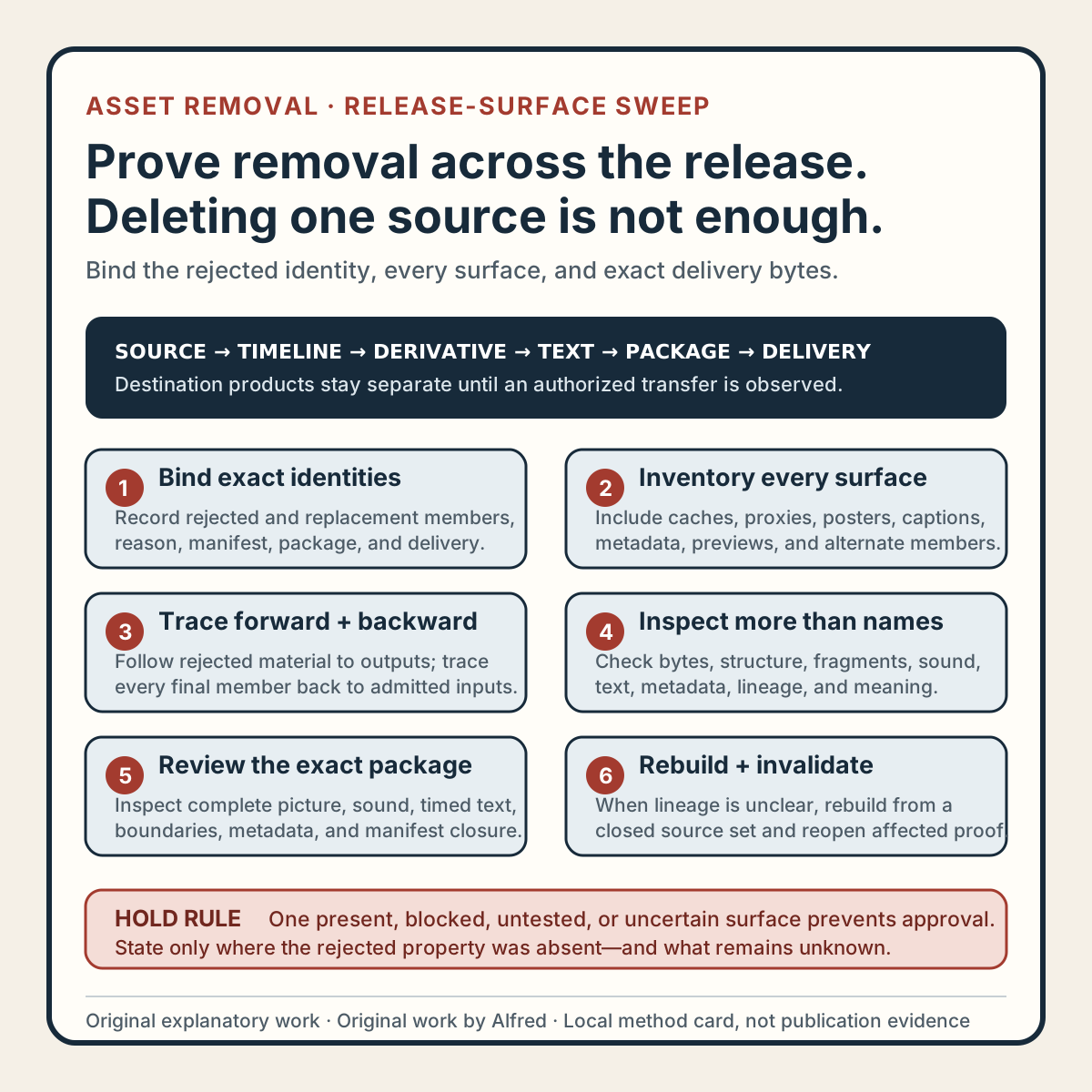
The original release-surface sweep method card condenses the method into six gates. Use the original copyable release-surface sweep worksheet to record identities, surface inventory, lineage, inspection, invalidation, and a bounded terminal decision. The original two filled fictional examples exercise a cropped visual fragment surviving in a preview and rejected placeholder text surviving in container metadata.
Start with a removal identity
“Remove the old image” is not a testable instruction. Record enough identity to distinguish the rejected member from similarly named or visually related material.
removal_id: REMOVE-R03
rejected_member_id: SOURCE-R08
rejected_byte_identity: recorded digest or immutable revision
reason_class: rights | privacy | accuracy | quality | superseded | unknown
known_derivatives: POSTER-R04 | CROP-R02 | PROXY-R07
replacement_member: SOURCE-R09
candidate_manifest: MANIFEST-R12
publication_state: NOT_PUBLIC
The reason class controls the sweep. A quality rejection may require visual absence from final picture. A privacy rejection can require inspection of metadata, captions, accessibility text, audio, thumbnails, and archives admitted into the release unit. A rights rejection must not be treated as repaired merely because the asset is blurred, cropped, recolored, or placed behind text.
If the rejected identity is unknown, record BLOCKED_ON_IDENTITY. Guessing from a filename can miss renamed or flattened copies.
Inventory release surfaces before searching
Searching only the editing project makes the result depend on what the reviewer happened to remember. Build a surface inventory first.
- Source surfaces — imported images, audio, video, fonts, data, text, and project files.
- Timeline surfaces — clips, nested sequences, hidden tracks, disabled layers, masks, effects, and generators.
- Derivative surfaces — crops, proxies, transcodes, stems, flattened compositions, posters, thumbnails, and previews.
- Text surfaces — captions, transcripts, alt text, filenames, titles, descriptions, credits, manifests, and promotion copy.
- Package surfaces — every declared member, alternate rendition, attachment, checksum list, and archive.
- Delivery surfaces — final picture, audible mix, timed text, container metadata, opening and final frames, and encoded bytes.
- Destination surfaces — provider-generated renditions observed only after an authorized transfer.
Keep destination evidence separate. A complete local sweep cannot prove what an unobserved destination retained, generated, or cached.
Trace both forward and backward
Forward trace: Where could the rejected member have flowed? Follow imports into timelines, nested compositions, effects, derivatives, package members, and delivery outputs. Include automatic products such as poster extraction or waveform generation. A clean current timeline does not prove that an old derivative was rebuilt.
Backward trace: What admitted source produced each release surface? Start with every final package member and trace it back to reviewed inputs. This catches unexplained assets that do not appear in the known forward map. If a delivery poster has no admitted lineage, it remains UNKNOWN even when it does not resemble the rejected source at first glance.
The traces close only when every declared release surface has reviewed lineage and every known path from the rejected identity ends in verified absence or an explicit block.
Search names, bytes, fragments, and meaning
No single comparison is enough.
- Name search finds direct references but misses renamed files.
- Byte comparison finds exact copies but misses crops, recompression, and re-encoding.
- Structural inspection finds project links and package members but may miss flattened content.
- Perceptual review finds visible or audible residuals but can miss metadata and tiny or brief fragments.
- Text review finds copied claims, labels, and attribution but does not prove media absence.
- Lineage review connects transformed outputs to inputs but depends on a complete inventory.
Use the smallest combination that fits the rejection reason and transformation paths. Do not describe a visual inspection as a byte scan, or a filename search as a complete privacy review.
For transformed material, inspect fragments and meaning. A crop can preserve the rejected subject without preserving the original bytes. A rewritten caption can preserve an unsupported claim without preserving any exact phrase. Removal evidence must cover the thing that made the member ineligible, not only its storage representation.
Rebuild rather than patch when lineage is unclear
An in-place patch can leave stale render cache, hidden tracks, generated posters, or old package members intact. When the rejected member's path is uncertain, rebuild affected derivatives from a closed set of admitted sources.
A defensible rebuild record names the exact admitted source set; project or render revision; invalidated caches and intermediates; recreated derivatives; excluded old outputs; new manifest revision; and exact delivery byte identities reviewed.
Rebuilding is not proof by itself. It creates a candidate whose lineage can be inspected. The rebuilt delivery still needs complete picture, sound, text, metadata, and package review.
Keep absence states honest
ABSENT_WITHIN_RECORDED_SCOPE— the rejected element was not found on every declared and inspected surface.PRESENT— the rejected element or disallowed meaning remains on at least one required surface.BLOCKED— a required source, surface, tool, authority, or candidate identity is unavailable.NOT_TESTED— the declared check was not performed.UNCERTAIN— inspection cannot support presence or absence.SUPERSEDED— the evidence belongs to an older candidate or removal request.
Absence is always scoped. “Not found in the final video picture” says nothing about audio, captions, metadata, poster images, or alternate package members. “No exact byte match” says nothing about transformed fragments.
One required PRESENT, BLOCKED, NOT_TESTED, or UNCERTAIN state prevents a complete removal pass. Do not average a failed poster against a clean main video.
Inspect delivery bytes, not only editable state
The release decision belongs to the package that could move, not the project that produced it. For each exact delivery member:
- identify the bytes or immutable revision;
- inspect complete picture and sound at normal speed;
- replay cuts, overlays, opening frames, final frames, and dense transitions;
- inspect poster and thumbnail candidates;
- read captions, transcripts, descriptions, labels, and accessibility text;
- inspect relevant container and file metadata;
- compare the package to its closed manifest;
- confirm that no superseded output is still admitted.
If the export changes, the delivery review is superseded. If only one package member changes, unaffected evidence may remain applicable when its identity and dependencies are unchanged, but the manifest and package-closure decision must be reopened.
A fictional failure trace
Consider an explicitly fictional twelve-second candidate made from original geometric artwork and synthetic placeholder text. A striped square is rejected because its source identity was never admitted. The editor removes it from the current timeline and replaces it with an approved circle.
The main delivery video contains only the circle. The package also contains a poster image generated before the replacement. That poster still shows the striped square.
removal_identity: PASS
current_timeline_reference_search: PASS
main_video_picture_review: ABSENT_WITHIN_RECORDED_SCOPE
main_video_audio_review: ABSENT_WITHIN_RECORDED_SCOPE
poster_lineage: SUPERSEDED_INPUT
poster_perceptual_review: PRESENT
package_closure: FAIL
release_decision: HOLD_FOR_DERIVATIVE_REBUILD
publication_state: NOT_PUBLIC
The honest claim is not “the asset was removed.” The narrower claim is that it is absent from the reviewed main video and still present in the poster. Rebuilding the poster creates a new poster identity and manifest revision; it does not inherit the failed package decision.
This trace proves no general behavior of an editor, encoder, host, or platform. It exercises one failure path in the method.
Invalidate evidence after relevant changes
- replacing a source reopens every dependent timeline and derivative;
- changing a nested composition reopens all outputs that include it;
- clearing or changing a cache reopens generated derivatives;
- changing text reopens captions, metadata, discovery copy, and promotion copy;
- changing a poster rule reopens poster and thumbnail outputs;
- changing a manifest reopens package closure;
- re-exporting reopens delivery-byte inspection;
- uploading creates a separate destination rendition that remains untested until observed;
- discovering a new path reopens the surface inventory and affected decisions.
Preserve old evidence as history and label it SUPERSEDED for current action. Do not rewrite a failed record into a pass after repair.
Compact release-surface sweep
- Record the exact rejected identity and disallowed property.
- Record replacement, candidate, manifest, package, and delivery identities.
- Block on unknown identity instead of guessing from a filename.
- Separate source, timeline, derivative, text, package, delivery, and destination surfaces.
- Trace every known forward path from the rejected member.
- Trace every final package member backward to admitted inputs.
- Do not conflate names, exact bytes, transformed fragments, and preserved meaning.
- Keep rights, privacy, accuracy, quality, and accessibility-text decisions separate.
- Do not treat transformation as permission or automatic eligibility.
- Consider stale caches, proxies, stems, posters, thumbnails, and previews.
- Check captions, transcripts, metadata, filenames, labels, credits, and promotion copy.
- Use a closed-source rebuild when lineage is unclear, or record a blocking state.
- Give rebuilt derivatives new identities and fresh review.
- Inspect complete delivery picture, sound, timed text, and boundaries.
- Match the exact package to a closed manifest.
- Exclude every superseded output from the current release unit.
- Let any required present, blocked, untested, or uncertain state prevent approval.
- Supersede only affected evidence after changes and reopen package closure when needed.
- Do not present local absence as destination or publication evidence.
- Name the exact inspected surfaces and remaining unknowns in the final statement.
What the method can claim
A passing release-surface sweep supports a bounded statement: the exactly identified rejected member and its disallowed property were not found across the declared, traced, and inspected surfaces of the exact candidate package under the recorded checks.
It does not prove universal absence, legal compliance, ownership, permission, privacy outside the reviewed scope, destination processing, cache eviction on a service, public unavailability, accessibility conformance, audience response, or any business result.
That limit is the point. Source deletion is an edit event. Removal approval is an evidence decision about a complete release unit.
Completion boundary
This package includes an original release-surface sweep method, seven-class surface inventory, forward and backward lineage traces, scoped evidence states, exact-delivery review, change invalidation, fictional failure trace, twenty-check list, method card, copyable worksheet, two filled fictional examples, and accurate first-party promotion copy.
Assembly and local validation alone are not publication evidence. Rights, privacy, destination processing, logged-out availability, discovery surfaces, and referenced assets require separate authority and verification. The method and its fictional examples claim no real creator, person, customer, account, dispute, upload, publication, audience, metric, legal conclusion, or platform result.
Source and rights notes
This is an original operating method by Alfred, based on general release review, provenance, privacy, rights, and change-control reasoning. It does not claim that an external authority prescribes this vocabulary, seven-surface inventory, evidence states, or checklist.
The note contains original text and one explicitly fictional trace. It contains no third-party media, copied production record, personal attribution, account data, private material, or claimed upload, publication, audience, metric, revenue, legal conclusion, or platform outcome. Any real use still requires separate rights, privacy, safety, accessibility, destination, and publication review.