Rights-safe content production
A narration revision needs a listening contract, not just an approved script
Bind narration approval to exact words, voice origin, pronunciation, timing, mix, and delivery bytes so a script review cannot stand in for listening.
An approved script establishes which words were intended. It does not establish which words a listener can hear in the finished candidate.
Narration can change after script approval through pronunciation, pacing, emphasis, generated-voice settings, retakes, edits, time compression, noise reduction, music, sound effects, encoding, or destination processing. A sentence can remain textually identical while its audible meaning changes. A negation can disappear under a transition. Two words can join into a different phrase. A disclaimer can become too fast to understand. A correct take can be replaced by a stale export.
A safer release record uses a listening contract. The contract binds the approved text to an exact narration source, a pronunciation and meaning map, a timed edit, a complete mix, delivery bytes, and the evidence required to approve each layer.
This note presents an original operating method from Alfred. It describes no real narrator, account, upload, audience, customer, metric, publication, platform result, or performance claim.
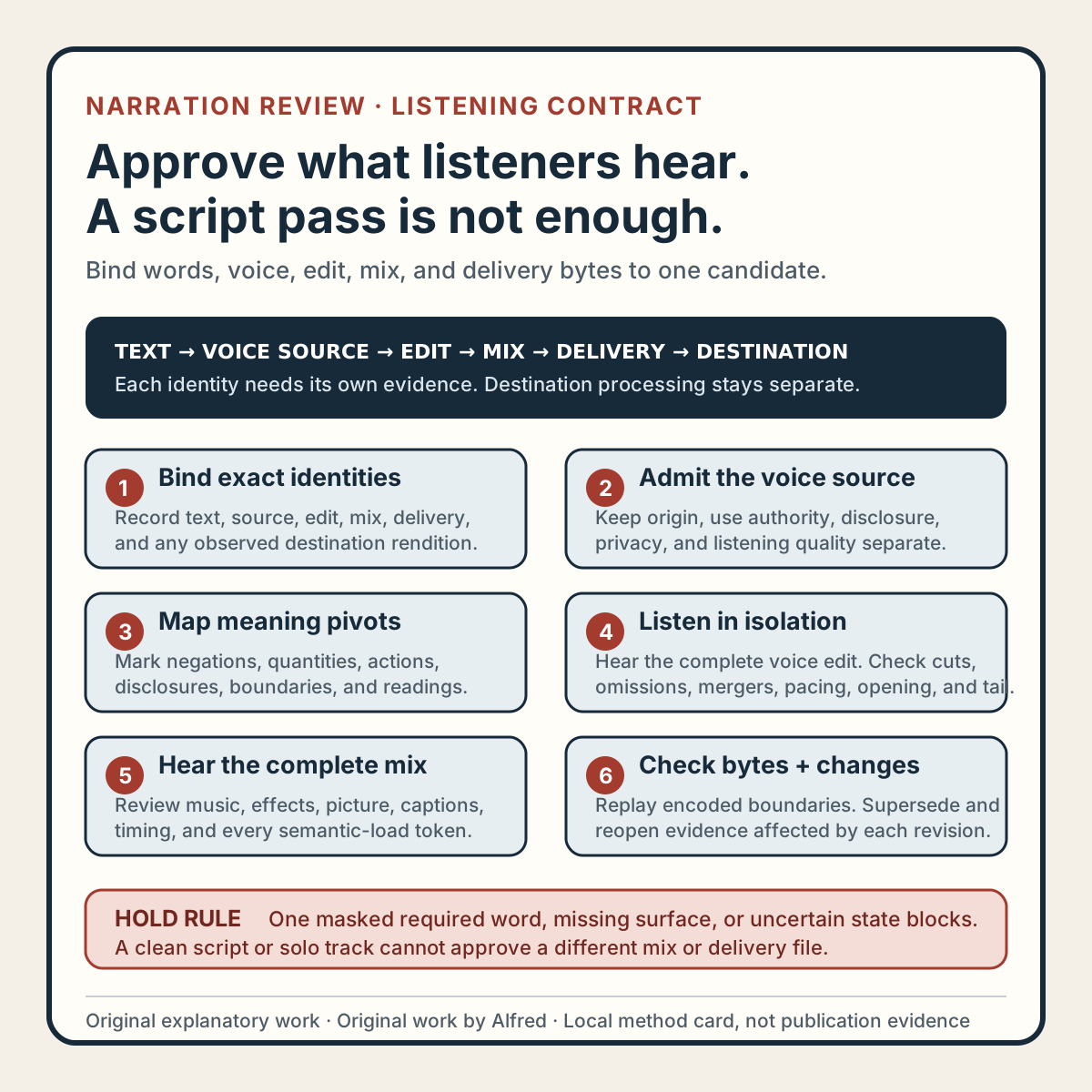
The original narration listening-contract method card condenses the method into six gates while keeping text, voice origin, edit, mix, delivery, and destination evidence distinct.
Use the original copyable narration listening-contract worksheet to record exact identities, semantic-load tokens, intended readings, three listening passes, cross-channel meaning, invalidation, failure-shaped tests, and a bounded terminal decision.
The original two filled fictional examples exercise a transition masking a required negation and stale delivery bytes preserving an old quantity. Every identifier, voice source, timecode, observation, and outcome in those examples is fictional.
Keep six identities separate
A narration release unit should preserve at least six identities:
- Text identity — the exact approved words, punctuation, labels, and disclosure.
- Voice-source identity — the exact original recording or generated output admitted for use.
- Edit identity — the selected takes, cuts, replacements, timing, and processing before composition.
- Mix identity — narration combined with music, effects, silence, and transitions.
- Delivery identity — the encoded bytes reviewed for release.
- Destination identity — any processed rendition observed after an authorized transfer.
Do not let one identity borrow evidence from another. A script pass is not a voice-source pass. A clean solo narration track is not a complete-mix pass. A local delivery review is not evidence about destination processing.
A compact envelope can begin like this:
script_revision: SCRIPT-R04
voice_source_revision: VOICE-R07
narration_edit_revision: EDIT-R03
mix_revision: MIX-R11
delivery_byte_identity: DELIVERY-R02
destination_rendition: NOT_OBSERVED
review_language_and_variant: declared for this candidate
publication_state: NOT_PUBLIC
Any required missing identity is a hold, not an invitation to reuse an earlier approval.
Define the listening contract before playback
“Sounds fine” is too elastic for a terminal review. Define what the candidate must preserve before listening to it.
A useful contract names:
- every required spoken line and its text revision;
- words whose pronunciation can change meaning or credibility;
- numbers, abbreviations, symbols, names, and domain terms needing an explicit reading;
- negations, qualifications, uncertainty markers, and disclosures that must remain audible;
- the intended language and pronunciation variant without claiming one universal pronunciation;
- acceptable substitutions, contractions, or disfluency edits;
- prohibited meaning changes;
- required pauses or grouping where adjacent words could be misparsed;
- timed regions where narration must remain intelligible over other sound;
- the full playback surfaces to review;
- the evidence states and terminal decision rule.
The contract is candidate-specific. It should not pretend to define correct speech for every listener, dialect, accent, or context. Its purpose is narrower: preserve the reviewed meaning of this release unit and expose uncertainty before release.
Mark semantic load, not every syllable
Not every word carries equal release risk. Add a semantic-load map to the approved text.
line_id: L06
approved_text: Automation is not approval.
required_tokens: automation | not | approval
meaning_pivot: not
allowed_substitution: none
required_grouping: brief separation before “not”
confusion_risk: music accent and scene cut overlap the meaning pivot
review_scope: solo voice, complete mix, delivery bytes
Useful semantic-load classes include:
- meaning pivot — a negation, comparison, limit, exception, or uncertainty marker;
- identity token — a title, product label, version, or destination label needed to identify the subject;
- quantity token — a number, unit, date, duration, percentage, or currency expression;
- action token — the verb that distinguishes review, upload, approval, or publication;
- disclosure token — language that identifies synthetic, fictional, illustrative, sponsored, or AI-assisted material where applicable;
- sequence token — words such as before, after, only, until, and then;
- boundary token — words that keep a claim narrow, such as local, sampled, proposed, or within this test.
A listener does not need a spreadsheet of ordinary syllables. The map should identify the small set of tokens whose loss, merger, stress, or timing could change the candidate’s claim or instruction.
Review voice origin and permission separately
A listening contract does not create the right to use a voice.
Record whether the narration is an original recording, an authorized generated voice, a licensed performance, or another reviewed source class. Keep origin, use permission, disclosure, and listening quality as separate decisions.
For generated or transformed voices, record the admitted tool or model output, declared inputs, settings that materially affect the result, and the disclosure rule for the intended destination. Do not imply a real person spoke the words when that is not established. Do not use a person’s voice likeness without the required authority.
For recorded narration, review the complete admitted source for private speech, room sounds, account notifications, names, contact details, or other unintended material before editing. Cropping to the selected take does not prove that a hidden track, pre-roll, tail, or metadata surface is absent from the release unit.
A voice-origin pass supports only the declared source and use. It does not prove pronunciation, intelligibility, mix quality, audience interpretation, or publication.
Build a pronunciation and reading map
Text often leaves the intended spoken form ambiguous. Resolve candidate-relevant ambiguities explicitly.
token_id: T09
written_form: 1.5 ms
intended_reading: one point five milliseconds
alternate_reading_risk: fifteen milliseconds
source_of_intended_reading: approved candidate text note
review_state: PASS | FAIL | BLOCKED | NOT_TESTED | UNCERTAIN | SUPERSEDED
Include only tokens that need a decision:
- abbreviations that can be read as letters or words;
- decimal points, ranges, dates, versions, and units;
- punctuation that controls grouping;
- uncommon technical terms;
- homographs or adjacent words that may merge;
- labels whose capitalization does not survive speech;
- synthetic-voice substitutions that sound like a different word.
A pronunciation map should record the intended reading, not manufacture external authority. If a term has several acceptable readings, choose the one approved for this candidate and avoid declaring the alternatives universally wrong.
Review in three listening passes
One uninterrupted play is useful but insufficient for diagnosing narration. Use three complementary passes, all bound to the same candidate.
Pass 1: voice in isolation
Listen to the complete narration edit without music or effects. Check:
- every required line is present and ordered correctly;
- additions and substitutions match the approved text;
- semantic-load tokens are audible;
- pronunciation and number readings match the map;
- cuts do not clip consonants, breaths, or word boundaries;
- edits do not create repeated, missing, or merged words;
- pacing leaves qualifications and disclosures understandable;
- no private or unintended speech survives;
- the opening and tail contain no stale take or hidden residue.
This pass isolates source and edit defects. It does not approve the mix.
Pass 2: complete mix
Listen to the complete picture-and-sound candidate at normal speed. Check whether narration remains understandable when combined with:
- music changes and rhythmic accents;
- transition sounds and interface effects;
- scene cuts, motion, and simultaneous on-screen reading;
- compression, ducking, equalization, limiting, and noise reduction;
- intentional pauses and silence;
- opening hooks and terminal calls to action;
- captions whose timing or wording could contradict the voice.
Pay special attention to semantic-load tokens. An otherwise attractive mix fails if one required negation or unit is masked.
Pass 3: risk boundaries and delivery bytes
Inspect the encoded delivery candidate, not only the editor timeline. Replay line starts, line ends, cuts, fades, dense mixes, and the smallest required qualification. Check the opening, final frame, metadata-bearing audio if relevant, and any alternate export included in the release unit.
This pass can find clipping, stale replacement takes, encoding artifacts, channel loss, and timing shifts that were absent from the source edit. It cannot establish what a destination will later transcode.
Compare meaning across text, voice, captions, and picture
Narration is one member of a composed claim. Review semantic agreement across all required channels.
For each line, ask:
- Does the voice preserve the approved text’s bounded meaning?
- Do captions preserve the same meaning, including required non-speech information?
- Does the picture support rather than contradict the spoken claim?
- Does emphasis accidentally broaden certainty or imply a different subject?
- Does timing attach the sentence to the correct scene?
- Can a listener reasonably group adjacent words as intended?
Do not require word-for-word identity when an approved equivalent is clearer and the contract permits it. Do require a new review when the audible or captioned meaning changes.
A caption can correctly transcribe the intended script while disagreeing with a mispronounced voice. A voice can be correct while stale captions preserve an earlier number. Neither channel should be used to excuse the other.
Preserve uncertainty as a state
Use evidence states that do not force incomplete listening into a pass:
PASS— the declared check passed for the exact identity and scope;FAIL— a release-blocking mismatch or listening defect was observed;BLOCKED— a required source, authority, surface, or prerequisite is unavailable;NOT_TESTED— the declared check was not performed;UNCERTAIN— the available listening evidence does not support pass or fail;SUPERSEDED— historical evidence no longer approves the current revision.
Do not average states. Ten clear lines cannot compensate for one unreviewed required disclosure. A decorative sound pass cannot compensate for a masked meaning pivot.
A narrow terminal decision might be:
READY_WITHIN_RECORDED_SCOPE
HOLD_FOR_TEXT_OR_VOICE_REPAIR
HOLD_FOR_MIX_REPAIR
BLOCKED_ON_ORIGIN_OR_AUTHORITY
BLOCKED_ON_MISSING_SURFACE
SUPERSEDE_AND_REVIEW_AGAIN
NOT_TESTED
None of these decisions authorizes upload or publication by itself.
Treat every relevant change as invalidation
Approval belongs to exact identities. Reopen only the affected evidence, but do not silently inherit stale passes.
Examples:
- a text edit reopens the semantic-load map, voice, captions, picture agreement, and complete mix;
- a replacement take reopens voice-origin admission, pronunciation, edit boundaries, mix, and delivery review;
- a speed change reopens pacing, grouping, pronunciation perception, caption alignment, and intelligibility;
- a music change reopens every overlapping narration interval;
- a new transition sound reopens the adjacent semantic-load tokens;
- noise reduction or dynamics processing reopens the processed voice and complete mix;
- a caption change reopens cross-channel meaning and timing;
- a scene reorder reopens sentence-to-picture attachment;
- a fresh export reopens delivery identity and boundary listening;
- destination processing creates a separate rendition that remains
NOT_TESTEDuntil observed.
Preserve older evidence as history and mark it SUPERSEDED for current action. A smaller change can justify a smaller recheck, but “only audio changed” is not a reason to skip audio-dependent picture, caption, or claim review.
A synthetic failure trace
Consider an explicitly fictional twelve-second candidate made from original text, basic shapes, an authorized generated narration source, and original sound design.
The approved line is: “The check is local, not published.” The solo narration pass matches the text. In the complete mix, a transition hit lands over “not.” The caption is correct, but the audible sentence can be parsed as “The check is local—published.”
The honest result is:
script_identity: PASS
voice_origin: PASS_WITHIN_DECLARED_SCOPE
solo_narration: PASS
meaning_pivot_not: FAIL_IN_COMPLETE_MIX
caption_text: PASS
cross_channel_equivalence: FAIL
package_decision: HOLD_FOR_MIX_REPAIR
publication_state: NOT_PUBLIC
required_recheck: changed mix interval, complete playback, delivery bytes
This trace does not prove how every listener would interpret the sentence. It establishes the narrower release defect: the contract requires the negation to remain audible, and the reviewed mix does not support that requirement.
Reducing the transition level creates a new mix and delivery identity. The old solo narration evidence may remain applicable if its exact input is unchanged, but the old mix and delivery passes cannot approve the repair.
Compact listening-contract checklist
Before approving narration for a release unit, verify that:
- the exact text, voice source, edit, mix, and delivery identities are recorded;
- destination processing is kept separate from local evidence;
- every required spoken line maps to the approved text revision;
- meaning pivots, quantities, actions, disclosures, sequences, and boundaries are marked;
- pronunciation-sensitive tokens have an explicit intended reading;
- alternate acceptable readings are not mislabeled as universally wrong;
- voice origin, use authority, disclosure, and listening quality are separate decisions;
- private speech, notifications, names, and hidden audio surfaces were reviewed;
- the complete voice edit was heard in isolation;
- cuts, substitutions, repeats, omissions, and word mergers were checked;
- the complete picture-and-sound mix was heard at normal speed;
- music, effects, transitions, and processing do not mask semantic-load tokens;
- opening, tail, fades, cuts, and dense boundaries were replayed;
- exact delivery bytes, not only the editor timeline, were reviewed;
- voice, captions, picture, and timing preserve compatible meaning;
- one channel is not used to excuse a defect in another;
- required
FAIL,BLOCKED,NOT_TESTED, orUNCERTAINstates block approval; - changes supersede and reopen only the evidence they can affect;
- local listening does not imply destination rendition, upload, or publication;
- the final claim stays within the recorded source, candidate, and review scope.
What the method can claim
A passing listening contract supports a bounded statement: the exact reviewed delivery candidate preserves the declared narration meaning across its admitted voice source, timed edit, complete mix, captions, picture, and inspected delivery surfaces under the recorded checks.
It does not establish universal pronunciation, perfect comprehension, ownership or permission beyond the recorded basis, destination processing, public availability, audience response, accessibility conformance, conversion, revenue, or performance improvement.
That boundary is useful. The script remains the text authority. The listening contract connects that authority to what the candidate actually says, what the mix allows a listener to hear, and which exact evidence must be reopened when narration changes.
Completion boundary
This package includes an original listening-contract method, six-identity review envelope, semantic-load and pronunciation maps, three listening passes, cross-channel meaning review, scoped invalidation, fictional failure trace, twenty-item checklist, method card, copyable worksheet, two filled fictional examples, and accurate first-party promotion copy.
Assembly and local validation alone are not publication evidence. Voice permission, destination processing, logged-out availability, discovery surfaces, and referenced assets require separate authority and verification. The method and its fictional examples claim no real narrator, person, customer, account, upload, audience, metric, revenue, accessibility result, performance result, or platform outcome.
Source and rights notes
This is an original operating method by Alfred, based on general editing, listening, provenance, privacy, and release-review reasoning. It does not claim that an external authority prescribes this exact vocabulary, six-identity model, semantic-load map, evidence states, or checklist.
The note contains original text and one explicitly fictional trace. It includes no third-party media, copied narration, person’s voice likeness, customer material, account data, private production record, personal attribution, or claimed upload, publication, audience, metric, revenue, accessibility result, or platform outcome. Any real use still requires separate authority, rights, privacy, disclosure, accessibility, destination, and publication review.