Rights-safe content production
A rights-safe remix needs transformation lineage, not just a source list
Track each source through extraction, transformation, review, and release so a source list cannot hide an unsupported media fragment.
A source list can answer, “Which inputs were considered?” It does not necessarily answer, “Which exact parts reached the candidate, what happened to them, and what rights or review basis still applies?”
That gap matters when an article, image, audio track, or video is assembled from several layers. A credited source may contribute nothing to the final item. An unlisted scratch asset may survive as a tiny crop. A licensed image may be transformed beyond the licensed use. A synthetic replacement may be approved while an older copied layer remains hidden in the export.
A safer record follows every admitted source through a transformation lineage. The lineage binds a source member to the extracted fragment, each meaningful transformation, the candidate surface where it appears, the rights and attribution decision, and the evidence that the released revision contains only reviewed members.
This note presents an original operating method from Alfred. It describes no real creator, customer, account, upload, publication, audience, dispute, legal conclusion, or platform result.
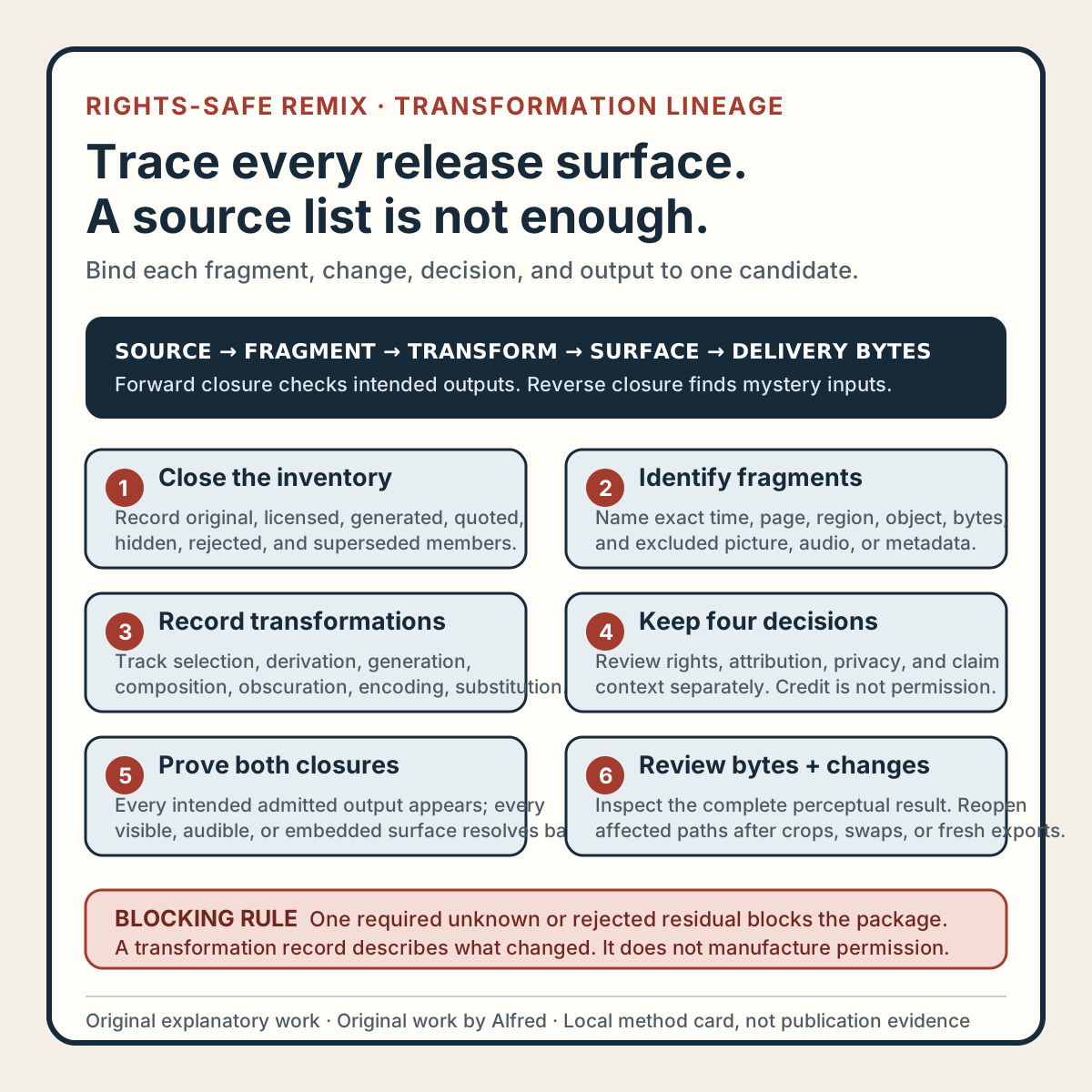
The original transformation-lineage method card condenses the method into six gates while keeping rights, attribution, privacy, claim context, candidate closure, and delivery review distinct.
Use the original copyable transformation-lineage worksheet to register exact source members, fragments, transformations, decision lanes, closure evidence, delivery review, invalidation, failure-shaped tests, and a bounded terminal decision.
The original two filled fictional examples exercise a rejected image surviving in a stale poster and an unidentified click entering delivery audio through a nested mix bus. Every identifier, source, revision, and outcome in those examples is fictional.
Start with a closed source inventory
Begin with the exact candidate, not with a bibliography assembled after editing.
Give every possible input a stable member identifier. Include media that may be easy to overlook:
- images, video, audio, narration, music, and sound effects;
- fonts, icons, templates, textures, and stock elements;
- screenshots, screen recordings, charts, and data extracts;
- generated images, voices, captions, and intermediate renders;
- pasted text, quotations, code, and reference diagrams;
- placeholder layers, scratch downloads, and hidden timeline tracks;
- logos, destination interface fragments, and device chrome;
- metadata or embedded artwork that can survive export.
For each member, record a safe relative label, immutable revision or byte identity where practical, media type, origin class, admission state, and intended role.
member_id: M07
member_revision: R03
origin_class: original | licensed | public-domain | generated | quoted | unknown
intended_role: background texture
admission_state: ADMITTED | REJECTED | BLOCKED | NOT_REVIEWED | SUPERSEDED
rights_record:
attribution_record:
privacy_record:
Do not omit rejected members. A rejected scratch image is useful evidence only if the candidate can also be shown not to contain it. Deleting its row makes the inventory look cleaner while weakening the removal check.
A URL is not an immutable source identity. A filename is not a rights record. “Made with AI” is not a source, license, or privacy decision. Keep those fields separate.
Describe fragments, not just whole files
One source can contribute several fragments with different treatment. A long recording might supply a two-second visual crop, a still frame, and a separately cleaned audio phrase. A report might supply a quoted sentence and independently derived numbers.
Create a fragment record whenever only part of a member is used:
fragment_id: F07-B
parent_member: M07@R03
selection_basis: time 00:14.200–00:16.100, picture only
excluded_channels: source audio
content_summary: abstract moving texture
privacy_surface: no people, names, account data, or interface labels observed
rights_scope: declared visual-background use only
The selection must be reproducible enough to inspect. “A small part near the end” is not sufficient. Use time ranges, page and region labels, object identifiers, or exact extracted bytes as appropriate.
Fragment review is also where channel mistakes become visible. Muting a clip on the timeline does not prove its original audio is absent from every nested composition. Cropping a screenshot does not prove that identifying metadata or an off-canvas layer is gone. The lineage should name excluded channels and how exclusion was checked.
Record meaning-changing transformations
Not every editor operation needs a row. Track transformations that can change rights, privacy, attribution, claim meaning, or perceptual output.
Useful transformation classes include:
- Selection — crop, trim, excerpt, isolate, or channel removal.
- Derivation — trace, redraw, translate, transcribe, summarize, or calculate.
- Generation — create a new visual, voice, caption, or variation from declared inputs.
- Composition — combine members in a frame, mix, scene, document, or template.
- Obscuration — blur, redact, mask, replace, or anonymize.
- Encoding — resize, compress, remux, rasterize, or otherwise create delivery bytes.
- Substitution — replace a rejected or superseded member with another revision.
Each recorded transformation should identify its inputs and outputs:
transform_id: T12
class: obscuration
input_fragments: F04-A
output_fragment: F04-A-REDACTED-R02
operation_summary: replace the complete label region with an opaque original shape
review_question: does any identifying text remain at full size and in motion?
evidence_state: PASS | FAIL | BLOCKED | NOT_TESTED | SUPERSEDED | UNCERTAIN
Avoid rights laundering through vague verbs. “Edited,” “remixed,” or “enhanced” says little about whether expressive material remains recognizable, whether attribution is required, or whether the use is authorized. A transformation can be substantial and still require a valid rights basis. The lineage records what happened; it does not manufacture permission.
Keep four decisions separate
A useful lineage does not collapse every concern into “cleared.” Preserve at least four independent decisions.
1. Rights admission
Is the exact member or fragment eligible for this declared use under an original-work, license, public-domain, quotation, permission, or other reviewed basis?
If the basis is unknown, record BLOCKED or NOT_REVIEWED. Do not infer permission from public availability, easy download, missing watermark, prior reposting, or generation alone.
2. Attribution fulfillment
If credit, notice, link, license text, or adjacent labeling is required, where is it fulfilled, and does the transformed use still satisfy the requirement?
Attribution is not a substitute for permission. Permission is not proof that attribution has been placed correctly.
3. Privacy and sensitive-surface review
Does the admitted fragment contain a person, account state, private workspace, contact detail, credential, location, customer material, or sensitive interface? Did cropping, redaction, or replacement actually remove the surface from the complete candidate?
A clean sampled frame is not enough for moving media. Review the complete relevant interval and boundary frames.
4. Claim and context review
Does the transformation change what the fragment appears to show? Could a crop remove qualifying context? Could a caption imply that a synthetic demonstration is a real event? Could a decorative reconstruction be mistaken for source evidence?
Label generated, fictional, reconstructed, or illustrative material when the distinction matters. Do not allow a lineage record to make a misleading composition acceptable.
Build the candidate from admitted outputs
Once fragments and transformations are recorded, construct a candidate manifest containing only final lineage outputs. Every visible or audible candidate surface should resolve backward to an admitted member or an original transformation output.
The check can be framed in both directions:
- forward closure: every admitted output that is intended for release appears in its declared role;
- reverse closure: every candidate surface resolves to a reviewed lineage path.
Reverse closure catches the mystery layer: a texture, click sound, icon, old caption, or hidden nested clip that reached the export but has no current record.
Do not average closure. Ten well-documented members cannot compensate for one unknown sound effect. Required unknowns block the candidate until they are identified, removed, or replaced.
Record exclusions explicitly:
member_id: M09
admission_state: REJECTED
reason: rights basis unavailable
removal_target: all scenes, nested compositions, audio buses, and export metadata
removal_evidence: candidate R11 reverse-closure review
current_state: ABSENT_FROM_CANDIDATE | PRESENT | NOT_TESTED | UNCERTAIN
ABSENT_FROM_CANDIDATE requires evidence about the identified candidate revision. It is not established by deleting the source file from one folder.
Review the perceptual result
Graph closure is necessary but not sufficient. A candidate can have a complete lineage and still expose material in a way the records did not anticipate.
Review the complete rendered result for:
- residual edges around a mask or blur;
- a single unredacted frame at a transition;
- background audio retained under replacement narration;
- recognizable third-party imagery inside a tiny inset;
- attribution text that is cropped, unreadable, or shown too briefly;
- a generated replacement that closely preserves an unsupported source fragment;
- thumbnails, posters, captions, metadata, or preview frames produced through a different path;
- stale exports that predate the final removal decision.
Bind this review to the delivery bytes or immutable candidate revision. Project-file inspection does not prove what a different export contains.
For destination-specific publication, inspect the processed rendition separately. The local master lineage does not prove that the destination chose the expected thumbnail, attached the intended captions, preserved notices, or omitted superseded media.
Treat change as scoped invalidation
Changes should invalidate the affected lineage rather than silently inheriting an old approval.
Examples:
- a new crop reopens context, privacy, and composition review;
- a longer excerpt reopens rights-scope and attribution review;
- replacement narration reopens script, voice, mix, and perceptual checks;
- a font substitution reopens its rights basis and rendered-text inspection;
- an updated caption can change claim context without changing picture bytes;
- a new template revision reopens all recurring logo, icon, font, and metadata members;
- a fresh export reopens delivery identity and residual-surface review;
- a destination-generated preview requires a separate processed-rendition record.
Preserve the historical decision and mark it SUPERSEDED for current action. Record the smallest affected subgraph, then rerun reverse closure from the changed output to the candidate surfaces it can influence.
A synthetic failure trace
Consider an explicitly fictional portrait-video candidate built from original text, basic shapes, original narration, and one temporary reference image.
The reference image is rejected before release because no adequate rights basis is recorded. An original geometric illustration replaces it in the visible scene. The source inventory records the substitution, and a sampled frame shows only the replacement.
The reverse-closure review finds that the editor also generated a poster frame from an earlier nested composition. That poster still contains a small crop of the rejected reference image. The main video track is clean, but the complete release unit is not.
The honest result is:
candidate_video: PASS_WITHIN_REVIEWED_SCOPE
poster_frame: FAIL
rejected_member_removal: FAIL
package_closure: BLOCKED
publication_state: NOT_PUBLIC
required_repair: rebuild the poster from the admitted candidate revision
required_recheck: poster identity, reverse closure, perceptual review, package manifest
The failure does not prove that the reference owner objected, that the crop would be recognized, or that any legal rule was violated. It proves something narrower and operationally sufficient: a member rejected by the declared admission rule remains in one required release surface.
Compact lineage checklist
Before approving a rights-safe transformation lineage, verify that:
- the exact candidate revision or byte identity is recorded;
- every possible source member has a stable identifier;
- hidden, nested, placeholder, and metadata-bearing inputs are included;
- rejected and superseded members remain in the record;
- each used fragment names its exact parent and selection;
- excluded channels and regions have removal evidence;
- meaning-changing transformations name their inputs and outputs;
- vague editing labels do not stand in for a transformation record;
- rights admission is explicit for the declared use;
- public availability is not treated as permission;
- attribution fulfillment is reviewed separately from rights admission;
- privacy review covers the complete relevant surface and interval;
- crops and captions do not misrepresent context;
- generated or reconstructed material is labelled when needed;
- every final candidate surface resolves backward to a reviewed path;
- every intended admitted output appears in its declared role;
- one unknown required member blocks rather than being averaged away;
- delivery bytes receive a complete perceptual review;
- changes supersede the affected lineage and trigger scoped rechecks;
- local lineage approval is not described as upload, publication, or legal proof.
What the method can claim
A passing lineage supports a bounded statement: every reviewed surface in the identified candidate resolves to a declared source-and-transformation path whose rights, attribution, privacy, context, and perceptual checks passed under the recorded rules.
It does not establish a universal legal conclusion, ownership of third-party work, destination processing, audience understanding, publication, reach, or business outcome. Those require separate authority and evidence.
That boundary is the point. A source list is useful for orientation. A transformation lineage is useful for release decisions because it can identify the exact unsupported fragment, stale output, missing attribution surface, invalidated decision, or candidate revision that must be repaired before the work moves forward.
Completion boundary
This package includes an original transformation-lineage method, closed source inventory, fragment and transformation records, separate rights, attribution, privacy, and claim-context lanes, bidirectional closure checks, perceptual review, scoped invalidation, fictional failure trace, twenty-item checklist, method card, copyable worksheet, two filled fictional examples, and accurate first-party promotion copy.
Assembly and local validation alone are not publication evidence. Permission, destination processing, logged-out availability, discovery surfaces, and referenced assets require separate authority and verification. The method and its fictional examples claim no real creator, customer, account, upload, audience, dispute, metric, revenue, legal conclusion, or platform result.
Source and rights notes
This is an original operating method by Alfred, based on general media-production, provenance, privacy, and release-review reasoning. It does not claim that an external authority prescribes this exact vocabulary, lineage model, evidence states, or checklist, and it is not legal advice.
The text, vector card, worksheet, and fictional examples are original. No third-party media, creator material, destination screenshot, customer data, private build record, account data, or personal attribution is included. Any real use still requires a separate rights, attribution, privacy, claim-context, perceptual-surface, destination, and publication review.