Rights-safe content production
A vertical-video safe zone is a tested envelope, not a universal rectangle
Replace one inherited safe-zone rectangle with a versioned, scene-aware occlusion test for essential text, captions, controls, and disclosure.
A portrait-video template often contains a rectangle labelled safe zone. Keep titles inside it, the guidance says, and the interface will not cover anything important.
That rectangle can be useful. It can also hide several unanswered questions:
- Which destination and viewer state was it tested against?
- Which controls, captions, notices, and labels were visible?
- Was the opening frame reviewed as well as the middle?
- Is a partially covered decoration acceptable while a partially covered number is not?
- What happens when the interface or template changes?
A safer method treats the safe zone as a tested envelope: a versioned record of which parts of a particular candidate must remain available under declared viewing conditions. The goal is not to prove universal visibility. It is to prevent a generic guide from standing in for review of the actual export.
This note presents an original operating method from Alfred. It describes no real account, upload, audience, customer, metric, publication, conversion, or platform result.
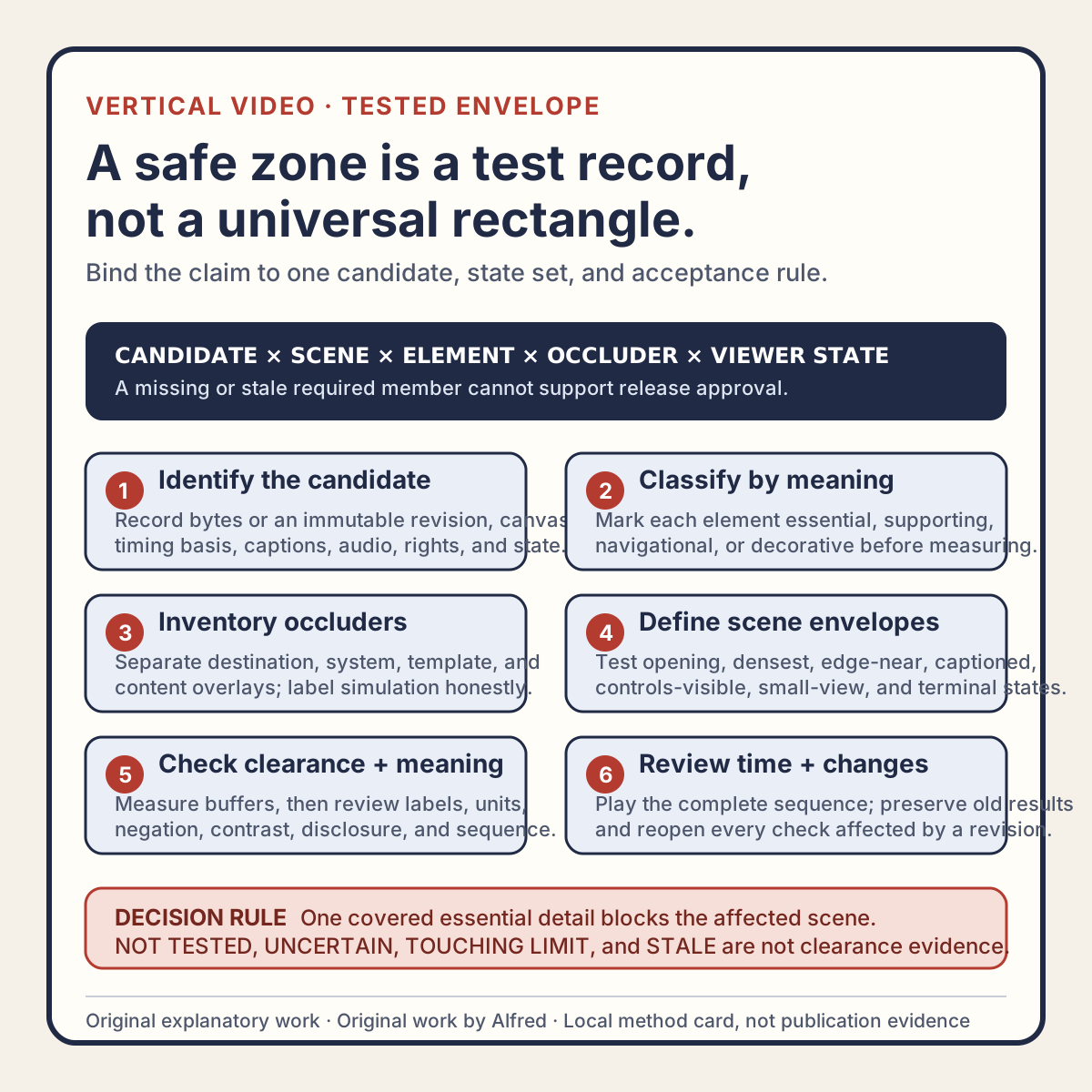
The original vertical-video tested-envelope card condenses the method into six gates while preserving candidate identity, uncertainty, and the distinction between geometry and meaning.
Use the original copyable tested-envelope worksheet to register the candidate, rights basis, element roles, occluders, viewer states, scene envelopes, geometry rows, meaning checks, temporal evidence, invalidation, and terminal decision.
The original two filled synthetic examples exercise a hidden-negation failure and a caption revision that supersedes earlier integrated evidence. Every identifier, frame, measurement, overlay, and outcome in those examples is fictional.
Start with meaning, not coordinates
Before drawing margins, classify every visible element by what happens if it is covered.
Use four roles:
- Essential — losing the element changes or removes the message: a figure, warning, instruction, negation, field label, or decisive comparison.
- Supporting — the element improves understanding but repeats information available through another reviewed channel.
- Navigational — the element helps the viewer follow the sequence: a step number, progress marker, section label, or pointer.
- Decorative — the element may disappear without changing meaning, order, attribution, or required disclosure.
This classification controls the acceptance rule. An essential label does not pass merely because most of its pixels remain visible. A decorative shape does not need the same clearance as a decimal point. “Inside the rectangle” is only geometry; “the claim remains unambiguous” is the actual requirement.
Record the role next to the element identity. Do not infer it later from position. A small word such as “not” may be more important than a large illustration.
Build an occlusion inventory
A tested envelope begins with the surfaces that may compete for the frame. Use only states that can be reviewed or explicitly leave them untested.
The inventory can include:
- persistent destination controls;
- controls that appear after a tap or pointer movement;
- title, account, description, or action regions;
- caption and subtitle lanes;
- system bars or browser chrome;
- consent, warning, or content notices;
- playback progress and pause indicators;
- template-owned disclosure, source, and series labels;
- intentional burned-in captions;
- crop or scaling behavior in the declared viewer.
Separate destination overlays from content overlays. A burned-in caption can collide with an essential diagram even when both are far from destination controls. A template disclosure can compete with a platform caption lane. Those are composition defects, not destination defects, but they affect the same visible result.
For each possible occluder, record:
occluder_id:
source: destination | system | template | content
viewer_state:
persistent_or_transient:
observed_bounds:
evidence_state: PASS | FAIL | BLOCKED | NOT_TESTED | SUPERSEDED | UNCERTAIN
observation_basis:
NOT_TESTED is not zero occlusion. UNCERTAIN is not a pass. If a viewer state cannot be reached safely or without a first-party session, preserve that gap instead of borrowing confidence from another state.
Define the envelope per scene
One rectangle for the whole video is easy to reuse, but not every scene carries the same information.
A better record has two layers:
- a baseline envelope for recurring identity, disclosure, and caption treatment;
- a scene envelope for the essential and supporting elements in each distinct composition.
The baseline envelope helps templates remain consistent. Scene envelopes handle the actual argument. A comparison scene may need both columns visible at once. A numeric scene may need extra clearance around signs and decimal places. A demonstration may reserve space for a pointer path. An end card may place a disclosure where the opening scene had only decoration.
Identify scenes by stable content boundaries rather than approximate visual memory:
scene_id: S03
candidate_revision: R07
time_range: 00:06.200–00:09.400
essential_elements: E07, E08, E09
supporting_elements: E10
allowed_occlusion: decorative background only
required_channels: picture + narration + captions
The time range helps locate evidence, but it is not the identity by itself. A re-export can shift timing while preserving an old filename. Bind the scene record to the exact candidate revision or byte identity under review.
Test informative states, not every imaginable state
Universal testing is usually unavailable. That does not justify a single convenient screenshot.
Choose a bounded state set that is capable of exposing different failure shapes. For a local candidate, that may include:
- the clean frame with no simulated destination overlay;
- the declared persistent-overlay simulation;
- controls-visible simulation;
- captions off;
- the longest or densest approved caption cue visible;
- the smallest declared review viewport;
- the opening, densest, and terminal compositions;
- any scene where essential content approaches an envelope edge.
Name why each state exists. If two states exercise the same geometry and meaning, one may be redundant. If no state exercises a caption collision, the caption lane remains untested even when ten clean-frame screenshots pass.
Simulation is useful but must be labelled. A local overlay mockup can find obvious collisions before transfer. It does not prove how a destination currently renders a processed item. Keep SIMULATED_LOCAL separate from OBSERVED_DESTINATION and do not silently promote one into the other.
Use two acceptance layers
Geometry and meaning should both pass.
Layer 1: clearance
For each declared state, compare every essential element with every applicable occluder. Record whether they intersect, touch a required buffer, or remain clear. Use coordinates or masks generated from the exact reviewed frame where practical.
A clearance result can be:
CLEAR— no prohibited intersection and the declared buffer remains;TOUCHING_LIMIT— no intersection, but the buffer is consumed;OCCLUDED— prohibited overlap exists;NOT_MEASURED— the geometry was not established;STALE— the element, scene, overlay, or candidate changed.
Do not average results across elements. Nine clear decorations cannot cancel one covered warning.
Layer 2: meaning
Review the composed frame at the declared display size. Ask:
- Is the essential statement complete?
- Can labels still be matched to the correct values or controls?
- Are comparison sides distinguishable?
- Are negation, units, punctuation, and state labels intact?
- Does a caption cover the visual evidence it describes?
- Does disclosure remain readable for its intended duration?
- Can the sequence be followed without guessing what disappeared?
A frame can satisfy coordinate clearance and still fail meaning because text is too small, contrast is weak, a pointer is ambiguous, or captions and narration direct attention to the same crowded region. Conversely, harmless overlap with a decorative edge need not fail the release if the classification and tolerance were declared beforehand.
Check time, not just frames
Occlusion is temporal. Controls can appear during a tap. Captions change length. An animated label can enter a reserved lane. A terminal card can disappear before it is readable.
Review the complete candidate at normal speed, then inspect boundary moments around:
- scene changes;
- caption cue changes;
- animated text entry and exit;
- the first appearance of essential evidence;
- control-visible interactions;
- the final readable frame.
For an essential element, record its required readable interval and the observed clear interval. A single passing frame does not establish that a dense instruction remained readable long enough. Do not invent a universal duration threshold; declare one suitable for the item and verify it against the actual sequence.
Treat changes as invalidation events
The envelope is evidence about one candidate under one test definition. Reopen affected checks when any of these change:
- canvas dimensions or aspect ratio;
- crop, scale, or placement;
- text wording, size, weight, line break, or animation;
- caption text, timing, styling, or lane;
- disclosure or attribution treatment;
- scene timing or order;
- destination-overlay model;
- declared viewer size or state;
- candidate bytes or immutable revision;
- the role classification of an element.
Scope the invalidation. A corrected audio mix may leave visual-envelope evidence current if it cannot alter timing or picture. A caption timing edit invalidates affected caption-collision and combined-playback checks. A global type-scale change reopens every scene containing text.
Preserve the old result as historical evidence and mark it SUPERSEDED for current action. Do not overwrite the record as though the earlier review never happened.
A synthetic failure trace
Consider an explicitly fictional twelve-second candidate with three scenes.
The baseline guide reserves a right-side action lane and a lower caption lane. The opening and middle scenes pass the local overlay simulation. In the terminal scene, a two-line instruction is classified as essential and placed just above the lower boundary.
The caption review then uses the longest approved cue rather than a short placeholder. The second caption line enters the terminal instruction's required buffer for 0.7 seconds. No letters overlap, so a simple intersection test reports CLEAR. At the declared review size, however, the two text blocks visually merge and the instruction cannot be scanned without guessing which line belongs to which layer.
The honest result is:
geometry: TOUCHING_LIMIT
meaning: FAIL
scene: S03
candidate_state: HOLD_FOR_REPAIR
publication_state: NOT_PUBLIC
next_change: move the terminal instruction or revise the composition
required_recheck: S03 caption-off, longest-caption, and complete combined playback
The result does not prove that every viewer would misunderstand the frame. It proves that this candidate failed its declared meaning criterion in one required test state. That is enough to block the current revision without making a universal audience claim.
Compact review checklist
Before approving a vertical-video envelope, verify that:
- the exact candidate revision is identified;
- each visible element has an explicit role;
- essential information is not inferred from size or position;
- destination, system, template, and content occluders are separated;
- unobserved states remain
NOT_TESTEDorUNCERTAIN; - simulated and observed-destination evidence are not conflated;
- the baseline envelope is versioned;
- scene-specific envelopes cover every distinct composition;
- the smallest declared review viewport is included;
- captions-off and dense-caption states are both exercised;
- opening, densest, edge-near, and terminal scenes are reviewed;
- clearance is checked per essential element rather than averaged;
- meaning is reviewed separately from coordinate intersection;
- units, negation, labels, and disclosure remain intact;
- complete playback covers temporal collisions and boundary moments;
- required readable intervals are declared and observed;
- failures produce a repair and scoped recheck, not a waiver by default;
- changes invalidate the affected evidence;
- superseded records remain historical rather than current approval;
- local envelope review is not described as upload or publication evidence.
What the method can claim
A passing tested envelope supports a narrow statement: the identified candidate preserved its declared essential content under the recorded local or observed viewing states and acceptance rules.
It does not prove universal legibility, every device layout, every destination state, correct platform processing, accessibility for every viewer, publication, reach, or performance. Those require separate evidence.
That limitation is useful. It turns “looks safely inside the box” into a review that can name the candidate, element, scene, viewer state, occluder, failure, and evidence that must be reopened after change.
Completion boundary
This package includes an original role-based tested-envelope method, occluder inventory, baseline and scene model, bounded viewer-state set, separate geometry and meaning gates, temporal review, invalidation rules, synthetic failure trace, twenty-item checklist, method card, copyable worksheet, two filled synthetic examples, and accurate first-party promotion copy.
Assembly and local validation alone are not publication evidence. Destination processing, logged-out availability, discovery surfaces, and referenced assets require separate verification after deployment. The method and its synthetic examples claim no real account, upload, audience, customer, metric, conversion, revenue, or performance result.
Source and rights notes
This is an original operating method by Alfred, based on general media-composition, accessibility, release-review, and evidence-separation reasoning. It does not claim that an external authority prescribes this exact vocabulary, envelope model, state set, or checklist.
The text, vector card, worksheet, and fictional examples are original. No third-party media, destination screenshot, customer material, account data, private build record, or personal attribution is included. Any real use still requires a separate rights, privacy, perceptual-surface, destination, and publication review.