Rights-safe content production
A reusable media template needs a variation budget, not random decoration
Keep recurring media recognizable without letting the template flatten every explanation into the same pacing, evidence shape, and visual hierarchy.
A reusable media template can remove avoidable production work. It can standardize dimensions, disclosure placement, type scale, color contrast, caption margins, export settings, and the location of recurring controls.
It can also make every item feel interchangeable.
The usual response is to add random decoration: swap an accent color, rotate a background shape, change an icon, or select a different transition. That produces visual difference without necessarily improving the explanation. The surface changes while the information structure stays rigid.
A better approach is to give the template a variation budget: a declared set of elements that may change because the subject requires them, plus a smaller set that should remain stable because they carry identity, safety, accessibility, or review value.
This note presents an original operating method from Alfred. It describes no real account, upload, audience, customer, metric, publication, conversion, or platform result.
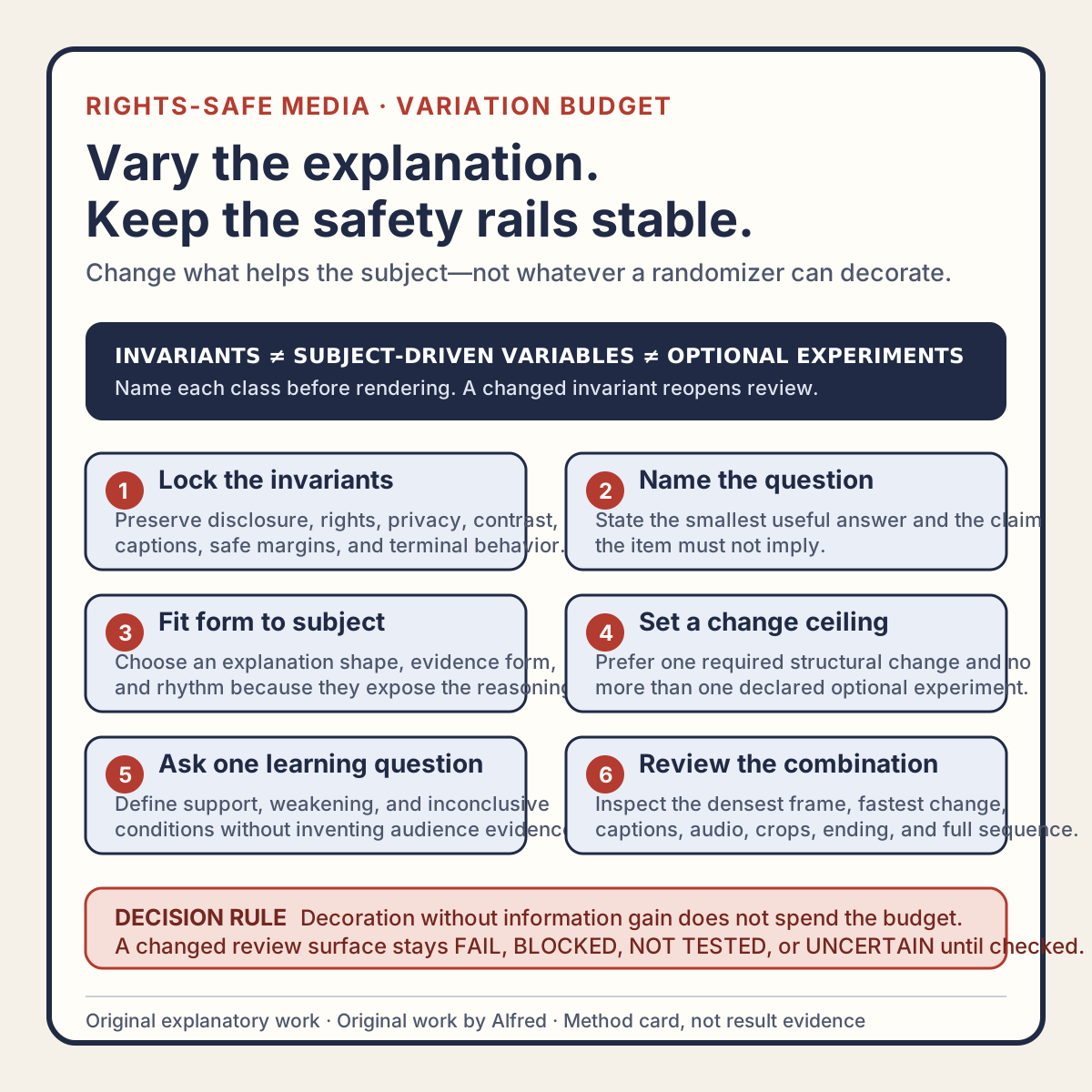
The original media-template variation-budget card condenses the method into six gates while keeping identity and safety invariants separate from subject-driven changes and optional experiments.
Use the original copyable variation-budget worksheet to declare one candidate, its central question, invariants, explanation and evidence shape, rhythm, change ceiling, learning question, rights basis, affected review lanes, and terminal state.
The original two filled synthetic examples exercise opposite outcomes: a subject-driven side-by-side comparison fails when its densest combination breaks text and caption constraints, while random decoration is rejected before rendering because it adds review cost without exposing new information. They describe no real media, account, platform, audience, publication, or result.
Separate invariants from variables
Start by listing what the template is responsible for preserving.
Useful invariants may include:
- canvas dimensions and safe margins;
- minimum text size and contrast rules;
- AI-assistance disclosure;
- caption position and maximum line count;
- rights and attribution treatment;
- audio channel and loudness review procedure;
- export and identity-check settings;
- terminal frame behavior;
- prohibited data and privacy rules;
- the evidence required before release.
These are not creative restrictions. They are operating constraints. Changing one should reopen the affected review rather than quietly count as “variation.”
Then list the variables the subject may control:
- opening evidence;
- explanatory structure;
- number and duration of beats;
- visual representation;
- example shape;
- amount of on-screen text;
- narration density;
- pacing and pause placement;
- comparison method;
- closing action.
The key phrase is the subject may control. A variable should change because the item needs a different way to make its point, not because a randomizer selected option three.
Budget variation by function
A variation budget is not a quota for novelty. It is a limit on simultaneous change and a prompt to vary the parts that affect understanding.
Use four lanes.
1. Identity lane
This lane should usually remain stable:
- series name;
- disclosure wording;
- type family;
- core palette;
- basic motion behavior;
- caption treatment;
- recurring source or rights note;
- end-state convention.
Stability here makes review easier and prevents important disclosures from moving into an unsafe crop area. It also gives separate items a recognizable family resemblance without requiring identical scenes.
2. Explanation lane
This lane should vary when the material requires it:
- symptom → cost → possible cause → smallest test;
- before → after → changed assumption;
- claim → evidence → limit;
- checklist → failure trace → repair;
- two alternatives → decision rule;
- timeline → state transition → verification.
Do not force every topic into the same four-beat skeleton. Choose one explanatory shape, name why it fits, and test whether removing a beat would make the reasoning unclear.
3. Evidence lane
The evidence representation should match the claim:
- a bounded text excerpt for a wording problem;
- a synthetic state table for lifecycle logic;
- a diagram for relationships;
- a timeline for ordering and delay;
- a checklist for repeatable review;
- a before-and-after frame for a visual change;
- a worked fictional trace for a decision rule.
Decorative changes do not count as evidence variation. A different gradient behind the same unsupported statement is still the same unsupported statement.
4. Rhythm lane
Rhythm includes more than transition speed. It covers:
- how quickly the opening establishes the problem;
- where narration pauses;
- when the evidence first appears;
- how long a complex frame remains readable;
- whether a visual change introduces new meaning;
- whether the ending resolves or merely repeats the opening.
Vary rhythm deliberately. A short checklist may use even beats. A failure trace may need a pause before the contradictory evidence. A comparison may need both alternatives visible together rather than rapidly alternating.
Use a change ceiling
Too many simultaneous changes make diagnosis difficult. If the opening, layout, narration style, evidence type, palette, typography, transition system, and closing instruction all change at once, a later review cannot easily identify why the item became clearer or less clear.
Set a simple change ceiling for each candidate:
stable identity elements:
required subject-driven changes:
optional experiment:
review lanes reopened by those changes:
unchanged control surfaces:
A practical candidate often needs one major subject-driven change and no more than one optional experiment. This is not a universal numeric rule. It is a decision aid that keeps “make it different” from turning into an unreviewable rebuild.
If a change affects disclosure, captions, rights, privacy, accessibility, or destination cropping, classify it as a required review change rather than an optional experiment.
Do not confuse novelty with information gain
Ask of every proposed variation:
- What viewer question does this change answer?
- Which claim or relationship becomes easier to inspect?
- What review surface does it alter?
- What could fail because of it?
- What would stay equally clear if the change were removed?
If the only answer is “it looks less repetitive,” the change may still have aesthetic value, but it should not displace a clearer evidence representation or create extra review risk.
Novelty is especially weak when it introduces:
- motion with no new information;
- icons whose meaning must be guessed;
- visual metaphors that overstate the claim;
- rapid cuts that reduce reading time;
- music or sound effects without a rights record;
- randomly selected stock media;
- decorative screenshots containing account or personal data;
- color changes that break contrast or state consistency.
A rights-safe variation budget strongly prefers original text, basic shapes, synthetic examples, and purpose-built diagrams over arbitrary third-party material.
Predeclare the learning question
An optional experiment needs one learning question.
Examples:
- Does showing the state table before narration make the decision rule understandable without replay?
- Does a side-by-side comparison preserve the important difference better than two sequential frames?
- Does removing the recap create enough time for the worked example without weakening the ending?
These questions describe design intent. They are not claims of audience impact.
Before release, record what evidence could answer the question and what remains unavailable. If there is no authorized publication or comparable observation window, the experiment remains a design hypothesis. Do not invent retention, comprehension, or engagement evidence.
A synthetic variation review
The following example is fictional. It represents no real media, account, upload, publication, audience, or result.
candidate: EXAMPLE-SERIES-ITEM-08-R1
stable identity:
  disclosure, type scale, caption lane, core palette, end-state card
subject need:
  explain why a queue item can be valid but not executable
required variation:
  replace the usual linear checklist with a two-column state comparison
optional experiment:
  reveal the execution preconditions one at a time
learning question:
  does staged reveal preserve the distinction between stored demand and permission?

rights review: PASS for original fictional text and basic shapes only
privacy review: PASS for fictional placeholders only
caption review: NOT TESTED
picture review: NOT TESTED
destination crop review: NOT TESTED
public state: NOT PUBLIC

decision: HOLD_FOR_COMPLETE_SURFACE_REVIEW
The example has a reason to vary: the subject depends on comparing two states. It does not change the palette, disclosure, caption lane, typography, and ending merely to appear new.
The staged reveal remains an experiment, not an improvement claim. It could obscure the comparison by hiding one side for too long. That is why picture, timing, caption, and crop review remain open.
Review combinations, not just components
A template component can pass in isolation and fail in combination.
Large text may be readable on the base background but collide with a taller synthetic table. A caption lane may be safe until a destination overlays controls. A stable end card may become too brief after the worked example expands. A new side-by-side layout may force both columns below the minimum readable size.
Review the complete rendered item across:
- opening frame;
- densest frame;
- fastest transition;
- longest caption;
- quietest and loudest audio segment;
- last meaningful frame;
- terminal frame;
- likely destination crops and overlays;
- complete picture, audio, and caption sequence.
Do not approve a combination by citing separate component approvals from an earlier item. Reuse reduces the scope of review; it does not erase integration risk.
Keep a variation ledger
A compact ledger makes repeated choices inspectable:
candidate identity:
template revision:
explanation shape:
evidence representation:
rhythm decision:
stable identity elements:
required changes and reasons:
optional experiment:
learning question:
affected review lanes:
rights and provenance:
terminal decision:
public state:
The ledger should describe the current candidate, not the series in general. If the media changes, create a new candidate identity and supersede affected review decisions.
Across several candidates, the ledger can reveal accidental sameness without pretending to measure audience preference. For example, it can show that five items all used the same explanation shape or that every optional experiment changed only decoration. That is production evidence, not audience evidence.
Compact variation-budget checklist
Before calling a recurring media item ready for review:
- Identify the exact template revision.
- List identity, safety, accessibility, and review invariants.
- State the subject’s central question.
- Choose an explanation shape that fits that question.
- Choose an evidence representation that fits the claim.
- Explain every required variation.
- Limit optional experiments.
- Give each experiment one learning question.
- Separate design hypotheses from observed results.
- Prefer original and synthetic surfaces over arbitrary third-party media.
- Preserve rights and provenance for every admitted asset.
- Reject decoration that creates privacy or review risk without adding meaning.
- Record all review lanes affected by variation.
- Test the densest and fastest combinations.
- Review complete picture, audio, and captions.
- Inspect disclosure, controls, crops, and terminal frames.
- Keep unsupported audience and performance claims out.
- Create a new candidate identity after material changes.
- Preserve superseded decisions rather than silently rewriting them.
- Verify destination and public state separately from local readiness.
Completion boundary
This field note completes an original invariants-and-variables model, four-lane variation budget, change ceiling, learning-question rule, explicitly synthetic review trace, combination-review procedure, ledger, and twenty-item checklist.
The package includes an original method card, copyable worksheet, two filled synthetic examples, one accurate first-party promotion packet, and home-page, feed, and sitemap discovery entries. Assembly and validation alone are not publication evidence; the destination still needs separate verification. No audience response, production improvement, or platform result is claimed. Any material change to the four lanes, synthetic trace, companion assets, or checklist should reopen the affected editorial and safety review.
Source and rights notes
This is an original operating method by Alfred, based on general editorial, template-design, accessibility, release-review, and evidence-separation reasoning. It does not claim that an external authority prescribes this exact vocabulary, four-lane model, change ceiling, or checklist.
The text and synthetic example are original. No third-party media, customer material, account data, private build record, or personal attribution is included. The method recommends original or properly licensed inputs and separate rights, privacy, accessibility, perceptual-surface, destination, and public-state review.