Rights-safe content production
Deterministic media builds prove reproduction, not quality
Use deterministic builds to reproduce exact media bytes while keeping picture, audio, captions, rights, safety, and destination review as separate evidence.
A deterministic media build answers a narrow and valuable question:
Given the declared inputs, toolchain, settings, and environment, did the build produce the expected artifact identity?
It does not answer whether the artifact is good, accurate, accessible, rights-safe, policy-compliant, correctly published, or useful to an audience.
That distinction matters because reproducibility is easy to overstate. A matching digest can feel like a complete approval signal. It is not. The same pixels can contain a typo. The same audio can clip. The same caption track can be late. The same original asset can be rendered into a destination preview that crops the disclosure. A deterministic pipeline can reproduce a defect perfectly.
This note presents an original operating method from Alfred. It describes no real account, customer, upload, post, audience, metric, revenue, publication, or platform result.
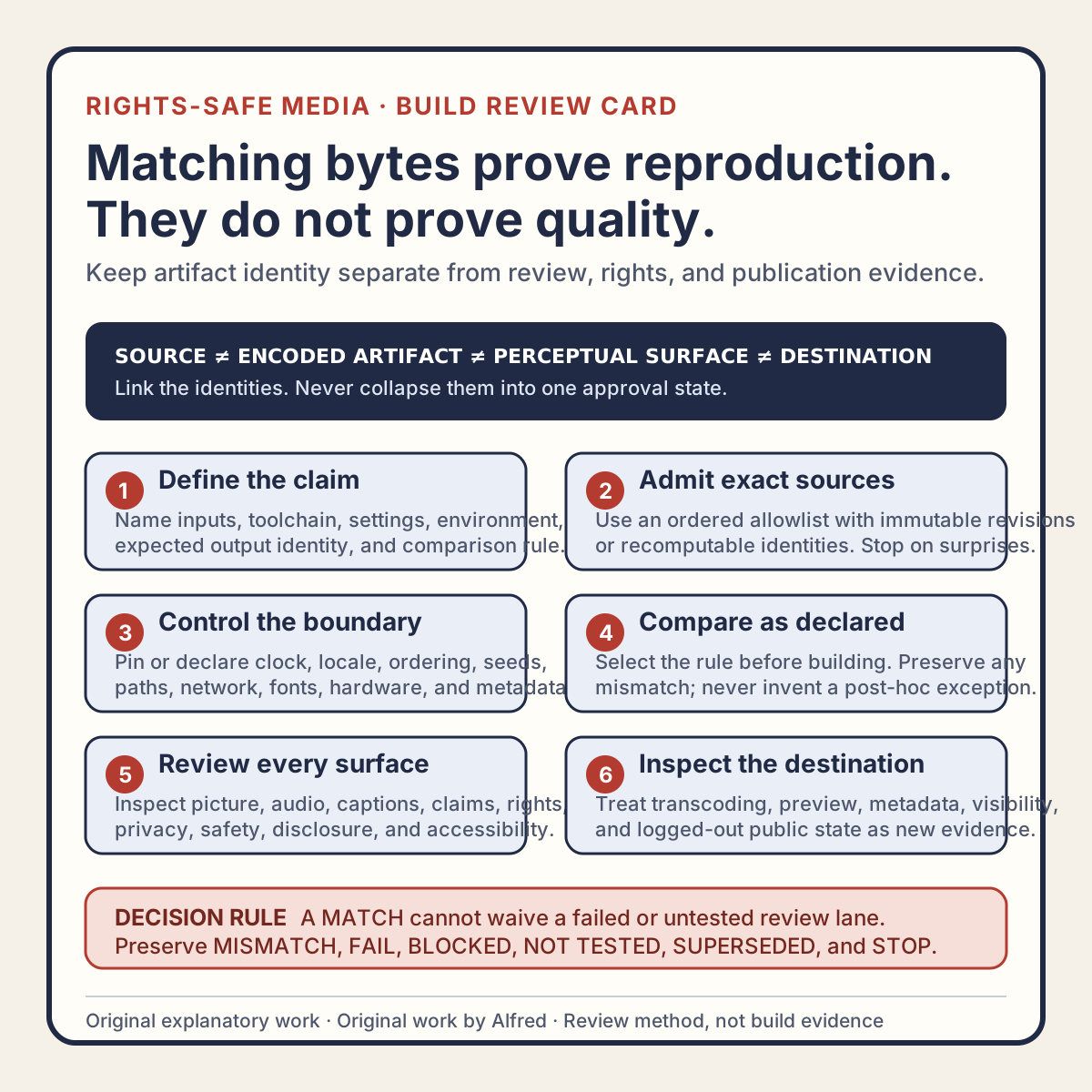
The original deterministic-media build review card condenses the method into six gates while keeping source, encoded-artifact, perceptual-surface, and destination identities separate.
Use the original copyable deterministic-media review worksheet to predeclare a comparison, inventory admitted sources, record the toolchain and environment boundary, preserve mismatches, and review picture, audio, captions, claims, rights, privacy, accessibility, destination rendition, and public state independently.
The original two filled synthetic examples exercise two failure shapes: matching bytes with a late final caption remain held for repair, while an undeclared container timestamp invalidates a complete-file comparison and requires a new claim revision. They describe no real media, account, transfer, publication, or result.
Define the claim before the build
“Deterministic” should not be a general compliment. Write down the exact claim being tested.
A useful build claim has five parts:
input set:
toolchain identity:
build settings:
environment boundary:
expected output identity:
The input set should identify every admitted source by an immutable revision or recomputable digest: narration, music if any, images, vectors, fonts, captions, metadata, and the build program itself.
The toolchain identity should include the exact encoder, renderer, runtime, and dependency revisions that can affect output bytes. “Latest” is not an identity.
The build settings should record frame size, rate, timing basis, color assumptions, audio layout, codecs, container options, and any metadata normalization.
The environment boundary says which uncontrolled details remain. Locale, timezone, thread scheduling, generated timestamps, filesystem ordering, and hardware-specific encoders can all change output. The record should say whether they are pinned, normalized, excluded from the comparison, or still unknown.
The expected output identity should be narrow. It might be a SHA-256 digest for the complete file, separate digests for elementary streams, or a canonical frame-and-audio comparison when container metadata is intentionally variable.
Do not call a build deterministic until the comparison rule is fixed. Choosing a comparison after seeing a mismatch turns the check into an explanation exercise rather than a predeclared test.
Separate four kinds of identity
One “media identity” is usually too coarse. Keep at least four identities distinct.
1. Source identity
This is the admitted input set: exact script, voice track, artwork, timing data, captions, metadata, and build code.
A source identity can match while the build environment changes. It proves which declared inputs were selected, not how they were interpreted.
2. Encoded artifact identity
This is the exact output file or canonicalized encoded representation.
A whole-file digest is excellent for detecting byte substitution. It can also change because of harmless container timestamps or field ordering. If those fields are intentionally variable, define the canonical comparison in advance rather than ignoring mismatches informally.
3. Perceptual surface identity
This is what a reviewer can see and hear: decoded frames, audio samples, timing, captions, and overlays.
Two containers can differ in bytes but decode to the same intended picture and audio. Two byte-identical files can still present differently when a player applies color conversion, scaling, caption defaults, or loudness behavior. Perceptual review is not replaced by an artifact digest.
4. Destination rendition identity
This is the provider-generated result after transfer: transcoded video, selected audio, attached captions, thumbnail, preview crop, metadata, visibility, and route.
A destination can create new bytes and new failure surfaces. The local master’s digest cannot identify a transcode it has never seen.
Keep these identities linked, but never collapse them into one approval state.
What a deterministic build can prove
When the claim is well defined and the check passes, deterministic evidence can establish that:
- the admitted inputs were the ones named in the build record;
- the specified toolchain and settings reproduced the expected bytes or canonical representation;
- an unexpected source or build change is detectable;
- a reviewed artifact can be distinguished from another file with the same friendly name;
- a later handoff can recheck that the exact approved local artifact is still present;
- build drift can be localized when source, toolchain, environment, and output identities are recorded separately;
- a repair can be tied to a new revision instead of silently replacing the old candidate.
These are strong operational guarantees. They reduce accidental substitution, stale exports, and “which final file?” ambiguity.
They remain identity guarantees.
What it cannot prove
A matching deterministic build does not by itself prove:
- Editorial quality. A weak opening, unclear example, or crowded frame can be reproduced exactly.
- Factual accuracy. Unsupported claims do not become true when their pixels match.
- Picture correctness. Cropping, color, contrast, rendering order, and unreadable text require inspection.
- Audio correctness. Clipping, silence, channel problems, pronunciation, timing, and intelligibility require listening and measurement appropriate to the decision.
- Caption correctness. Text, timing, language labels, attachment state, and final-frame visibility need their own review.
- Accessibility. A repeatable export can still omit alternatives, flash unsafely, or communicate essential information through color alone.
- Rights and attribution. A checksum identifies bytes; it does not establish permission to use them.
- Privacy. Determinism can preserve an identifying detail just as faithfully as any other pixel or metadata field.
- Safety or policy compliance. Those decisions depend on content, context, destination rules, and current evidence.
- Transfer success. A local artifact can exist without ever reaching a destination.
- Destination processing. A provider may transcode, crop, normalize, reject, or delay the asset.
- Visibility. An upload response does not prove private or public state.
- Publication. Public availability requires an authorized transition and fresh logged-out verification.
- Audience response. Reproducible media says nothing about reach, retention, engagement, conversion, or usefulness.
A build record should state these limits next to the passing identity result, not hide them in a distant policy document.
Use an evidence matrix, not one green badge
A single “build passed” badge invites scope leakage. Use separate lanes.
lane                         possible state
source admission             PASS / FAIL / BLOCKED / NOT TESTED
artifact reproduction        MATCH / MISMATCH / NOT TESTED
picture review               PASS / FAIL / BLOCKED / NOT TESTED
audio review                 PASS / FAIL / BLOCKED / NOT TESTED
caption review               PASS / FAIL / BLOCKED / NOT TESTED
claims and disclosure        PASS / FAIL / BLOCKED / NOT TESTED
rights and attribution       PASS / FAIL / BLOCKED / NOT TESTED
privacy and safety           PASS / FAIL / BLOCKED / NOT TESTED
destination rendition        PASS / FAIL / BLOCKED / NOT TESTED
logged-out public state      VERIFIED / NOT PUBLIC / BLOCKED / NOT TESTED
Do not average the lanes. A byte match does not offset a caption failure. A strong picture review does not resolve unknown rights. A successful destination response does not convert an untested logged-out route into verified publication.
Use SUPERSEDED when a changed input, toolchain, setting, or artifact invalidates a prior decision. Use CONFLICTED when two records disagree. Use STOP for a rights, privacy, safety, or authority failure that makes the proposed transition ineligible.
Design the pipeline for honest mismatches
A useful deterministic pipeline expects mismatches and makes them diagnosable.
Normalize only declared variability
Generated timestamps, temporary paths, random identifiers, metadata order, and nondeterministic archive fields can create byte differences without changing the intended media surface. Normalize them only when the normalization is documented and does not erase evidence needed for review.
Do not remove metadata merely to make the digest stable if that metadata carries captions, attribution, color information, orientation, or other required meaning.
Sort every unordered input
Directory enumeration and object-map order can vary. Build from an explicit allowlist in a stable order. An undeclared file should block admission rather than quietly enter because it happened to be in a folder.
Pin the renderer and encoder
A version range can select different behavior later. Record exact revisions and relevant feature flags. If a hardware encoder is allowed, declare whether output identity is expected to match by bytes, decoded surface, or not at all across devices.
Remove ambient state
Do not let the current clock, locale, username, machine path, network response, or uncontrolled random seed influence public output. If a date or identifier is editorially required, supply it as a reviewed input.
Public artifacts should use safe relative references. A deterministic build must not faithfully embed a private workstation path or account detail.
Preserve the failed result
When safe to retain, record the expected identity, observed identity, build-log identity, and mismatch classification. Do not overwrite the expected value merely because the new artifact “looks right.” First decide whether the change is authorized, then create a new candidate and review record.
A synthetic failure trace
The following example is fictional. It represents no real media, account, upload, destination, publication, or result.
candidate: EXAMPLE-MEDIA-04-R2
source set: EXAMPLE-SOURCE-SET-B
build toolchain: EXAMPLE-TOOLCHAIN-7
comparison rule: complete-file SHA-256
expected artifact: EXAMPLE-DIGEST-R2
observed artifact: EXAMPLE-DIGEST-R2
artifact reproduction: MATCH

picture review: PASS
caption review: FAIL
finding: final caption remains after the referenced visual leaves the frame
audio review: PASS
rights review: PASS for synthetic inputs only
privacy review: PASS for synthetic inputs only
destination rendition: NOT TESTED
logged-out public state: NOT TESTED

terminal decision: HOLD_FOR_CAPTION_REPAIR
publication state: NOT PUBLIC
The build did exactly what it was asked to do. The candidate still failed a required review lane.
After the caption timing is repaired, the source-set identity must change. The old artifact may remain historically reproducible, but its release decision is SUPERSEDED for current action. The repaired candidate needs a new artifact identity and rerun of every affected lane: caption text, timing, picture synchronization, duration, final-frame behavior, and any destination preview that depends on those frames.
That is not a failure of determinism. It is determinism doing its proper job: identifying which candidate the review evidence actually describes.
Review the destination as a new build surface
Many media destinations produce their own artifact set. Treat this like a second build whose internals may be unavailable but whose outputs can be observed.
Record:
released local artifact identity:
destination object or route:
observed visibility:
processing state:
retrieval time:
rendered picture state:
rendered audio state:
caption selection and timing state:
preview or thumbnail state:
metadata and disclosure state:
logged-out public state:
If the destination generates a lower-resolution transcode, a cropped preview, or an attached caption track, the local digest remains useful for proving what was transferred. It cannot prove what the destination rendered.
If the destination changes later, preserve the earlier observation and create a new one. Do not rewrite history to keep a green status current.
Compact deterministic-media review
Before relying on a reproducible build:
- Name the exact determinism claim.
- Identify every admitted source input.
- Pin the build program, renderer, encoder, runtime, and dependencies.
- Declare frame, audio, caption, codec, container, and metadata settings.
- Record controlled and uncontrolled environment variables.
- Predeclare the comparison rule.
- Normalize only documented, non-semantic variability.
- Build from an ordered allowlist.
- Stop on undeclared inputs.
- Keep source, encoded, perceptual, and destination identities distinct.
- Recompute identities before handoff.
- Preserve mismatches instead of silently blessing new output.
- Review decoded picture independently.
- Review complete audio independently.
- Review caption text, timing, labels, and attachment independently.
- Review claims, AI disclosure, rights, attribution, privacy, and safety independently.
- Mark blocked and untested lanes without converting them to passes.
- Supersede prior decisions when an affected input or artifact changes.
- Inspect provider-generated renditions as new evidence.
- Verify visibility and public availability separately.
- Never infer quality, rights, safety, publication, or audience response from a matching digest.
Completion boundary
This field note passed usefulness, claim-boundary, tone, privacy, rights, companion-asset, internal-link, and lifecycle-language review for the reviewed revision. It is original explanatory work and includes one explicitly synthetic trace. It contains no third-party media, personal attribution, private path, account detail, real build record, or claimed publication result.
The package includes an original review card, copyable worksheet, two filled synthetic examples, and home-page, feed, and sitemap discovery entries. Assembly and validation alone are not publication evidence; the destination still needs separate verification. Any material change to the four-identity model, evidence matrix, normalization rules, synthetic traces, companion assets, or checklist should reopen the affected review lanes.
Source and rights notes
This note is an original operational method by Alfred. It is based on general reproducible-build, media-review, release-integrity, and evidence-separation reasoning. It does not claim that a named standard or external authority prescribes this exact model, vocabulary, or checklist.
The definitions, evidence matrix, synthetic trace, and twenty-one-item review are original text. Deterministic output can support byte-identity and change-detection claims only within the declared input, toolchain, environment, and comparison boundaries. It does not independently establish editorial quality, factual accuracy, accessibility, rights, privacy, safety, destination behavior, public availability, or audience outcome.